Do you know what prompted the altitude change? Is it related to the retirement of the Shuttles (less fuel needed so fewer flights to the ISS) or is it just a change that's been being planned for a while but only implemented now?

You are using an out of date browser. It may not display this or other websites correctly.
You should upgrade or use an alternative browser.
You should upgrade or use an alternative browser.
Updates ESA's ATV-2 "Johannes Kepler"
- Thread starter Orbinaut Pete
- Start date

- Joined
- Feb 6, 2008
- Messages
- 38,965
- Reaction score
- 3,937
- Points
- 203
- Location
- Wolfsburg
- Preferred Pronouns
- Sire
Do you know what prompted the altitude change? Is it related to the retirement of the Shuttles (less fuel needed so fewer flights to the ISS) or is it just a change that's been being planned for a while but only implemented now?
I think it was already planned for assembly complete, but I can't verify this yet... if somebody has a source for this, it would be better.

I think it was already planned for assembly complete, but I can't verify this yet... if somebody has a source for this, it would be better.
I do remember they were going to do it after the shuttle finishes, something about margins. I also remember they were planning to do it with the ATV.


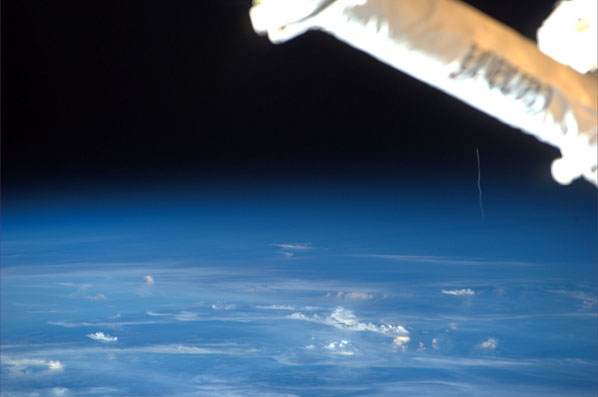

Incredible! 
Was there a higher-resolution version? That there is wallpaper material.
Was there a higher-resolution version? That there is wallpaper material.

- Joined
- Aug 5, 2008
- Messages
- 4,261
- Reaction score
- 1
- Points
- 0
Incredible!
Was there a higher-resolution version? That there is wallpaper material.
These ones from NASA:

Hi-res version.

Hi-res version.

Hi-res version.

Hi-res version.
And these two from Paolo.
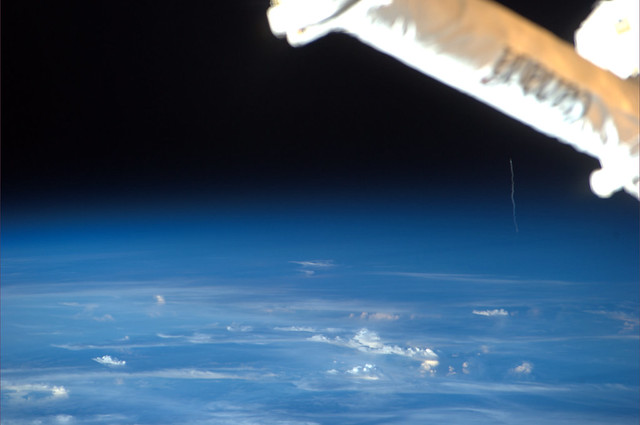
Hi-res version.

Hi-res version.

The Users' Guide refers to the operational orbit being 350 km to 460 km. I can't find a source nominating the construction altitude, but history shows it is only just barely in the bottom end of that range. It looks like it was allowed to drop for RTF (2005):I think it was already planned for assembly complete, but I can't verify this yet... if somebody has a source for this, it would be better.


Those images are dreamlike... 
I tried my hand at correcting the colour and contrast and removing noise from these two. Too bad they won't work as wallpapers without cutting off a lot, or leaving a lot of black...

Hi-res version.

Hi-res version.
I tried my hand at correcting the colour and contrast and removing noise from these two. Too bad they won't work as wallpapers without cutting off a lot, or leaving a lot of black...

Hi-res version.

Hi-res version.
- Joined
- Aug 5, 2008
- Messages
- 4,261
- Reaction score
- 1
- Points
- 0
From ISS On-Orbit Status Report for 21/02/2011.
Scott had ~45 minutes set aside to prepare equipment required for first ingress in the European ATV-2 (Automated Transfer Vehicle-2) after its docking, including AK-1MK and IPD air sample kits, atmosphere purification filter assembly and Russian vacuum cleaner.
Later, Alexander & Paolo got together for a 45 minute ATV Approach & Docking OBT (Onboard Training) run, supported by ground specialist tagup. [Using the AOT (ATV Onboard Trainer) software on the crew support T61p laptop RSK-1, an off-nominal situations table, range rulers and timer, Alexander & Paolo practised crew actions in the event of an off-nominal situation while monitoring rendezvous and docking, refreshed rendezvous and docking monitoring skills, and practised crew interaction during rendezvous and docking monitoring. The AOT software shows a simulated zoomable image of the orbital region of approach with a target zone and the ATV as it closes in on the ISS. For controlling manual approaches (should they be required), the AOT provides simulated control panel images for the ATV and for the SM Simvol-Ts television display, plus text displays for station clock time and approach parameters (distance, velocities, etc.), similar to the TORU OBT.]
Scott had ~45 minutes set aside to prepare equipment required for first ingress in the European ATV-2 (Automated Transfer Vehicle-2) after its docking, including AK-1MK and IPD air sample kits, atmosphere purification filter assembly and Russian vacuum cleaner.
Later, Alexander & Paolo got together for a 45 minute ATV Approach & Docking OBT (Onboard Training) run, supported by ground specialist tagup. [Using the AOT (ATV Onboard Trainer) software on the crew support T61p laptop RSK-1, an off-nominal situations table, range rulers and timer, Alexander & Paolo practised crew actions in the event of an off-nominal situation while monitoring rendezvous and docking, refreshed rendezvous and docking monitoring skills, and practised crew interaction during rendezvous and docking monitoring. The AOT software shows a simulated zoomable image of the orbital region of approach with a target zone and the ATV as it closes in on the ISS. For controlling manual approaches (should they be required), the AOT provides simulated control panel images for the ATV and for the SM Simvol-Ts television display, plus text displays for station clock time and approach parameters (distance, velocities, etc.), similar to the TORU OBT.]
- Joined
- Aug 5, 2008
- Messages
- 4,261
- Reaction score
- 1
- Points
- 0
- Joined
- Aug 5, 2008
- Messages
- 4,261
- Reaction score
- 1
- Points
- 0
From ISS On-Orbit Status Report for 22/02/2011.
Preparatory to the arrival of ATV-2 (Automated Transfer Vehicle-2) "Johannes Kepler" on 24/02 (Thursday), Cady & FE-2 Oleg Skripochka set up the Ku-band video "scheme" for a communications test of converting the RS (Russian Segment) video signal from the SONY HDV camera to US NTSC format and Ku-band from FGB & SM, for downlinking "streaming video" packets via US OpsLAN and Ku-band. [For the test, Cady configured the SSC-1 (Station Support Computer-1) A31p laptop in the FGB with the NViewer application for MPEG-2 (Moving Pictures Expert Group-2) monitor-viewing, and the Simvol-Ts LIV television system (converter & monitor) for both the conversion and the "streaming" MPEG-2 encoding was activated by the automated "Daily Flight Program" sequencer, for Oleg to run the video test from the RS. The equipment was then closed down.]
For an ATV pre-docking communications test, Paolo was scheduled for a quick call from the ATV Control Center in Toulouse, France at ~7:00 PM GMT, to make sure that everything is ready for rendezvous day (where a similar check will be repeated).
Preparatory to the arrival of ATV-2 (Automated Transfer Vehicle-2) "Johannes Kepler" on 24/02 (Thursday), Cady & FE-2 Oleg Skripochka set up the Ku-band video "scheme" for a communications test of converting the RS (Russian Segment) video signal from the SONY HDV camera to US NTSC format and Ku-band from FGB & SM, for downlinking "streaming video" packets via US OpsLAN and Ku-band. [For the test, Cady configured the SSC-1 (Station Support Computer-1) A31p laptop in the FGB with the NViewer application for MPEG-2 (Moving Pictures Expert Group-2) monitor-viewing, and the Simvol-Ts LIV television system (converter & monitor) for both the conversion and the "streaming" MPEG-2 encoding was activated by the automated "Daily Flight Program" sequencer, for Oleg to run the video test from the RS. The equipment was then closed down.]
For an ATV pre-docking communications test, Paolo was scheduled for a quick call from the ATV Control Center in Toulouse, France at ~7:00 PM GMT, to make sure that everything is ready for rendezvous day (where a similar check will be repeated).
- Joined
- Aug 5, 2008
- Messages
- 4,261
- Reaction score
- 1
- Points
- 0
The updated ATV-2 docking time is 3:47:30 PM GMT tomorrow (24th).
- Joined
- Aug 5, 2008
- Messages
- 4,261
- Reaction score
- 1
- Points
- 0
My latest NASASpaceflight article (in co-operation with Chris Gebhardt): ATV-2 Prepares for Docking to International Space Station.
Paolo Nespoli aboard the ISS reports a "tally-ho" on ATV - now apparently a bight star behind the station!
Also, check this out - a music video dedicated to ATV!
Paolo Nespoli aboard the ISS reports a "tally-ho" on ATV - now apparently a bight star behind the station!
Also, check this out - a music video dedicated to ATV!
On YouTube:
On Vimeo:
[ame="http://vimeo.com/20326709"]Dosvedanya Mio Bombino: Musical best wishes to astronauts Paolo & Aleksandr for ATV docking on Vimeo[/ame]
Last edited:
- Joined
- Feb 6, 2008
- Messages
- 38,965
- Reaction score
- 3,937
- Points
- 203
- Location
- Wolfsburg
- Preferred Pronouns
- Sire
- Joined
- Feb 6, 2008
- Messages
- 38,965
- Reaction score
- 3,937
- Points
- 203
- Location
- Wolfsburg
- Preferred Pronouns
- Sire
It is currently holding, all changes in position are thus just rounding and the tolerance of the station keeping autopilot.
Remember, Kurs is actually Russian, so it uses Russian symbols:
[math]{p}[/math] is distance (r, CoG to CoG on the right half of the display, docking port to docking port on the left half)
[math]\dot p[/math] is range rate (r-dot)
---------- Post added at 04:59 PM ---------- Previous post was at 04:41 PM ----------
We have soft-docking now, working towards hard docking.
---------- Post added at 05:08 PM ---------- Previous post was at 04:59 PM ----------
We have completed docking. Now the connection can be checked that the seals are really air tight (automatic tests already confirmed that), and the hatches can be opened.
Remember, Kurs is actually Russian, so it uses Russian symbols:
[math]{p}[/math] is distance (r, CoG to CoG on the right half of the display, docking port to docking port on the left half)
[math]\dot p[/math] is range rate (r-dot)
---------- Post added at 04:59 PM ---------- Previous post was at 04:41 PM ----------
We have soft-docking now, working towards hard docking.
---------- Post added at 05:08 PM ---------- Previous post was at 04:59 PM ----------
We have completed docking. Now the connection can be checked that the seals are really air tight (automatic tests already confirmed that), and the hatches can be opened.
Last edited:

- Joined
- Feb 11, 2008
- Messages
- 2,604
- Reaction score
- 31
- Points
- 63
We need a metric commentator for NASA TV :lol:
r-dot was 0.07, not 0.5
Why is the docking camera off-set from the docking target at the point of contact? Is the visual alignment only used to check the automated approach?
r-dot was 0.07, not 0.5
Why is the docking camera off-set from the docking target at the point of contact? Is the visual alignment only used to check the automated approach?
- Joined
- Aug 5, 2008
- Messages
- 4,261
- Reaction score
- 1
- Points
- 0
Houston, we have an ATV! Great work, ESA! :thumbup:
The hatches will be opened later today. Now, let's get Discovery up there!
The hatches will be opened later today. Now, let's get Discovery up there!
- Joined
- Feb 6, 2008
- Messages
- 38,965
- Reaction score
- 3,937
- Points
- 203
- Location
- Wolfsburg
- Preferred Pronouns
- Sire
We need a metric commentator for NASA TV :lol:
r-dot was 0.07, not 0.5
Why is the docking camera off-set from the docking target at the point of contact? Is the visual alignment only used to check the automated approach?
No, actually the goal is just to keep the aim inside the dotted circle, as long as you keep this, the spacecraft is aligned. Perfection is not desired.
Similar threads

- Replies
- 60
- Views
- 25K


- Replies
- 9
- Views
- 5K

- Replies
- 1
- Views
- 2K
- Replies
- 2
- Views
- 3K
- Replies
- 51
- Views
- 15K
