News Ferry sinks near South Korean coast

It is far too early to say that, once rescue ops are complete and the investigation begins thats when it can be proved or disproved.


It's never too early to say no evidence when there is no evidence. Remember the whole burden of proof thing? :tiphat:

I was only trowing the question out there for it to be beaten down with the kind of reply from Urwumpe.

He also said no evidence, but, whatever.
 
I'm only saying this because its Korea, but what is the possibility that the North Korea where involved.

Well, I can undertstand why someone would down something like the Cheonan, military, in waters I see as mine. Civilian, somewhere down in the south? Meh.
 
More information is now known why the ship didn't evacuate in time: The local sea traffic control did give them wrong information.

The crew asked the local control center, if other ships are underway and that all passengers could get evacuated in time, should they be forced to leave the ship now. An important question, since the currents are very strong in that region. The control center did not answer this question and instead said, that it is up to the captain to decide this. At that time, a ship was 10 minutes away and had already declared to the control center, that it can take all passengers on board.

Still, the decision of the crew to keep all passengers under deck and not at least sent them to the gathering points on deck is strange.
 
Still, the decision of the crew to keep all passengers under deck and not at least sent them to the gathering points on deck is strange.

Not really. If he didn't expect the ship to capsize immediately, it might be safer to keep the passengers below. If the ship hadn't gone all the way over, it probably would have been the best option.
If you give the order to muster while the ship is listing badly, you risk that passengers start leaving the ship before the abandon ship is ordered. That is the worst thing to do if the ship isn't going down.
Sadly they didn't manage to stabilize the ship, and the result was disaster.
 
New facts so far:

  • Captain Lee, the helmsman and his third officer are under arrest
  • Captain Lee was not commanding the ship, when it capsized. His third officer was commanding, while he was in his cabin.
  • The ship did not run aground.
  • The ship capsized after performing a hard turn - but no information is known, why this turn was performed.
  • The ship had been in service for 20 years with little known problems, but was modified before entering Korean service last year for having a higher cargo capacity.
  • It is now investigated, if the ship capsized due to shifting cargo.

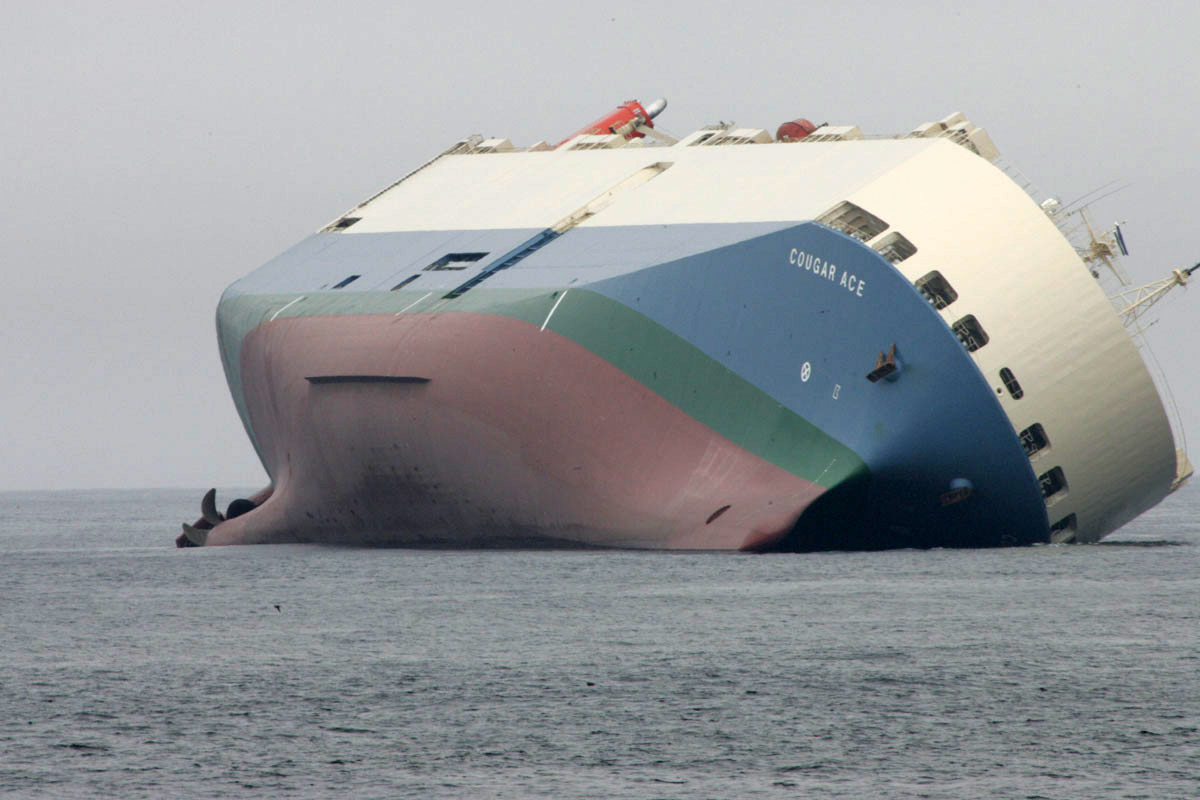
A ship can indeed sink alone by shifting cargo, there are many examples. The Cougar Ace for example did simply not sink, despite developing a 60° list, because of its construction as car carrier with a very high freeboard.

Cougar_Ace_on_side_%28starboard_side%29.jpg


Other ships would have capsized and rapidly sunk under such conditions.

Germans especially remember the fate of the clipper Pamir, which also sank due to shifting cargo during a Hurricane. It had been overloaded and the bulk cargo was not properly secured, because it was loaded by the ships crew instead of professional dockworkers (which had been on strike). For the statistic: The ship capsized and sank in 2 hours after getting in distress. The ship had reached 30° list (after all sails had already been recovered or urgently cut away in the suddenly appearing Hurricane-strength winds) about 1.5 hours before capsizing and sank 20-30 minutes later. Despite the 12-14m waves at that point, the primary cause had been shifted cargo. There had been even loose barley cargo in the ballast tanks, which made counter-flooding hard to impossible. And most of the barley cargo had been stored loose, instead in bags, as common for ships of sail.


So... yes, a ship can be both intact and still sink alone by shifting cargo. And even make the impression, that the situation can still be controlled, despite the opposite being already the case. The stability of a ship is a very complex function and still hard to predict in simulations assuming extreme conditions.
 
The ship did not run aground.

So it is as I suspected... the descriptions of the accident just didn't sound like the kind of runing aground that could sink a ship in 2 hours.

Shifting Cargo is a possibility, especially for a ferry and the kind of ill-secured "drive-by" cargo it's transporting. The question would then be, why the turn? how much expierience did the third officer have with this type of boat?
 
So it is as I suspected... the descriptions of the accident just didn't sound like the kind of runing aground that could sink a ship in 2 hours.

Shifting Cargo is a possibility, especially for a ferry and the kind of ill-secured "drive-by" cargo it's transporting. The question would then be, why the turn? how much expierience did the third officer have with this type of boat?

That's the problem. IIRC she has only several months of experience at the wheels (3 months or so).
 
That's the problem. IIRC she has only several months of experience at the wheels (3 months or so).

But that says little of the qualification. before you are even qualified for becoming third officer, you already went through hard training. 3 month experience as third officer on a ferry means usually 3 months of daily practice. After all, the third mate or third officer is the fourth in command on a ship - usually acting as safety officer.

http://en.wikipedia.org/wiki/Third_mate#Emergencies
 
Looks like the cause for the hard right turn of the ferry, was a failed rudder mechanism.

The ships crew had already reported problems weeks earlier, but it did not get fixed, according to the third officer, she ordered the rudder to 5° right, but the rudder went to hard right.

This can cause a shifting of cargo, also such a manoeuvre could exceed the safe list of a ship by itself, should the ships cargo capacity have been increased, since the ships are usually only tested for executing such a manoeuvre in their original commission or after massive redesigns. The ferry never under went such a new test after the modifications.

The ship was extremely overloaded - a normal situation in Asia. Instead of the rated 987 tons of cargo, it had 3608 tons on board. This further means that a hard right turn of the ship was highly dangerous, since the ships stability and freeboard had been significant reduced. Also the crew had already reported that after the modifications, the ship was instable and difficult to steer.

So, it looks like the primary problem is the management of the fleet, that modified the Sewol to become that instable and sending it to its final travel with three times more cargo than allowed. The captain is likely also guilty there, because he did accept to leave port under such dangerous conditions.
 
Looks like the cause for the hard right turn of the ferry, was a failed rudder mechanism.

I was actually thinking about that possibility, but I thought "surely modern Vessels have a safety against hard rudder movements hooked up to the speed measuring, and some safety restraints so the rudder doesn't go completely haywire when the chains break." Looks like I was wrong...

Instead of the rated 987 tons of cargo, it had 3608 tons on board.

Ships are quite often overloaded, since they tend to take it a lot better than cars or planes, but... over 300%? No matter how much the managment might be the cause behind this, the captain is at the end of the responsability chain here. They should bleed for the bad maintenance, though.
 
I was actually thinking about that possibility, but I thought "surely modern Vessels have a safety against hard rudder movements hooked up to the speed measuring, and some safety restraints so the rudder doesn't go completely haywire when the chains break." Looks like I was wrong...


Ships are quite often overloaded, since they tend to take it a lot better than cars or planes, but... over 300%? No matter how much the managment might be the cause behind this, the captain is at the end of the responsability chain here. They should bleed for the bad maintenance, though.

Ship was not over loaded
I heard cargos are not fixed to ship
 
Ship was not over loaded
I heard cargos are not fixed to ship

It was also overloaded. The ship had been certified by the Korean regulation authority for 987 tons, but the freight manifest had been confirmed by the shipping company to be over 3000 tons.

It is quite right, that ships are often found overloaded. If the ship only needs to travel from A to B without bad weather or other incidents, it is no problem. But when stability of the ship is challenged, overloading is a really bad problem.

---------- Post added at 12:09 PM ---------- Previous post was at 11:58 AM ----------

I was actually thinking about that possibility, but I thought "surely modern Vessels have a safety against hard rudder movements hooked up to the speed measuring, and some safety restraints so the rudder doesn't go completely haywire when the chains break." Looks like I was wrong...

No chains, hydraulic pistons. And for most older or smaller ships, you have no further regulation except the hydraulic system itself.

http://www.nauticexpo.de/prod/hydroster-ship-machinery-works/ruderanlage-schiff-31135-193039.html

As you can see in that example, these are huge servoactuators, which are essentially a pair of small hydraulic pistons moving a big valve that controls the big piston.

Installed in a ship of the size of that ferry, such a system looks like that:

733_rudder_engine.jpg


Only on newer and bigger ships, you have electronic controls. There you usually don't steer the ship directly most of the time, but instead tell the autopilot which waypoint should be steered next.
 
according to S-Korea Media JTBC's interview with former crew of sewol, ship's stabilizer was often unable to use.
and looks like owner(well not direct... own company that own company has sewol...) of ship is leader of a gnosticism christianity cult(gowonpa, gowon=salvation) in korea... involved in mess sucide in 1987(again not DIRECTLY involved...)
http://www.ateliervagabond.com/blog/2012/10/08/ahae-photo-exhibit-in-paris/ <- this... this ahae.
http://ko.wikipedia.org/wiki/%EC%9C%A0%EB%B3%91%EC%96%B8 wiki page about him
http://en.wikipedia.org/wiki/Sinking_of_the_MV_Sewol

in SKorea middle and high school student live most of time front of books, in class room, private educational institute...
they dont have much time to live own lives... and so I was...

even though im SKorean. goverment's actions(so many mistake, unappropriate action of high offices...) on this tragedy is really terrible makes me wonder about very existence this goverment...
 
Last edited:
I don't know why this is, but somehow the fact that a single high school was almost wiped out seems to make this so much more horrific and tragic than if 300 randomly distributed people had been lost.

:(
 
A failed counterbalance valve in the steering circuit perhaps?

Maintenance is the key. Contaminated fluid... worn hosing... any number of issues can arise in a hydraulic circuit. If pilot pressure wasn't achieved to one of the counterbalance valves it would seize movement in that particular direction. Lots of questions... few answers.
 
Last edited:
The vice principal of the highschool committed suicide by hanging in Jindo, after being rescued from the sinking Ferry. He hanged himself with his belt on a tree near the gym, where he and the relatives of the missing children slept after the accident. His suicide note said, that he felt unable to continue living, while 200 of his students did not survive. He wished to be cremated and have his ashes shattered over the site of the accident.
 
Back
Top