Project Galileo II probe to Jupiter

Yeah, it's a fantastic level of precision and planning! It rises up Forum Orbiter Italia addon level! Well done! Ben fatto!

 
LOL

---------- Post added at 05:19 PM ---------- Previous post was at 04:25 PM ----------

Anyway... i made some test flights (with a Delta Glider) to verify the Delta-V required for the various manoeuvres of the mini-lander. The Delta-V for the orbit circularization is very high, and some changes in the strategy are required.
 
Yes, the circularization in not possible.. you have to mantain a very elliptical orbit with the same inclination as Europa.. a godd strategy to save fuel could be to use Jupiter Atmosphere for aerobraking!
 
Aerobraking is a strong option that i always keep in mind... should be necessary an aeroshell for the protection of the lander, in your opinion?

Another option was the ion engine, that allow a great Isp. But the energy requirement is perhaps too high for an RTG-powered spacecraft, so i discarded the idea.
 
Jupiter atmosphere... aerobraking... uncertainty is rather high in real life, we still don't know enough about Jovian weather to survive a one hundredth degree deviation off the optimal aerobraking angle.
 
The problem with Ion engines is that we in Orbiter lack adequate navigation tool for spacecraft with slow acceleration. Both IMFD and TransX suppose the vessel is capable of instantaneous acceleration, so anything that can't accelerate at a meaningful fraction of G can make some problems if the required change in velocity is large, as would be the case here.
 
Last edited:
Jupiter atmosphere... aerobraking... uncertainty is rather high in real life, we still don't know enough about Jovian weather to survive a one hundredth degree deviation off the optimal aerobraking angle.

this is probably true... should know if the first Galileo during his final dive has gathered sufficient information about the outer layers of the Jovian atmosphere to plan an aerobraking with a reasonable degree of accuracy.
 
The fact is that Huygens probe was supposed to brake using Titan atmosphere, and this is the main difference beetwen Cassini and Galileo II mission.. if Jupiter aerobraking is not possible and Ion engine discardable, the only way to save as much fuel as possible is to perform multiple slingshots..

It's hard but i think it's the only way out..
 
In any case, the intended maneuver is not a brutal aerocapture (a single atmospheric passage from an hyperbolic orbit with consequent orbital capture), but a very soft and gradual maneuver in the high atmosphere for the reduction of the Salviati's apoapsis, much like the one performed by the Mars Reconnaissance Orbiter in 2006, that has requested 5 months (445 orbits) for his completion.

---------- Post added 09-20-11 at 09:48 AM ---------- Previous post was 09-19-11 at 09:53 PM ----------

This image suggest that the upper part of the jovian atmosphere is at least 450 km high (considering as "surface" the altitude where the atmospheric pressure is 1 bar). Orbiter seems to be fairly consistent with these data: i have made a test with a Delta Glider, encountering atmospheric friction at an altitude of 700 km. This can be the lower limit of the periapsis for a prudent aerobrake trajectory. Can be realistic or i have to discard the idea?

Galileo_atmospheric_probe.jpg
 
I think that Jovian atmosphere is a great chance to perform this mission, and the question is: if Galileo did it, why Galileo II could not?

in any way, i belive that slingshot has to be used..
 
you mean the Venus Earth Earth Gravity Assist used on the Galileo probe?

slingshot with the others galileian moons for course correction to Europa, i think.

Anyway, if the orbit resultant from the aerobrake has an apoapsis tangential with the Europa orbit (this can be obtained in several successive aerobrakes along with traditional orbit corrections), the slingshots can be avoided, i think... It's question of timing: the probe must pass the apoapsis when Europa is in immediate vicinity for allow the gravitational capture.
 
slingshot with the others galileian moons for course correction to Europa, i think.

Anyway, if the orbit resultant from the aerobrake has an apoapsis tangential with the Europa orbit (this can be obtained in several successive aerobrakes along with traditional orbit corrections), the slingshots can be avoided, i think... It's question of timing: the probe must pass the apoapsis when Europa is in immediate vicinity for allow the gravitational capture.


I mean a single (Venus) gravity assist, at least!
 
Ah, OK. I misunderstood. A gravity assist will be necessary with all launchers except Jarvis M; perhaps, Earth is more comfortable than Venus for gravity assist... :hmm:

---------- Post added 09-21-11 at 07:19 AM ---------- Previous post was 09-20-11 at 10:21 PM ----------

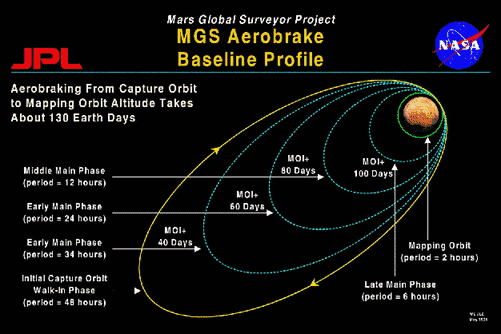
This image relative to the Mars Reconnaissance Orbiter mission shows the concept of "aerobraking from capture orbit" that i intend utilize for the lander of Galileo II. The maneuvre will take several Jovian orbits and, naturally, don't end with a complete orbit circularization; the final orbit must have an apoapsis tangential with the Europa orbit and the periapsis must be raised with a traditional engine burn.

brakeprof2.gif
 
Last edited:
another question is if this maneuvre require an aeroshell for the spacecraft, given the very high altitude of the atmospheric passage. I think that a light aerodynamic aeroshell is necessary in order to assure a correct attitude and orientation during the aerobrake without an extensive use of the RCS engines, but it's only an hypothesis...
 
Huygens probe has a large and heavy aeroshell because must resist at the extreme temperature of the high velocity descent in the Titan atmosphere.
Salviati lander must only perform a soft aerobraking; it not dive in the denser layers of the Jupiter atmosphere. So, his aeroshell can be smaller and lighter than the one of Huygens.

Galileo II is similar to Cassini but slightly larger and heavier: i estimate some 7000 kg, but i will be more precise. However, Galileo II can use the Jarvis rocket, that (even in the "E" variant) is far more powerful than the Titan IV of Cassini. So, Galileo II trajectory can be more direct, altough at least one gravity assist will be needed.
 
Last edited:
Just an idea: Can't you launch the Galileo II to Mars with an engine stage/rocket that is powerfull enough to bring it to Mars without gravity assists, and then make a gravity assist to Jupiter trough Mars?
 
Mars is a weakling as far as assists go... AFAIR Venus and Earth are the only two inner system bodies that can be used for slings in short-duration transfers (if you are dispatching the craft on low-energy routes via Lagrange points, it's very different, but so far no principal investigator has wanted his pet project to come to fruition after he retires).
 
Hypotetic layout of the Salviati lander with detachable aeroshell. The aft engine section remains uncovered in case of orbital corrections.
These corrections can be necessary because the orbital parameters fluctuates due to the gravitational interference by the Galileian Moons, so the periapsis can be vary greatly from the target value.

 
Last edited:
One question: is the Jovian aerobrake performed by Salviati itself (after separation i mean) or when the lander is attached to the mother probe? The first oprion i suppose..

In that case, you have to consider the loss of time (and energy) nedeed to mantain Salviati active.. how many orbits (and time ) before the right orbit is achieved?
 
In that case, you have to consider the loss of time (and energy) nedeed to mantain Salviati active.. how many orbits (and time ) before the right orbit is achieved?

I have to do an accurate simulation to answer at this question; i think, With a prudent trajectory, from 5 to 10 orbits.

Anyway, my Salviati's design is vaguely inspired by the minilander of the proposed Europa Lander Mission Concept (2005). That lander has a tiny RTG to assure a long term electric alimentation.

You can find a PDF related to this mission here:
http://trs-new.jpl.nasa.gov/dspace/bitstream/2014/37545/1/05-0403.pdf
 
Back
Top