Flight Question Geo-stationary target, Launch Window

Capt_hensley

Captain, USS Pabilli
Donator
Joined
Oct 20, 2010
Messages
832
Reaction score
1
Points
16
Location
Alamogordo
Website
www.h-10-k.com
How are geo-stationary launch windows determined?, unlike ISS they will never pass overhead. Is it fair to say, I launch to a GEO-Transfer orbit first, then elevate and aim at my target on subsequent orbits? My target lies in a perfect circular orbit directly over 140 degrees west and the equator.(in the Pacific ocean between South America and Hawaii) Do I make an intercept course for the time it passes over the equator in its figure eight wobble to give me a fixed target to aim for? That happens twice a day which equals two launch windows right? But at what time do I launch. Lets say for arguments sake I'm using a Ariane 5 HLV. Launching form KSC or Wallops. This all just confuses me, I'm no astronaut, physicist, or mathmatician. Help Please and please see that I'm a noobee! Fancy terms and MFD settings or usage will probably go way over my head. Be gentle, thank you.
 
I wouldn't look for a specific launch window as such, but just go into an LEO parking orbit to start. With an orbital period of about 90 min, you'll quickly lap your geo-stationary target. Do a Hohmann transfer burn 180 degree from your target point, allowing for the transfer time between apo & perigee, and the Earth rotation below you for the same period.
 
Alternatively, just aim for a geostationary orbit directly, with only a short coast phase if needed, but instead of directly entering geostationary orbit, go into a slightly higher or slightly lower orbit and drift into your desired target location slowly.

This is done that way with the Ariane 5, which can't restart its cryogen rocket stage and needs to get from launch to GTO in a single burn.
 
What TJohns said - you better launch into a temporary orbit and then burn your engines on the other part of the orbit.

In pictures...

...sorry for the bad drawing in Paint. >.>
 
In pictures...

lol ... I love the drawing. (Your orbit will probably be rounder. I about fell out of my chair laughing.)

Anyway, I have this program I use all the time for taking screenshots and annotating images. I knew it could draw circles, so I thought I'd take a crack at redrawing your image ... mainly just to see if I could do it.

Here's what I came up with.

UcdrM.png
 
Last edited:
blixel: Your drawing suggests you are smarter than 30% of the aerospace students here...these draw elliptic orbits with two periapsis.
 
Wow lots of great answers, Thank you all so much.

Now the newby(thats me)has to try these things. And now I can reveal a few more tantalizing goals:
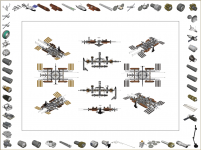
1 I have designed my space station in 3DS Max 2011(it's a kit bash of several ISS parts{various sources which will get credit} and a hand full of scratch objects well within our current technology)
2 I want to place it in Geo Stationary orbit using several HLVs in a period of 5 years
3 it has 330 separate parts that will take about 170-200 rockets, to orbit and assemble the lot
4 I need to launch an average of three times a month, plus a manned capsule every other load for the first 30 loads. Then the station can be manned for the rest of the assembly
5 the station is about 5 times larger than the ISS, it uses only the available launch vehicles right now(HLVs, and EELVs). Only 4 very special shuttle missions to deliver the ET's rather than the shuttle itself, to GEO for re-purposing.

All of this needs to be done according to the real rules of space travel, with all it's limitations and advantages.

The poster center images are small, but the pieces are large enough for you to see my work. The textures are mostly from ISS v3.207 and ISS textures v2(Kendo) found in this forum. If things work out I'll be asking for a add-on builder (david_413 & others)to work on the station as an add on. I wish to contribute while I glean information and resources.

So can I launch several missions within days of each other if I use different LVs and different launch sites, all to GEO?
 

Attachments

  • Poster V1.png
    Poster V1.png
    486.3 KB · Views: 58
Last edited:
blixel: Your drawing suggests you are smarter than 30% of the aerospace students here...these draw elliptic orbits with two periapsis.

I found out long ago I couldn't draw orbits (or any geometric shapes, including lines) to any reasonable accuracy without really having to think about it. Curse my twitchy hand! :lol:

That being said, I do try to maintain a "one periapsis per orbit" rule. :thumbup:
 
Does anyone see a problem with my projected launch schedule of 3 per month? I want to make sure the real world perameters will work, otherwise my paper will be wrong, which is a bad thing...
 
Capt_hensley,

I'm sorry about the off topic post, but what's the story behind that space station in your sig?
 
Only 4 very special shuttle missions to deliver the ET's rather than the shuttle itself, to GEO for re-purposing.

I think you should first do the numbers with this concept.

Lifting ET up to GEO with shuttle INHO is bad idea. I suggest removing shuttle from stack and placing a small cluster of 2 or 3 SSMEs with proper guidance computer in place of shuttle.

Also you can add RCS system to the ET to manuevre it in orbit and finally without all the mass of the shuttle whole rig would hopefully be able to reach GEO (normal shuttle can't reach GEO, especially with ~38 ton tank underneath it.)

If you only need to lift ET into LEO for further "tug" operations I suggest using equatorial base for launching (~30 degrees plane change will consume terrible ammount of fuel).
 
Capt_hensley,

I'm sorry about the off topic post, but what's the story behind that space station in your sig?

The station image above is not in my sig, but rather a reference shot. Along with the links to more imaged of the modules I have made for it in 3ds.

The station pretty much is the topic, getting into GEO with whatever, in a "as real as possible" method. It's part of my thesis. I made the mesh in 3DS Max 2011, and want to try to make it into an add-on at some point so others will have a large space station with lots of activities to play with, as well as put a human manned platform into GEO.

A possibility would be to make radiation, and other significant factors affect the way you go to GEO, live and return. It will make for a pit stop for interplanetary travel, once I get some of the Mars Fleet ideas together, along with advanced drives like Vasimr.

I'm making a Gateway users guide for the station, about 130 pages when complete. It's not for orbiter, but to convince my professors my mind is capable of thinking and engineering.

Question are very welcome, keep um comming...

---------- Post added at 06:00 PM ---------- Previous post was at 05:43 PM ----------

I think you should first do the numbers with this concept.

Lifting ET up to GEO with shuttle INHO is bad idea. I suggest removing shuttle from stack and placing a small cluster of 2 or 3 SSMEs with proper guidance computer in place of shuttle.

Also you can add RCS system to the ET to manuevre it in orbit and finally without all the mass of the shuttle whole rig would hopefully be able to reach GEO (normal shuttle can't reach GEO, especially with ~38 ton tank underneath it.)

If you only need to lift ET into LEO for further "tug" operations I suggest using equatorial base for launching (~30 degrees plane change will consume terrible ammount of fuel).

I really just wanted to extend the Space Shuttle program with 4 more shots, it could haul light loads to GEO to get the highly modified tanks into GEO for the station itself.

You're right I looked it up, and it would make it to GEO. It would be very risky. Shuttle-C is the other solution you're speaking of, and while it would work, it just wouldn't be the same as STS.

Tugging the tanks into GEO from LEO could work, but the Shuttle crew and the tools in the bay would be needed to extract the tank liners, and install the accessories needed to make the tanks habitable for repairs. Once the liner is out, the lights, arms, HVAC, and door mechanisims would all need to be installed. An additional partition in the second tank would be in place but would need to be tweeked up for two bay isolation. The third and fourth tanks would need to be set up for fuel, and gas storage, they would need stir fixtures for the cryogens, and compressors and refrigerators for the high pressure cold storage of hydrogen and oxy, and Nitrogen on orbit.

All of this gets back to the point of having to launch as many GEO/GTO missions as possible. SO the question still stands, can the real world mission pace of 3 missions per month, be accomplished with off the shelf rockets, and launch facilities. I need to get this thing in orbit and constructed in 5 years or less.

As far as orbiter goes, we can pre-orbit the entire station until each of the modules are brought up to spacecraft3.dll standards and can be launched, assembled, and dockable for realtime or quicktime play.

The users guide is 1/3rd finished, but gives a basic idea of what I want to accomplish, about half of the guide is text, the other is images and renders.

It could prove useful to orbiter as a basis of the manual for making the new add-on. A good way to look at this eventual project/add-on is a very large and more capable ISS, except in GEO, with a 1g habitat, and afacility for building interplanitary ships.

Keep those questions comming...

 
Maybe it's just me, but 3 launches per month seems a bit ambitious. Just wondering what the average mission duration will be.

This looks interesting. Best of luck! And a new set of station modules is always welcome.:)

P.S. What role do the shuttle ETs play? Modules? LOX storage?


:hailprobe:
 
Maybe it's just me, but 3 launches per month seems a bit ambitious. Just wondering what the average mission duration will be.

This looks interesting. Best of luck! And a new set of station modules is always welcome.:)

P.S. What role do the shuttle ETs play? Modules? LOX storage?


:hailprobe:

Three is minimum for 5 year construction time.

I'm sure when these are finished they would be compatible with ISS modules and others.

Shuttle ETs:
Tank 1, Large Maintenance bay, the Hydro portion is lined, and uses two large pressure doors equal to half the ET diameter. Once the liner is removed the tank becomes a pressure vessel for the largest enclosed and pressurized maintenance bay in orbit. Capable of fitting any of the station modules for repair. Also things like Hubble, for it's recycling and retro fit to be used permanently on the station. The LOxygen portion would retain it's uses to store the LOX portion of the environment gasses.

Tank 2, hydro portion is lined, but smaller doors facilitate the removal of the liner. Once the compressors are installed and the tank resealed the tank becomes a storage tank for Nitrogen, to be used to pressurize the maintenance bays, and station. The Oxy portion remains for LOX storage for the environment pressurization.

Tank 3, is lined as described above,except the hydro portion is split into two half's, this ET has two maintenance bays and 4 smaller doors, for smaller satellite maintenance and so on. The oxy tank remains for environment gasses (LOX) storage. A smaller bay will use less environment gasses and enable a longer lasting storage of those gasses.

Tank 4, Another tank for storage, this time for hydrogen, and Water. The hydro portion is converted into water storage, and a cracking plant to process the water into it's two components, Hydrogen, and Oxygen. The hydrogen is transferred to storage and used to refuel the space tugs used on-orbit, the oxygen is transfered to storage and used as the oxidizer portion of fuel and environment gasses.

Hopefully I have made the right decisions to create the right quantity of storage tanks for each of the functions.

Now another thing. There must be some type of gasses recycling system to prevent a mass of gas loss due to routine environment purging of the bays for deployment of the items repaired inside them.

As mentioned above, RMS arms, and lights must be installed, and the mechanisms for opening and securing the doors to enable pressurization. All the technology we need to make these modifications, is on the shelf.

The difficulty will be getting the heavier tanks into orbit, with a shuttle attached. One possible solution is a larger diameter tank, and two more boosters, (Buran sized maybe)

Keep those questions comming...
Now water can be faired to the station for breakdown, and fuel components can also be faired and stored.
 
You're right I looked it up, and it would make it to GEO. It would be very risky.

AFAIK STS Shuttle Orbiter has ~300 m/s dV and equatorial LEO to GEO transfer needs ~1630 m/s.

...and that's just one way.

How do you want to achieve missing 1330 m/s??
 
Additional Fuel and Strap-on boosters, it's in an old profile, in an old design. It would have about the same appearance as Buran. But going to LEO, then Tugging would work cheaper and easier.

Shuttle would sacrifice bay space for internal Tanks in the old design. It's possible if all you want to do is get it there and back, not much of a mission. I think I'd rather just get it to LEO and tug the tank.
 
Just wondering what the average mission duration will be.

:hailprobe:

8 Days average, 5 for some non-space walk missions, 2 weeks for the few missions that require moving several modules where de-pressurization, and re-pressurization will be needed. This happens early in the construction near the end of the habitat construction phase (Phase-1).

Keep those questions comming :)
 
Back
Top