Updates GOCE Mission News

Just a quick one, I keep trying to change this thread's title to something more relevant like Goge Mission News. It often says it will but dosen't. Could some good Moderator have a go? Many thanks, N.
 
Done. Thread renamed and its prefix changed.
 
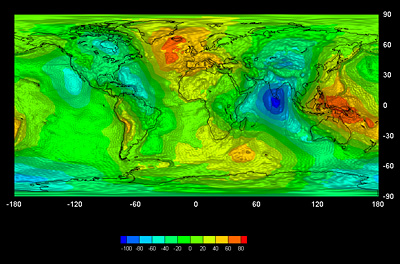
This map gives a hint on what helps enlightened yogi to levitate:

GOCE-Geoidkarte_mit_Schatten_L.jpg


;)

Am I reading this map right? The tip of India is at 1 m/s^2 below average Earth surface gravity? That doesn't sound right.
 
ESA: Mapping the Moho with GOCE

[table="head;width=200"]
Click on images to enlarge


This map shows the global Mohorovičić discontinuity – known as Moho – based on data from the GOCE satellite. Moho is the boundary between the crust and the mantle, ranging from about 70 km in depth in mountainous areas, like the Himalayas, to 10 km beneath the ocean floor.​
Credits: GEMMA project​


Comparison between an old global Moho model (left) based on seismic/gravity data and Moho-mapping based on GOCE data (right) in South America.​
Credits: GEMMA project​


While the figure on the left shows Moho depth beneath the Italian peninsula derived from GOCE data, the figure on the right depicts ground gravity reduced by the effect of Moho. The effect of sediments in the Po Valley (northern Italy) is visible, as well the boundary of the main tectonic plates (in white).​
Credits: R. Barzaghi, A. Borghi, M. Reguzzoni, D. Sampietro. Presented at AGU autumn meeting 2011.​
[/table]​
 
In the map of Italy is a yellow spot south of Switzerland around Genoa, what's the reason that there is a thicker crust, but in the Apennine Mountains is no difference to the surrounding area?
And how should this discontinuity vary in a volcano region, like the Etna or huge volcanoes in the Andes?
 
ESA: GOCE’s second mission improving gravity map:
16 November 2012

ESA’s GOCE gravity satellite has already delivered the most accurate gravity map of Earth, but its orbit is now being lowered in order to obtain even better results.

[table="head;width=200"]
Click on image to enlarge​


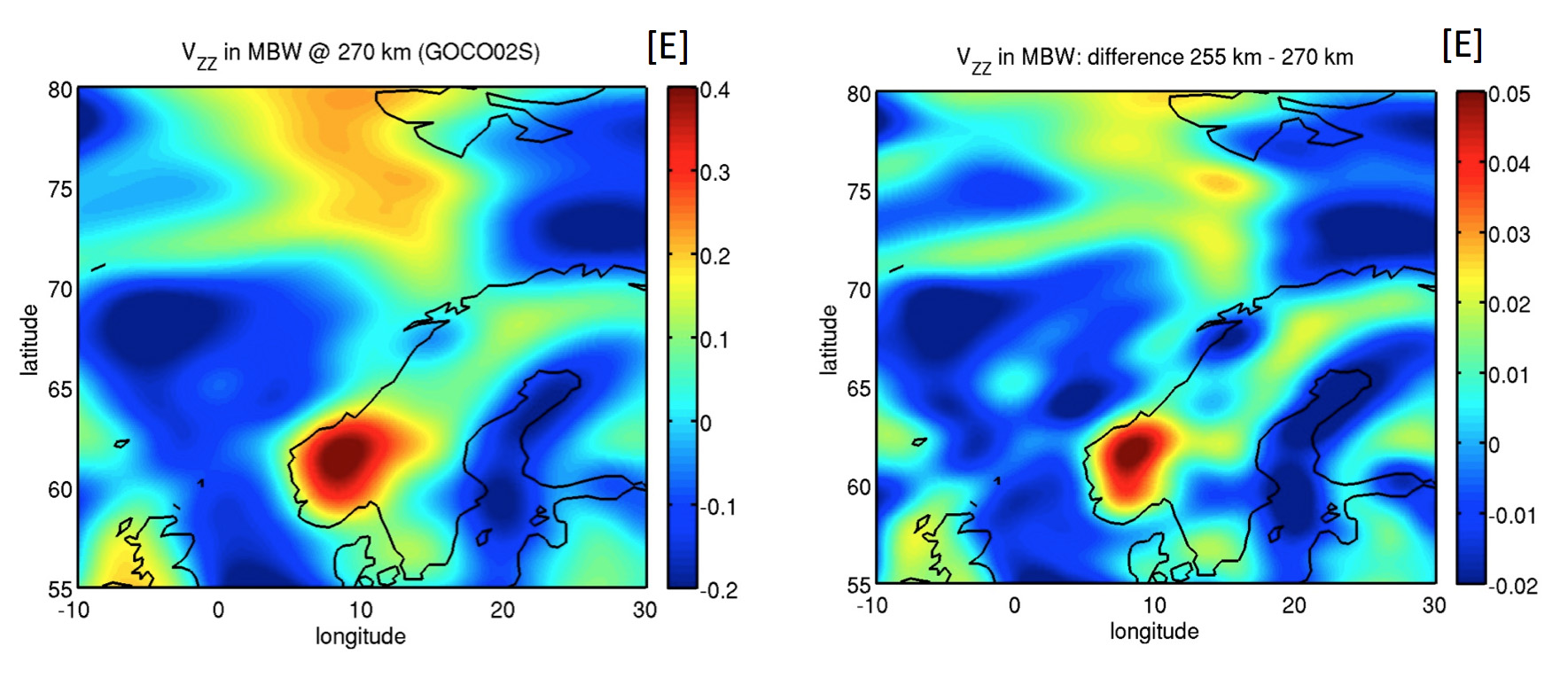
The image on the left shows GOCE’s gravity measurements over northern Europe, acquired from its previous altitude. The image on the right depicts the expected measurements over the same area after the satellite has been lowered by 15 km. An increased signal and improved spatial resolution is evident.
Credits: ESA / GOCE+ Theme 2​
[/table]​

{...}

Spaceflight Now: GOCE gravity-mapper drops closer to Earth for science
 
Goodbye GOCE. The satellite's xenon reserves are set to run out any time between now and November, followed by just a few weeks of unpowered life before reentry.

"Some satellites take decades to come back after finishing operations; we will re-enter in no more than three weeks," says Esa mission manager Dr Rune Floberghagen... Engineers are expecting the engine to die around 16/17 October, give or take two weeks.

http://www.bbc.co.uk/news/science-environment-24043526
 
Last edited:
We should make a proper Space Viking funeral party for GOCE. It really deserves it.
 
NASASpaceflight: European duo heading for fiery farewells:
{...}

No exact time of entry is known at this time, with many factors in play.

Z4According to ESA, GOCE was last reported to be at an altitude of roughly 205 km, having lost about 19 km since depletion of fuel on 21 October. The atmospheric drag has increased substantially during the orbital decay, from an average of about 8 mN (milli Newton) to above 15 mN.

“The spacecraft behaviour is as expected, with the attitude control system continuing to work fine,” added ESA. “We keep doing our routine spacecraft operations activities; no major problems have been encountered so far.”

Per the parameters of how soon GOCE will end its mission via a destructive re-entry, the recent rise in solar activity has contributed to a noticeable increase in drag on the spacecraft, in turn accelerating its descent.

ESA also note several coronal mass ejections (CMEs) are expected to reach our planet, which may spark storms in Earth’s geomagnetic field and hence lead to a large increase in the atmospheric drag at GOCE’s altitude.

{...}
 
Looks like GOCE has only a few days left:( Never got the glamour and news coverage it deserved for such a good looking and competent vehicle.

Blog is here:
http://blogs.esa.int/rocketscience/

N.
 
That BBC article was a little over dramatic for me.

@orbitops on twitter is providing more interesting information:

Sat 9 Nov 18:00UT #GOCE orbit 87.73 minutes 155.6 x 164.2 km Position 21.7N,21.6E alt=166.1km Unlit ~Re-entry 18h [0.43d]
 
Sounds like time for another game of Re-Entry Roullette!

Where will GOCE come down? Place your bets ladies and gentlemen. Around and around she goes, where she'll stop nobody knows...
 
Last edited:
Back
Top