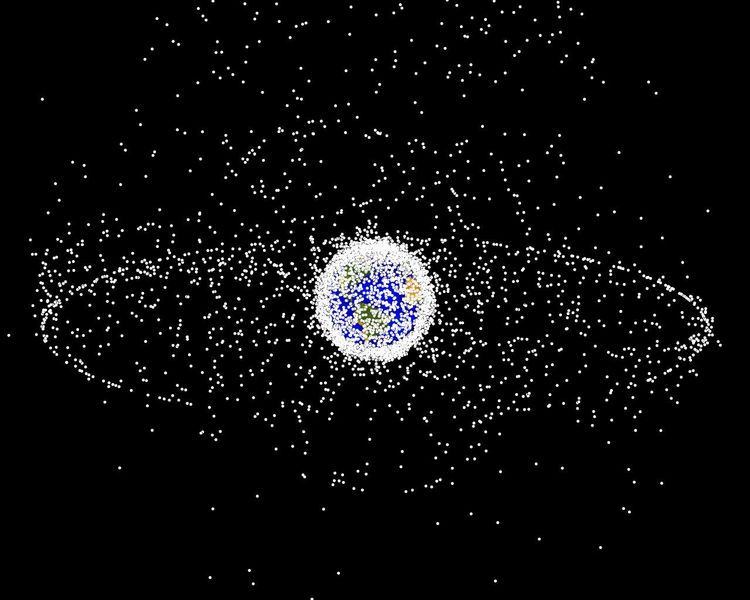
Has anyone seen this video?

Impressive.

This is also interesting.
750px-debris-geo1280.jpg
 
Last edited:
That`s :speakcool: Perhaps in the future Earth will get rings from old satellite debris.
 
That`s :speakcool: Perhaps in the future Earth will get rings from old satellite debris.

That would kinda suck, you can't really have an orbit around the Earth that wouldn't pass through the plane of the rings, which if they were dense enough to be visible would be extremely dangerous to go through. Odds are, if we had enough debris for rings, Kessler Syndrome would have long since made space travel impossible.

It would be neat if we had a couple more moons like Phobos to look at, though.

Say, how can I edit Phobos into Earth's orbit?
 
That would kinda suck, you can't really have an orbit around the Earth that wouldn't pass through the plane of the rings, which if they were dense enough to be visible would be extremely dangerous to go through. Odds are, if we had enough debris for rings, Kessler Syndrome would have long since made space travel impossible.

It would be neat if we had a couple more moons like Phobos to look at, though.

Say, how can I edit Phobos into Earth's orbit?

Yeah space travel would suck although for destinations beyond Earth orbit it might be possible to launch from poles and avoid equatorial plane however that would be fuel inefficient.

It is possible to edit Phobos or any other moon into Earth orbit. I have not done it but I think it can be done by editing sol.cfg or Earth.cfg files
 
The rings would certainly be nice to look at, and give a different view of the sky.

But, couldn't an object orbiting the Earth go into a lower or higher altitude than the rings?
 
Higher altitude would work--rings tend to thin out once you are outside of the Roche limit, and in LEO (few hundred km or less), particles' orbital lifespans will be short enough to keep that population thin as well. Notice how Saturn's thinnest rings are the innermost and outermost ones, while the A, B, and C rings are the densest and brightest.

I would wonder about the rate of large meteors falling onto Earth's equator (from ring particles that fell onto Earth) if we had rings like that, since at Earth's distance from the sun there would be very little ice and the particles would be mostly stony or carbonaceous.
 
The rings would certainly be nice to look at, and give a different view of the sky.

But, couldn't an object orbiting the Earth go into a lower or higher altitude than the rings?

You'd have to, or do what Cassini did and aim your orbit to pass through a relative gap in the rings.
 
Hmmm, probably the reduced sunlight in the lower latitudes would lead to a weaker gradient of temperatures between the equator and the polar regions, which would mean that ocean currents like the Gulf Stream would be slower. Earth as a whole would be slightly cooler (though hopefully not cool enough for perpetual ice age).

Meanwhile, all of that surface area reflecting sunlight onto the night side of the planet would give us hundreds of times as much nighttime illumination as the full moon (at least at 10-70 degrees latitude--the equator would see the rings edge-on and the polar regions would have most or all of the rings below the horizon). As such, animal life would have a reduced need for extremely sensitive night vision--it would be bright enough for humans with our own night vision to see clearly and even read ordinary 10 or 12 point black-on-white text as well as seeing colors.
 
Iridium + Cosmos + time = Ring
 
Back
Top