News Here be Dragons: SpaceX reveals manned Dragon design

While this is of "Dragon V1.3" (as Musk called it), the landing is pretty much the same. The Dragon V2 probably will not perform a full propulsive landing for ISS missions, more likely a rocket-assisted like Soyuz. As the video shows.

 
Last edited:
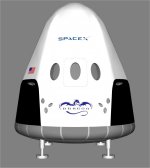
Started texturing.
 

Attachments

  • WIP3.jpg
    WIP3.jpg
    42.7 KB · Views: 46
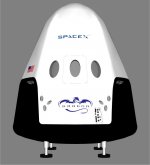
Started texturing.

Great, Looks almost like the presentation object now. Will it have an interior? :tiphat:

EDIT: OK, the umbilical connection to the trunk is missing:

 
Last edited:
It will have an interior, but it definitly looks like a mock-up. I wonder how different the real deal will be. I assume frames around the windows, bolted on TPS like the original dragon.
 

Attachments

  • WIP4.jpg
    WIP4.jpg
    43.5 KB · Views: 33
Hey Don. Take a look at the landing legs, the back two are closer together than the front two. Elon makes mention of it during the Q&A session after the reveal.
 
Last edited:
It will have an interior, but it definitly looks like a mock-up. I wonder how different the real deal will be. I assume frames around the windows, bolted on TPS like the original dragon.

I also assume that the umbilical connections will be covered by a hatch with heat shield, similar to the guidance sensors of the current Dragon, should the spacecraft be reusable.
 
GUI: http://i.imgur.com/75UM1R8.png (via r/space)

I see several problems with this, starting from the choice of colors (white on gray).

Maybe someone should send Elon a copy of Orbiter with Orb::Connect::Web...
 
GUI: http://i.imgur.com/75UM1R8.png (via r/space)

I see several problems with this, starting from the choice of colors (white on gray).

Maybe someone should send Elon a copy of Orbiter with Orb::Connect::Web...

It looks much like a widget interface, so I am pretty sure, a different color theme would be no big deal. Other things there are much worse. Take for example the formal design language of the display: Can you identify by first glance, which element has which type of function? Actually all look the same, no differences. That's pretty bad design.

Also, the layout of the indications is very much looking like a plain static mockup. If you assume that the biggest areas in the interface are the most important information, the display starts to be pretty strange.

And then there are the engineering problems: The meter accuracy of the apogee/perigee indications - pretending higher accuracy than the navigation system actually has. Or a N-W-S coordinate system for the burn data (North-West-South?)

It makes little sense if you think more about it.

But it sure gives an impression, how the spacecraft could eventually look like, including the user interface.
 
Last edited:
They way I look at this is: could I fly in Orbiter using this? Emphatically, NO. There is no attitude information and critical orbital parameters (Inc, LAN, AoP) are missing.
 
They way I look at this is: could I fly in Orbiter using this? Emphatically, NO. There is no attitude information and critical orbital parameters (Inc, LAN, AoP) are missing.

Even if you expect this craft to be highly automated, it makes little sense. The actual autopilot mode is a very tiny field nearly lost in the status information on the right. There is no status display for monitoring the activity of the autopilot.

I can work without Inc, LAN and AoP... since plane changes are rarely done. But what is the attitude?

And why is the FDIR state one single global attribute and given as FDIR_INIT? FDIR is Fault Detection, Isolation and Recovery. You have not one global FDIR usually, but FDIRs for every subsystem or even major assembly.
 
Last edited:
Uh, how exactly do I perform a manual emergency reentry if the spacecraft loses power?

"Checklist says tap the...ah dammit!"
 
What I just wonder... how do you trim this one? Usually, a capsule has an off-centre CoG for getting the ideal AOA and the RCS is only needed for banking and neutralizing oscillations.

But that would be bad for powered landing - the engines are placed symmetrically. The only way I see by the known components is using slightly varied thrust levels so that the torque is zero - but then, the thrusters are not spaced equally around the spacecraft, but towards the sides (About 40°, 140° , 40°, 140°, instead of 90° between the thrusters). You would have less control in the pitch axis by the SuperDraco thrusters.
 
The actual autopilot mode is a very tiny field nearly lost in the status information on the right.

Wait, there is an autopilot control somewhere?

Oh... You mean Perigee_Raise_Plan under Nitrox reserves?
 
Wait, there is an autopilot control somewhere?

Oh... You mean Perigee_Raise_Plan under Nitrox reserves?

Yes, the FC State = Flight Control State.

Which is also approximately below the computer status (But I don't know what the eight squares should mean. CPU cores?)
 
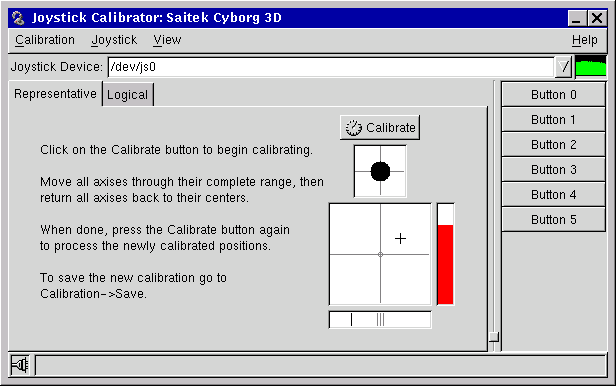
l I imagine configuring and calibrating the joystick to control a manual capsule has an off-centre CoG for getting the ideal AOA and the RCS
:idea:

5666.png


but this is a joke. I think the system really will be next to this :)

v2land.png
 
Hey Don. Take a look at the landing legs, the back two are closer together than the front two. Elon makes mention of it during the Q&A session after the reveal.


Could you paraphrase ?
 
Could you paraphrase ?


if you look at the photo of the presentation, you can see that the landing gear leg pair towards the hatch is further apart than the pair on the opposite side, forming rather some sort of a tricycle gear than four equally spaced landing gear legs.

The rendering in perseus post also shows this.

I suppose it has something to do with the internal structure of the capsule.
 
He'd mentioned about how it would descend if were using a parachute, landing on the "back" legs first, with the crew more or less head-down. momentum (I suppose) would have the capsule tilt forward onto the remaining two legs. But yes, that picture shows it pretty well.

Not very precise due to the viewing angle, but you can clearly see how close the back legs are to one another. If I can get some time, I'll watch the video again and get a time index.
 
Using a small study of perspective, it is clear that the distance of the front landing gear is more 2.6 times wider than the back.
is logical for moreover distributes the weight in 4 surfaces, adapts to any surface like a tripod and are actually two overlapping tripods, if a landing gear breaks.

See image attached.
 

Attachments

  • dragon2pers.jpg
    dragon2pers.jpg
    111.3 KB · Views: 55
Last edited:
Back
Top