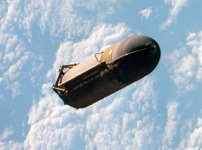
How could the Shuttle remain....

Cosmos

New member
Joined
Mar 16, 2008
Messages
72
Reaction score
0
Points
0
Location
San Diego, CA
Everytime I see a shuttle liftoff, I can't understand it. With all the weight of the shuttle, payload and stresses of the blast off, how could the Shuttle remain attached to the main fuel tank by those little supports? I would think there would have to about ten times the attachments. Any thoughts?
 
My guess is that the struts are strong enough.;)
 
Cosmos said:
That front attachment point must be incredibly strong!
If I had to guess I'd say that the lower struts are designed to take most of the weight.

Also keep in mind that, at liftoff, much of the orbiter's weight is supported by it's own engines. Once the SRBs separate, all of the thrust is coming from the orbiter's engines, and so it's really the external tank that has to be supported. But at SRB sep the ET is much lighter than it was at liftoff, and it continues to get lighter still as the ascent goes on (In fact, if I'm not mistaken, the strain on the support struts should remain the same between SRB sep and the throtteldown shortly before engine cutoff, as the lightening of the ET balances the increased acceleration.).

Taking all of that into consideration, I wouldn't be surprised if the support struts actually experience to most load when the shuttle is just sitting on the pad, though of course you still have to consider the vibrations during launch.
 
There's also two ball&socket attachments at the back of the ET which mates with two sockets in the umbilical wells of the orbiter.
 
Well evidently it was well designed as there haven't been any strut failures. Seems like a weak link to me though. But then a failure of the cargo bay doors getting stuck open crossed my mind.
 
Everytime I see a shuttle liftoff, I can't understand it. With all the weight of the shuttle, payload and stresses of the blast off, how could the Shuttle remain attached to the main fuel tank by those little supports? I would think there would have to about ten times the attachments. Any thoughts?

You have to remember the scale of the Shuttle - it is huge, but for its mass, very light. Also most forces apply to the aft attachment, which is very strong, while the forward attachment only is there for avoiding that the Orbiter can rotate around the aft attachments - like you learn in school, longer lever arm means lower forces. ;)

The connections look tiny, but actually, they are massive (remember size of the Shuttle). The propellant tubes which enter the Shuttle are of 17 inches diameter (43 cm) the struts keeping the Shuttle in place are roughly 30 cm diameter.

Just look at this image and the tiny humans in the lower left corner.
08pd0669-m.jpg
 
But then a failure of the cargo bay doors getting stuck open crossed my mind.

There's a long list fo things that can go wrong; the payload bay doors are only one.

The PBDs, BTW, did get stuck open on an early shuttle flight, I believe it was STS-1? The crew reported that the doors wouldn't close, but the ground figured out that the structures had swelled in the hot sun, so they told the crew to rotate the orbiter and put the doors in the shade. This did the trick and the doors closed with no problems.

There is a procedure for closing the doors manually, it involved going out into the payload bay in suits and installing clamps to hold the doors shut for reentry. All the astronauts train for this, according to Mike Mullane, who hated practicing this in the water tank because the clamps are so heavy and you have to hold them over your head in the pool while attaching them.
 
Isn't the Orbiter supported by some pad structure on the ground? After that, I don't think the SSMEs have enough thrust to produce more than the force pushing down on the Orbiter. After that, it's all relative to each other. Sort of how an ion engine with as much thrust as a couple pieces of paper can push a hundred kg probe across the solar system.
 
The entire shuttle stack is supported by the bolts holding down the SRBs. The SRBs hold the ET, the ET holds the orbiter. Nothing else props it up, AFAIK.
 
Some good information, thanks. I was just watching the STS-1 video that was awesome. I can't believe now that we have much improved safety procedures, that we going to retire the shuttle in 2010 with a 4 year gap until Constellation...I would think that the shuttle could last 4 more years. But then these are the same guys that want to retire the Hubble telescope without a replacement.
 
I can't believe now that we have much improved safety procedures, that we going to retire the shuttle in 2010 with a 4 year gap until Constellation...I would think that the shuttle could last 4 more years.
This could lead to some issues with extending the service life of the shuttle:
http://www.nasaspaceflight.com/content/?cid=5113
I am sure there are other similar issues.
 
There is a procedure for closing the doors manually, it involved going out into the payload bay in suits and installing clamps to hold the doors shut for reentry. All the astronauts train for this, according to Mike Mullane, who hated practicing this in the water tank because the clamps are so heavy and you have to hold them over your head in the pool while attaching them.
This is false information.
The doors are winched closed using a winch located on the aft payload bay bulkhead.

But unless the payload bay is empty whoever is going out to to manually close the doors have to remain in there until the ground operations team could access the payload bay to get him/her out of there!
 
The PBDs, BTW, did get stuck open on an early shuttle flight, I believe it was STS-1? The crew reported that the doors wouldn't close, but the ground figured out that the structures had swelled in the hot sun, so they told the crew to rotate the orbiter and put the doors in the shade. This did the trick and the doors closed with no problems.

It was on STS-4, and it was a intentional test for researching the banana effect.

But that the PLBDs did not close was worse than the engineers expected.
 
It was on STS-4, and it was a intentional test for researching the banana effect.

But that the PLBDs did not close was worse than the engineers expected.
Banana effect? I haven't heard of that one before. Something to do with the PLBDs bending, I presume.
 
Banana effect? I haven't heard of that one before. Something to do with the PLBDs bending, I presume.

The whole shuttle bends. Not only doors, but also all other structures. But the effects on the other hardware is pretty low.
 
This is false information.
The doors are winched closed using a winch located on the aft payload bay bulkhead.

But unless the payload bay is empty whoever is going out to to manually close the doors have to remain in there until the ground operations team could access the payload bay to get him/her out of there!

Yes, I think Mullane mentioned using a winch to close the doors, but he also talked about clamping them to keep them shut. And since the hatch leading from the mid-deck to the outside is underneath the doors, why would they have to wait in the bay until landing? Unless you are talking about the ODS... Perhaps Mullane was referring to the older configuration with no ODS?
 
What if . . . ?

What would happen to the crew of a space shuttle if they couldn't get the bay doors to close? Would they just have stay up there until NASA could get them down?
 
nahh....the only reason why it can withstand all the stress because it's made to do so.
 
Back
Top