Science How i belive a flying car could be built

Moach

Crazy dude with a rocket
Addon Developer
Joined
Aug 6, 2008
Messages
1,582
Reaction score
63
Points
63
Location
Vancouver, BC
Ok...
continuing from the google cars thread, where i suggested a concept for a flying car - here it is:


let's build it from the base up, shall we - this is the basic chassis and interior design:

picture.php


there's a reason for the inverted tricicle setup - it'll be clearer further along, but for now, it's basically to allow for a more car-like configuration and road handling

i shall explain the cockpit layout and handling characteristics later on - for now let's just focus on the vehicle's construction:

picture.php


this makes for a very driver-friendly design, being very intuitive... so far, the only major difference between that and a normal car is the tricicle setup...

but let's go on to how it should fly:

picture.php


this is the main reason for the inverted tricicle configuration - it gives us a nice layout for the ducted fans....

those are all electrical - and computer-controlled - the driver does little more than suggest to the computer what to do through the flight controls

now, let's see about the power supply...

picture.php


those are three very simple, reliable turbines... also controlled by the computer (the driver has little more to do with them than turning them on and off)

when on ground, only one of the three needs to be running to provide enough power to the wheels... the other two should come alive on time for takeoff


and this is what it should look like in the end:

picture.php


this design is a lot more urban-oriented than the Moller Skycar, hence, no wings (although it's conceivable how retractable wings could be attached) and no need for complex retractable gear mechanisms....

while the Moller is a VTOL airplane that can be used as a car, this concept is more of a car that can be used as a helicopter :hmm:


i'll post more on the flight controls later... i got it all figured out :thumbup:
 
So you're using turbines to create electrical power for the actual motors? sounds a wee bit inefficient...

Anyways, purely practical design suggestion: jonny everyday handling the thing is not a pilot, so a window in the floor that he sees where he lands might be neccessary.

What about the thrust rating of those fans? any math for it?
 
I wouldn't fly in that thing if you paid me. I think the tricycle setup is interesting though.

the driver does little more than suggest to the computer what to do through the flight controls

While this obviously lifts the burden on the pilot/driver (and the society that would have to deal with them), what happens when something unforseen occurs that the autopilot can't handle?

I mean, not to bash your idea, but while drawings are one thing, an actual concept that actually works and is practical is another. VTOL in general and flying cars in particular, are very, very difficult to do.
 
What's the fuel fraction? There are a few reasons why even convertoplanes have wings, lift being one of them.
 
not sure about how inneficient using the turbines for electrical drive would be... M1A1 tanks do it... shouldn't be an all-terrible idea, i hope :shifty:

in the worse case, we could just replace that with those awesome Rotamax Wankel-cycle engines used by Moller, those seem to work well...


and in the event of a worst-case-scenario - an automated parachute system would fire (like airbags) and lead the car back to ground safely... in the event of a water landing, flotation packs would be inflated around the vehicle so it remains afloat until rescue comes along

there's an aircraft that has this parachute system, i think it's called the "Cirrus"-something... they call it the "Volvo of the skyes"


as for crashing, it should not be possible to do so - the FBW system must be hooked to an array of distance sensors (as well as a virtual spatial representation of terrain and stuff) which allows the program to avoid any collisions...
this should be better explained once i get around illustrating my concept for the flight controls scheme

another thing worth noting, is that the FBW computer is constantly connected via internet (or whatever works best) to a local air-traffic command centre server... it is that centre that's responsible for coordinating the PAV airways with the existing ATC routes and restrictions, as well as detouring/restraining from disagreeable weather - aka: "roads in the sky"

it should be considered illegal to fly at certain areas/altitudes, fly "manually" on automated skyways, or go "off-road" without special permits... the flight computer would report any foul activity to the local control center for law enforcement purposes (it would advise the driver against doing so beforehand, then report should he choose to ignore such advice)

the air traffic would be coordinated by clustered servers, maintained and supervised by specialized companies (government or not), minimizing the legal impact, and elminating the need for drivers to contact ATC by themselves - except when flying "off-road", in which case, the driver must be properly trained and permitted to do so


i do believe the technology to build such a thing is already available (or at least emerging)
the hurdles to be overcome lie mainly in infrastructure and in convincing the needed folks that it IS, in fact, possible
 
Look up Rudy Heeman and wing-in-ground ;)
 
Look up Rudy Heeman and wing-in-ground ;)

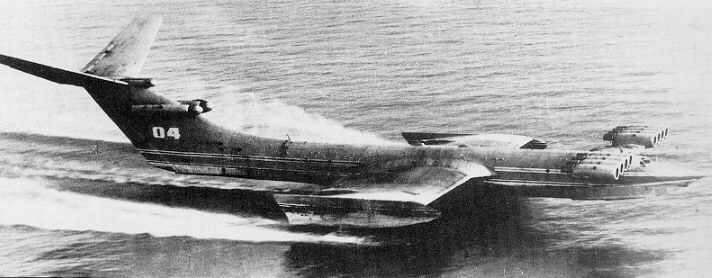
cool! :thumbup: it's like a miniature version of the "Caspian Sea Monster":
km3.jpg


doesn't solve any urban traffic problems tho... but sure seems like a fun ride :thumbup:

---------- Post added at 04:25 PM ---------- Previous post was at 04:20 PM ----------

Anyways, purely practical design suggestion: jonny everyday handling the thing is not a pilot, so a window in the floor that he sees where he lands might be neccessary.

What about the thrust rating of those fans? any math for it?


a window on the floor may not be practical (specially if we decide this should have wings which would then extend from below the chasssis)...

so i was thinking a high-res digital camera mounted on the bottom would do that job better, no?


as for the math, that's one of the reasons why i'm posting this here - does anyone have any idea on what we could expect from this (or a similar) design:
 
A lot of fuel guzzled for very low range. Do you still want to solve Sao Paulo's traffic problems - I suspect the fuel will be alcohol, if a leak develops, DUI is inevitable :(
 
Been there, done that...


---------- Post added at 19:50 ---------- Previous post was at 19:45 ----------

not sure about how inneficient using the turbines for electrical drive would be... M1A1 tanks do it... shouldn't be an all-terrible idea, i hope :shifty:

Yea, M1A1's also use up like 8 gallons of fuel to start the turbine...
 
M1A1 tanks do it... shouldn't be an all-terrible idea, i hope

I have the slight feeling that tanks are not a good case study on efficiency :lol:

so i was thinking a high-res digital camera mounted on the bottom would do that job better, no?

Ah, yes. I'm forgetting good old cameras again...
 
where is the brder between a flying car and a four-wheeled helicopter, Quadrocopter or something like that?
 
where is the brder between a flying car and a four-wheeled helicopter, Quadrocopter or something like that?

i think it would be the general-public accessibility and the absence of that large murderous spinning thing on the top :hmm:

also - it's street-legal :thumbup:
 
A fuel consumtion would be very high since this thing relies on thrust to create lift. I think some sort of extendable wing would be a must to reduce load on the ducted fans while cruising. Full power would be used only for VTOL.

according to this source
http://amd.nbc.gov/akro/akflight/pdf/ex2.pdf
Bell 206 light helicopter burns 25 galons or 95 liters per hour, it has maximum speed of 224 km/h. So it turns out this helicopter burns 42l/100 km which is very low fuel efficiency when compared to tipical car. This helicopter has empty mass of 777 kg and max takoff mass of 1451 kg,
[ame="http://en.wikipedia.org/wiki/Bell_206"]Bell 206 - Wikipedia, the free encyclopedia[/ame]
I think it is safe to say your 4 seat flying car likely would have similar weight. An extendable wing would help to cut down fuel consumption during cruise phase but I have no idea by how much. To be competitive with normal cars you would probably want fuel consumption in the range 10 - 15 l/100 km which is comparable to consumption of tipical SUV.
 
A fuel consumtion would be very high since this thing relies on thrust to create lift. I think some sort of extendable wing would be a must to reduce load on the ducted fans while cruising. Full power would be used only for VTOL.

according to this source
http://amd.nbc.gov/akro/akflight/pdf/ex2.pdf
Bell 206 light helicopter burns 25 galons or 95 liters per hour, it has maximum speed of 224 km/h. So it turns out this helicopter burns 42l/100 km which is very low fuel efficiency when compared to tipical car. This helicopter has empty mass of 777 kg and max takoff mass of 1451 kg,
Bell 206 - Wikipedia, the free encyclopedia
I think it is safe to say your 4 seat flying car likely would have similar weight. An extendable wing would help to cut down fuel consumption during cruise phase but I have no idea by how much. To be competitive with normal cars you would probably want fuel consumption in the range 10 - 15 l/100 km which is comparable to consumption of tipical SUV.


it shouldn't weigh as much as a b206 helicopter - for one, it's much smaller, and another, it should be made of polymer composites and carbon fibers mostly - i suspect it's empty weight should not exceed 500kg's

but i reckon wings are a must-have if we hope for good fuel efficiency... (tho SUV's don't reaally do 10~15km/l - they're fuel guzzlers, so it's more like 8km/l or so... my all-economic Honda Fit does 12 in average)

another thing worth noting, is that ducted fans are more efficient than rotors, they can spin faster without breaking mach 1, the duct eliminates tip-bleed loss - and they allow a higher top speed, since you won't have the retreating-blade problem helicopters have...

an extendible wing would cut down the fuel rate by a signifficant amount (probably more than half), i believe....

but folding a wing in a relyable way poses a mighty engineering challenge - anyone up for it?
 
another thing worth noting, is that ducted fans are more efficient than rotors, they can spin faster without breaking mach 1, the duct eliminates tip-bleed loss - and they allow a higher top speed, since you won't have the retreating-blade problem helicopters have...

If ducted Fans have so much advantages, I wonder why they aren't used so far?
 
Guestimations are all fine and well, but where's the real math?

I mean, I'm not trying to be funny here- if you neglect math, you are setting things up for failure. HVIPS is a good example of that.
 
It may be possible to construct such a thing with today technology, altough it wouldn't have a good range. I think 20min of flighttime is a good suggestion.

But the real problem is, when you try to leave the 2 dimensional space of the road and enter the 3 dimensional space of the air, it needs a complete different qualification for the person who sits at the controls. With or without autopilots, flying cars are never a subject for the general-public, not in the next 100 years!
 
Yea, M1A1's also use up like 8 gallons of fuel to start the turbine...

and that directly coupled to the transmission, no conversion from mechanic to electrical power and back. If you have turbines, you need no electric motors for the propellers, you better use the turbines directly in the propellers...
 
another thing worth noting, is that ducted fans are more efficient than rotors, they can spin faster without breaking mach 1, the duct eliminates tip-bleed loss - and they allow a higher top speed, since you won't have the retreating-blade problem helicopters have..

And where did you hear that fairy tale?!

RC Ducted fans for medium sized planes (the ones you don't need to pay 2000 bucks for) produce 1 to 2 kg of thrust TOPS. If you use a propeller instead, it will draw the same current and give you at least twice the thrust.

A ducted fan running a 6 cell will give you about 2 kg of thrust. A propeller on the same battery will give you 4 to 5.

There's also the issue of running out of power. On a plane you can glide, on a heli you can autogiro, but on a flying car you go ballistic.


People have been trying to make flying cars ever since planes were invented. People that *know what they're doing*.
 
Last edited:
Back
Top