I thought I might have been able to get this through our office's standards subscription but its current status is showing "withdrawn" so it is not available in electronic form. I guess I'll have to find some different holiday reading

, unless you can point me to an alternative.
Yes, this is annoying. I had access to this a dozen years ago and remember it as very useful. I looked it up expecting $20 and found it was double that. (Like Texas property taxes, they have only one useful tax so they charge enough to be painful.)
If +X is pointing at the orbiting body the frame is rotating, not inertial. Also, Why have Y lies in the local horizontal plane, it does not convey any useful information about the orbit that way. A local horizon frame is useful, as is an orbital frame, but not some hybrid of them - IMHO.
I use this frame for rendezvous work, for example using the Hill's / Clohessy-Wiltshire equations.
For whatever it is worth, these are the coordinate systems I have defined rotations for and found useful with Orbiter. None of these are "Orbiter" frames. All are right handed.
----------------------------------
HE-Frame: Heliocentric Ecliptic (Inertial).
X along Vernal Equinox radius in Earth ecliptic plane,
Y fwd in orbit plane
Z up
P-Frame: Planet Centered Inertial (Inertial)
Reference inertial coordinates for planet.
For Earth:
X along Vernal Equinox radius in Earth ecliptic plane
Y fwd in direction of circular orbit, in Earth equatorial plane
Z up
R-Frame: Rotating (or Relative) Planet frame (Rotating)
Rotated from P-Frame by longitude of reference meridian at epoch
N-Frame: North-East-Down (Rotating)
X = in local (oblate or spherical) horizontal plane, Northwards
Y = Eastward
Z = down toward center of planet
H-Frame: Horizon (Variant of NED, similar to that used by Orbiter)
NED but additionally rotated about +Z by velocity heading. (F-frame without flight
path rotation)
C-Frame: Hill - Clohessy-Wiltshire Rendezvous frame (rotating)
X up along radius
Y fwd in circular orbit path
Z left out of plane
B-Frame: Base Frame. (Rotating, fixed to planet) Local horizontal coordinates of a ground
base. Rotated about +Z (down) from N-Frame by base rotation.
X in horizontal plane, rotated from North by base rotation
Y in horizontal plane, rotated from East by base rotation
Z down
L-Frame: Launch Inertial. (Inertial) Up - Right - Downrange (fixed at time of launch)
X Local Up (spherical or oblate)
Y out of Up-Downrange plane to the Right
Z Downrange (As defined by Launch Azimuth at launch) in local horizontal plane
F-Frame: Flight Path frame (Rotating). Used as basis for aero angles
X forward along flight path
Y right out of plane of flight path, in local horizontal plane
Z completes the set (roughly “down” for near zero fpa)
B-Frame: Body frame. (Rotating)
X fwd axis of body
Y right axis
Z down
----------
Detailed Rotations (Order of rotations is right to left):
(THP = transformation FROM Heliocentric TO (Earth) Planetary
THP = R1(Inclination to Ecliptic) R3 (longitude of ascending node to ecliptic)
Only correct for Earth. (Other planets may have 3 rotations?)
(My Inclination to Ecliptic for Earth is -23.45 degrees. Orbiter may use a positive value so the R1 rotation about the X axis above would probably be reversed when using the Orbiter value.)
This is a rotation about the +Z axis followed by a rortation about the new +X axis.
TPC = R1(pi) R3(argper) R1(inc) R3(RAAN)
TPR = R3(long0 = longitude of reference meridian at epoch)
TRN = R2(Lat + pi/2) R3(rel long)
TNL = R2(pi/2) R3(Laz)
TPL = R1(pi - Laz) R2(lat) R3(long0 + long)
TNF = R2(fpa) R3(heading)
TFB = R1(roll) R3(-sideslip) R2(AoA)
TLB = R3(- chi_yaw) R1(chi_roll) R2( - Chi_pitch)
TNB = R1(roll) R2(pitch) R3(heading)
Remember, these are all non-Orbiter and right-handed frames.



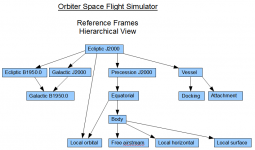
 one can be about trying to clearly and unambiguously define this sort of thing:
