Spaceflight101.com: HTV-4 ends its Flight via Re-Entry - ISS Crew observes its fiery Demise
Following its departure from the International Space Station on Wednesday, HTV-4 spent two and a half days in free flight, performing a number of altitude reduction maneuvers to set up for re-entry.
Early on Saturday, the vehicle performed its final deorbit maneuvers and hit the dense atmosphere shortly thereafter – breaking up upon re-entry with surviving fragments crashing in the Pacific Ocean. HTV’s re-entry was heavily studied – from within the re-entering vehicle and from the Space Station that had a near-perfect view of the event.
HTV-4 performed its first Deorbit Maneuver on Saturday at 0:07 UTC followed by a second retrograde maneuver that came at 1:37 UTC and lowered HTV-4’s orbital altitude in preparation for the final targeted deorbit burn.
This burn began at 6:11 UTC and slowed HTV down just enough to enable it to intercept Earth’s atmosphere at a pre-planned location above the Pacific.
Picture
Photo; NASA/JAXA
Atmospheric Entry started at 6:37 UTC as HTV-4 started to feel the first traces of the atmosphere heating up its shell.
As the vehicle hit the dense atmosphere, heat started to build up on the vehicle and aerodynamic force started acting on the spacecraft leading to its break-up and disintegration. Most vehicle components burned up in the atmosphere before crashing into the Pacific between 6:49 and 7:05 UTC on Saturday morning. Splashdown was targeted to occur far away from populated land masses.
HTV-4’s re-entry was heavily studied both, from inside the vehicle and from the International Space Station that had a good view of re-entry.
Picture
Photo: JAXA
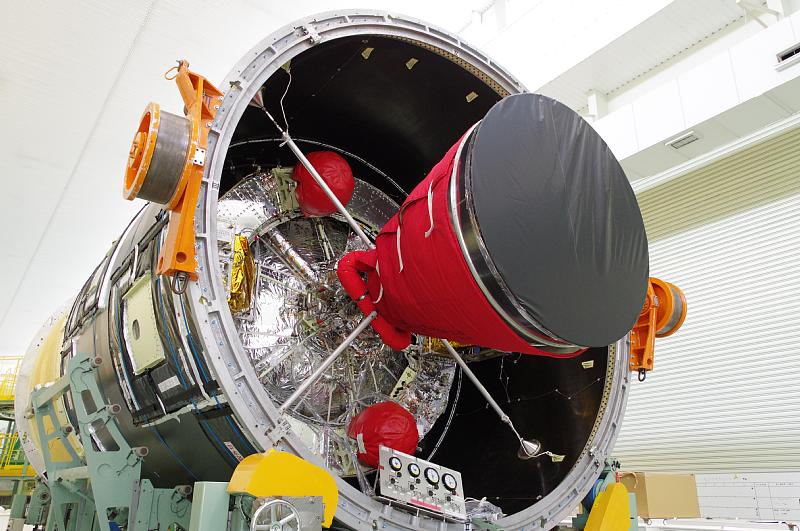
A single re-entry data recorder was installed inside the vehicle to record temperature, pressure and acceleration during entry and take photos of the vehicle’s break-up. The I-Ball re-entry recorder is spherical in shape, has a diameter of 40 centimeters and includes two cameras that acquired footage of HTV’s fiery return to Earth to give insight in the destructive re-entry environment. Also, the device includes sensors for measuring pressure, temperature and accelerations. Additional sensors are installed inside the cabin of HTV-4 taking data at a frequency of 10Hz.
In addition, i-Ball houses a GPS Transponder to track the device during & after re-entry throughout the final stages of its flight. Its final descent is decelerated by a parachute that is deployed before splashdown in the ocean. The Data Recorder was developed by IHI Aerospace Co. Ltd. And has a total mass of 15.5 Kilograms.
iBall made its first flight on HTV-3 and successfully returned data and imagery. For HTV-4, iBall featured the same basic design with improved sensors and data handling.
The improvements included the implementation of three peripheral thermocouple plates mounted inside the spacecraft – one on the shell of each bulkhead and one on a Resupply Rack.
I-Ball’s objective is to provide data to more thoroughly understand the processes and characteristics regarding spacecraft re-entry.
To take advantage of favorable visibility angles from the Space Station, HTV’s re-entry was timed so that it occurred within the field of view of ISS. Aboard the station, cameras were set up inside the Cupola to take video & still imagery of the re-entering spacecraft. The cameras were pre-staged looking to the appropriate direction with timers set up for re-entry time.
Inside the US Lab, the ISERV Payload was controlled by Mission Control to acquire imagery of the event. The SERVIR Environmental Research and Visualization System (ISERV) was designed to assess an automated data acquisition process. Originally designed to acquire high-resolution Earth imagery, the payload was capable of recording HTV’s re-entry in very high-resolution. It operates from the Window Observation Facility in the Destiny Laboratory.
The Space Station crew members also did not want to miss the event. They were stationed inside the Russian modules, cameras at hand, to observe HTV-4’s re-entry through the Service Module Windows.
Break-up as seen from the ISS.





r)2eOwQ~~60_12.JPG)