
You are using an out of date browser. It may not display this or other websites correctly.
You should upgrade or use an alternative browser.
You should upgrade or use an alternative browser.
News JAXA-Hayabusa mission news.
- Thread starter Notebook
- Start date


- Joined
- Aug 5, 2008
- Messages
- 4,261
- Reaction score
- 1
- Points
- 0
That's a courageous little probe ! I hope it will succeed, the whole trip was a real odyssey ! May theprotect her !!
N_Molson, we weren't going to tell you this, but since you are now "in the trusted circle", you might as well know:
Hayabusa is the
!:rofl:
ar81
Active member
- Joined
- Jun 19, 2008
- Messages
- 2,357
- Reaction score
- 8
- Points
- 38
- Location
- Costa Rica
- Website
- www.orbithangar.com
Hayabusa is not the
Look at this:

and look at this...

Is Hayabusa a Tie Fighter? Or do we have evidence that a Tie Fighter damaged the japanese probe?
Look at this:
and look at this...
Is Hayabusa a Tie Fighter? Or do we have evidence that a Tie Fighter damaged the japanese probe?


- Joined
- Feb 18, 2008
- Messages
- 365
- Reaction score
- 259
- Points
- 63
- Location
- Melbourne
- Website
- eightymileshigh.wordpress.com
I wonder which aircraft? SOFIA?
Sky and Telescope says it's going to be the DC-8:
http://www.skyandtelescope.com/community/skyblog/newsblog/91854724.html
See also:
http://airborne.seti.org/hayabusa/
http://www.nasa.gov/centers/dryden/aircraft/DC-8/index.html
Pretty exciting!
TCM-1 was completed at 2010-05-04 02:57 UTC. Perigee remains at about 200 km. The purpose of the TCM was to slow Hayabusa down prior to TCM-2. TCM-2 is to correct the trajectory perpendicular to the velocity vector however it also includes a significant prograde component due to spacecraft attitude constraints and TCM-1 was performed retrograde to reduce the spacecraft velocity by roughly the same amount so that the re-entry is still phased correctly with Woomera. TCM-2 should occur at the end of May.

http://www.isas.jaxa.jp/e/enterp/missions/hayabusa/trj.shtml#new
I'm trying to find some current state vectors from Hayabusa but I'm not having much luck. The ones on JPL Horizons pre-date the trajectory correction burns. Does anyone have any other sources?
BTW, get your re-entry t-shirts here http://www.cafepress.com.au/planetaryshop.441600448
http://www.isas.jaxa.jp/e/enterp/missions/hayabusa/trj.shtml#new
I'm trying to find some current state vectors from Hayabusa but I'm not having much luck. The ones on JPL Horizons pre-date the trajectory correction burns. Does anyone have any other sources?
BTW, get your re-entry t-shirts here
http://www.cafepress.com.au/planetaryshop.441600448...or even your "Hayabusa Return Teddybear"BTW, get your re-entry t-shirts here

http://www.cafepress.com.au/planetaryshop.441600432
Hayabusa was the first spacecraft I ever made for Orbiter (way back), so I'm rather fond of this mission, especially considering the enormous problems the spacecraft and the JAXA team have overcome during the last 7 years.I'm trying to find some current state vectors from Hayabusa but I'm not having much luck. The ones on JPL Horizons pre-date the trajectory correction burns. Does anyone have any other sources?
I remember I emailed JAXA to see if there was any information available about the trajectory, and received an email back from Prof.Kawaguchi (no less!) with a link and password to access info on the Kawalab database!
Sadly, I've lost the link and password in the intervening years. But you could try contacting them. http://www.hayabusa.isas.jaxa.jp/kawalab/index_e.html
Let us know if you find any state-vectors, I haven't had any luck so far.
I imagine succesful return of the capsule is still very uncertain - will the seperation and parachute mechanisms work after an extra three years in space? Are there still problems with unpredictable outgassing of the leaked hydrazine? etc. etc.
But, oh man, if they can get it back - and there are a few grains from Itokawa on board - I'll be celebrating with some Sake for sure!!
Go Hayabusa and JAXA people!
"It is quick, the �"
Cheers,
Brian

- Joined
- Oct 11, 2009
- Messages
- 3,488
- Reaction score
- 407
- Points
- 123
- Location
- Utrecht
- Website
- www.spaceflightnewsapi.net
If it survives the reentry, then it is one of the first successful ''sample return'' missions right?
If it survives the reentry, then it is one of the first successful ''sample return'' missions right?
Apart from the various Lunar sample-return missions, I can think of Genesis (solar wind samples from around L1 point) which crashed on return and contaminated the samples, and Stardust (comet tail samples from Wild2) which was successful.
But Hayabusa would be the first to touch down(briefly) on a body other than the Moon, and return samples. And also the first sample return mission to use ion propulsion, I think.

- Joined
- Nov 20, 2007
- Messages
- 11,965
- Reaction score
- 765
- Points
- 188
...or even your "Hayabusa Return Teddybear"
http://www.cafepress.com.au/planetaryshop.441600432
Hayabusa was the first spacecraft I ever made for Orbiter (way back), so I'm rather fond of this mission, especially considering the enormous problems the spacecraft and the JAXA team have overcome during the last 7 years.
I remember I emailed JAXA to see if there was any information available about the trajectory, and received an email back from Prof.Kawaguchi (no less!) with a link and password to access info on the Kawalab database!
Sadly, I've lost the link and password in the intervening years. But you could try contacting them. http://www.hayabusa.isas.jaxa.jp/kawalab/index_e.html
Let us know if you find any state-vectors, I haven't had any luck so far.
I imagine succesful return of the capsule is still very uncertain - will the seperation and parachute mechanisms work after an extra three years in space? Are there still problems with unpredictable outgassing of the leaked hydrazine? etc. etc.
But, oh man, if they can get it back - and there are a few grains from Itokawa on board - I'll be celebrating with some Sake for sure!!
Go Hayabusa and JAXA people!
"It is quick, the �"
Cheers,
Brian
What can I say! Hopefully all will go well, and I'm biased that it will head toward Woomara...and its history.
N.
- Joined
- Aug 5, 2008
- Messages
- 4,261
- Reaction score
- 1
- Points
- 0
Hayabusa Captured its Home Earth!
http://www.isas.jaxa.jp/e/topics/2010/0517.shtml
Hayabusa completed TCM-2:
http://www.isas.jaxa.jp/e/enterp/missions/hayabusa/trj.shtml#new

Also, there is a new "Final Approach" website: http://hayabusa.jaxa.jp/e/index.html
Finally, in relation to getting state vector data, I emailed Jaxa but have had no response as yet. I did find this page but all the SPICE kernels linked to are quite old.
http://www.isas.jaxa.jp/e/topics/2010/0517.shtml
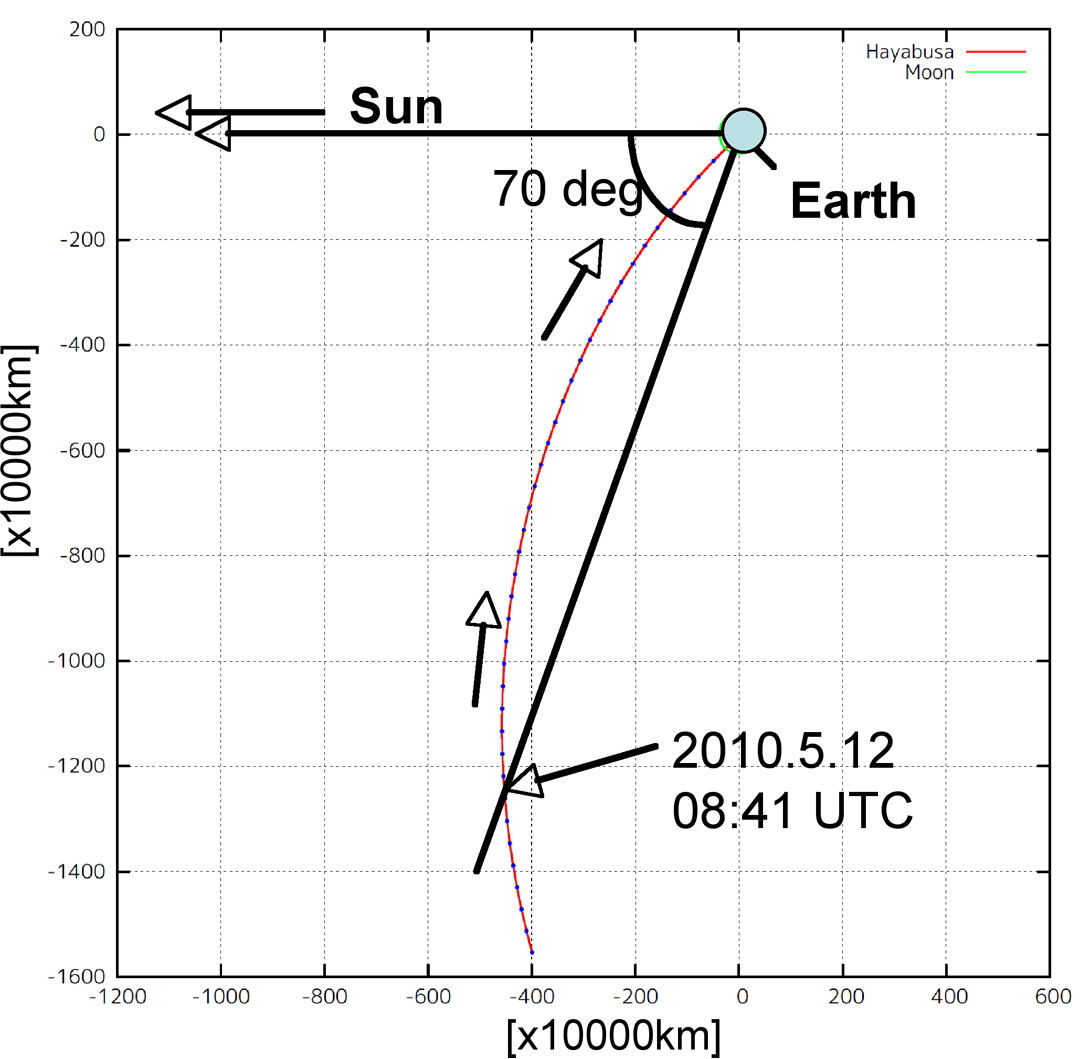
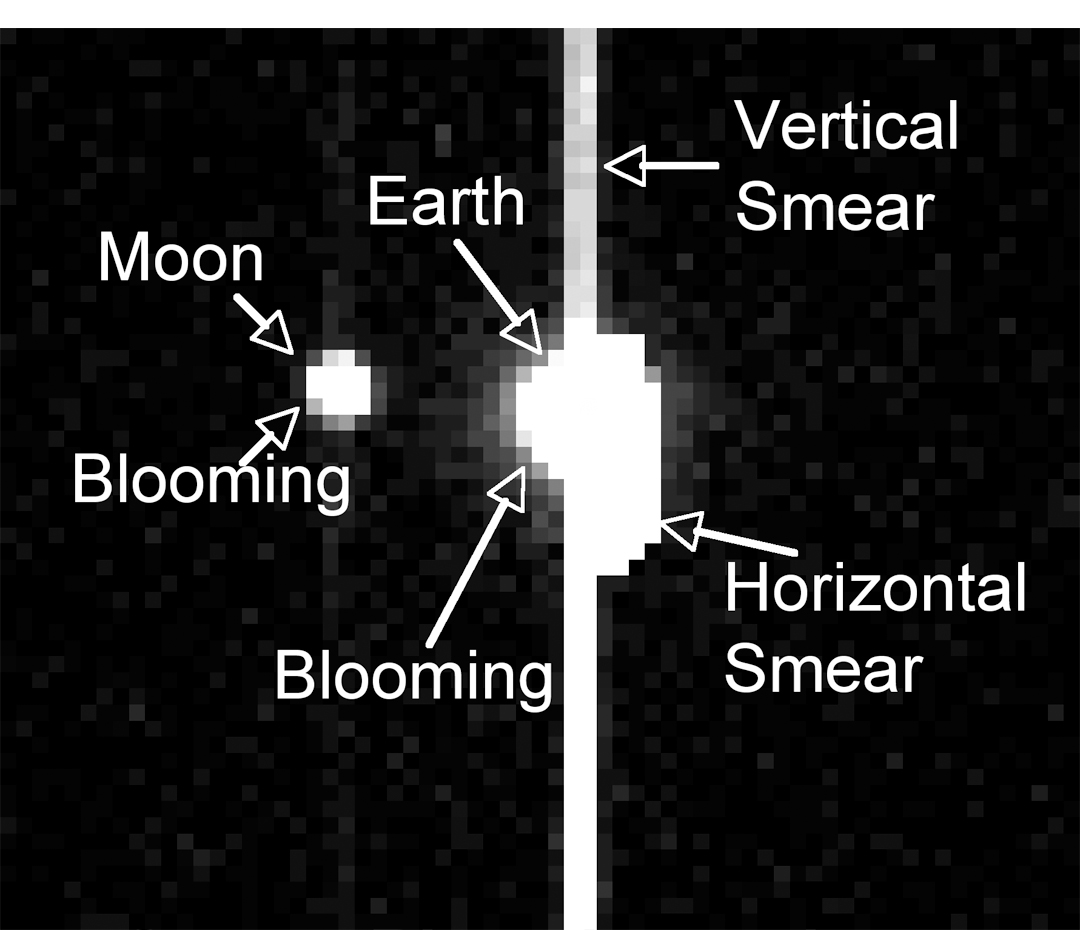
Hayabusa successfully photographed its home Earth and Moon on May 12th last week, by using the CCD sensor on the Star Tracker instrument aboard.
The Earth was seen so brightly that the image contained strong smear in it, but the image clearly separates the Moon from the Earth. (Magnitude of the Earth is -8.3, and that of Moon is -4.6.)
The Earth was seen between Sagittarius and Capricornus.
Hayabusa will continue to voyage back to Earth at the speed of 18 thousand kilometer per hour.
Hayabusa completed TCM-2:
http://www.isas.jaxa.jp/e/enterp/missions/hayabusa/trj.shtml#new
Hayabusa started its TCM-2 operation from May 24th and completed it on May 27th. TCM-2 is the largest orbit correction among a series of TCMs. The operation was performed almost as planned and the ion engine aboard worked in order.
Currently the rigorous orbit estimation is under way, but the project thinks the TCM-2 successfully guided the spacecraft well within the intended zone for the TCM-3.
Also, there is a new "Final Approach" website: http://hayabusa.jaxa.jp/e/index.html
Finally, in relation to getting state vector data, I emailed Jaxa but have had no response as yet. I did find this page but all the SPICE kernels linked to are quite old.

- Joined
- Feb 13, 2008
- Messages
- 5,398
- Reaction score
- 8
- Points
- 0
- Location
- Khimki
- Website
- tigerofsiberia.livejournal.com
http://www.isas.jaxa.jp/home/hayabusa-live/?itemid=533&catid=34
2010/06/03 12:25 JST: TCM-3 operation started, shift the target from Earth's outer rim to WPA
JAXA would like to announce that TCM-3 operation has commenced (12:00 June 3rd, 2010 (JST)). It will take around 50 hours for ion thrusters to accelerate.
Hayabusa system is going well.
*TCM : Trajectory Correction Maneuver
*WPA : Woomera Prohibited Area
2010/06/03 12:25 JST: TCM-3 operation started, shift the target from Earth's outer rim to WPA
JAXA would like to announce that TCM-3 operation has commenced (12:00 June 3rd, 2010 (JST)). It will take around 50 hours for ion thrusters to accelerate.
Hayabusa system is going well.
*TCM : Trajectory Correction Maneuver
*WPA : Woomera Prohibited Area
- Joined
- Nov 20, 2007
- Messages
- 11,965
- Reaction score
- 765
- Points
- 188
Japan Aerospace Exploration Agency
----------------------------------------------------------------------
Asteroid Explore "HAYABUSA" (MUSES-C) Completed TCM-3 operation,
shift the target from Earth's outer rim to WPA
June 5, 2010 (JST)
Japan Aerospace Exploration Agency (JAXA)
The Japan Aerospace Exploration Agency (JAXA) would like to announce
that TCM-3 operation was successfully completed (1:44 p.m. June 5th,
2010 (JST)).
By this operation, Hayabusa was guided from Earth's outer rim toward
WPA in Australia.
Hayabusa system is going well.
* TCM : Trajectory Correction Maneuver
* WPA : Woomera Prohibited Area
http://www.jaxa.jp/press/2010/06/20100605_hayabusa_e.html
Marvellous, Woomera in the sights, wish I could see it!
N.
- Joined
- Feb 13, 2008
- Messages
- 5,398
- Reaction score
- 8
- Points
- 0
- Location
- Khimki
- Website
- tigerofsiberia.livejournal.com
(oops, wrong Japanese probe thread)
- Joined
- Aug 5, 2008
- Messages
- 4,261
- Reaction score
- 1
- Points
- 0
- Joined
- Feb 13, 2008
- Messages
- 5,398
- Reaction score
- 8
- Points
- 0
- Location
- Khimki
- Website
- tigerofsiberia.livejournal.com
http://www.isas.jaxa.jp/e/enterp/missions/hayabusa/trj.shtml

June 8, 2010. Hayabusa project team successfully completed the most critical maneuver TCM-3 from June 3rd to 5th. It made the trajectory flying by the Earth rim to the Woomera Prohibited Area, a designated landing area. Attached is the relevant information regarding the approach geometry. It also presents the reentry objects light trace seen from Glendambo city, South Australia. On June 9th, the final TCM-4 will be conducted to precisely target the landing point near the recovery team already deployed
- Joined
- Oct 11, 2009
- Messages
- 3,488
- Reaction score
- 407
- Points
- 123
- Location
- Utrecht
- Website
- www.spaceflightnewsapi.net
will the landing be live at a webcast or something?
- Joined
- Aug 5, 2008
- Messages
- 4,261
- Reaction score
- 1
- Points
- 0
Similar threads

- Replies
- 16
- Views
- 5K

- Replies
- 0
- Views
- 5K

- Replies
- 21
- Views
- 18K

- Replies
- 19
- Views
- 8K
