Updates JAXA's HTV-2 "Kounotori 2"

Orbinaut Pete

ISSU Project Manager
News Reporter
Joined
Aug 5, 2008
Messages
4,261
Reaction score
1
Points
0
This thread is for updates on JAXA's HTV-2.

HTV-2 is currently scheduled to launch on January 20, 2011, and be captured by the SSRMS & berthed to the ISS on January 27. It will be unberthed from the ISS & released by the SSRMS on February 24.

These are the HTV-2 Payloads:
PLC:
• Kobairo rack (contains Gradient Heating Furnace (GHF)) – will be installed in JPM1F3 (JPM Forward 3 location).
MPSR rack – will be installed in JPM1A4 (JPM Aft 4 location).

ULC:
• FHRC – will be installed on ELC-4 inboard-facing FRAM by SPDM "Dextre".
• CTC-4 (filled with RPCMs) – will be installed on ELC-4 inboard-facing FRAM by SPDM "Dextre".
Following the cancellation of recent SPDM tasks, this will likely be the SPDM's first operational use.


HTV-2's preflight processing recently kicked off when HTV-2 arrived at the Tanegashima Space Center in late July.
100728_htv2_l.jpg

All HTV-2 elements will be assembled & integrated and final launch preparation will commence at the end of October.

Also, HTV-2's ULC payloads were shipped from KSC in Florida to Tanegashima Space Center last week.
Below are some photos & videos of the event:
2010-4397-m.jpg

Hi-res version.

2010-4398-m.jpg

Hi-res version.

2010-4399-m.jpg

Hi-res version.

2010-4400-m.jpg

Hi-res version.

2010-4401-m.jpg

Hi-res version.

2010-4402-m.jpg

Hi-res version.


All in all, it should be a very exciting mission!


Acronyms used above:
PLC = Pressurised Logistics Carrier.
ULC = Unpressurised Logistics Carrier.
FHRC = Flex Hose Rotary Coupler.
CTC = Cargo Transportation Container.
RPCM = Remote Power Control Module.
FRAM = Flight Releasable Attachment Mechanism.
SPDM = Special Purpose Dextrous Manipulator.
 
Last edited:
SpaceRef Canada: "Meet Canada's Special Purpose Dexterous Manipulator or Dextre for Short".

Once Dextre is able to pull its weight on the station, the CSA is looking ahead to the first major maneuver involving Canadarm2, the mobile base the arm rests on, and Dextre.
Slated for January 2011, the Japanese HTV-2 cargo spacecraft will make a supply run to ISS. Once it arrives, a robotic ballet dance will ensure between the Canadian instruments.

Canadarm2 will first snag HTV-2 and take out a hardware rack - called the Exposed Pallet - to hand over to a Japanese robotic arm aboard ISS on the Kibo module. Next, the arm will be moved over to its mobile base to move Dextre to the pallet. Dextre will take out two payloads from the rack, then hitch a ride on Canadarm2 to the opposite side of the station to install them.

When the installation is complete, Canadarm2 will drop Dextre off in the middle of the station and move back towards the Kibo module, where it will pick up the empty rack and stow it on HTV-2.

Around 40 days after HTV-2 arrives at the station, Canadarm2 will release it. Both the Japanese spacecraft and the rack will take a controlled plunge into Earth's atmosphere, burning up upon re-entry.
 
(Originally posted by orb in the "ISS UPDATES" thread.)


We have confirmation that Dextre's first operational use will be during HTV-2 EP ORU transfers!

Spaceflight Now: "Dextre's debut reset for January cargo mission".

---------- Post added 16th Sep 2010 at 01:26 AM ---------- Previous post was 15th Sep 2010 at 09:38 PM ----------

I just came across this NASA article. It's a bit old, but I'll post it anyway since it contains useful info that's relevant to current ops.


NASA Payloads Take First Trip to Station Aboard Japanese Rocket.

For the first time, two unpressurized orbital replacement units (ORUs) bound for the International Space Station will be delivered by a launch vehicle other than the space shuttle. Pressurized ORUs have been sent to the station before on other spacecraft.

Another first for the unpressurized ORUs was traveling more than 7,500 miles by land, air and sea to arrive at their final processing and launch destination in Tanegashima, Japan, which is an island about 35 miles off the country's coast.

The ORUs are the flex hose rotary coupler (FHRC) and the cargo transportation container (CTC), which basically is a box containing five smaller ORUs. They will be installed in a Japanese H-II Transfer Vehicle (HTV-2) and launched to the International Space Station aboard a Japanese H-IIB rocket in January 2011.

"We've never done this before," said Dr. Jose Nunez, who is the NASA mission manager at Kennedy Space Center. "This is a whole new set of firsts that we've embarked on for NASA and Kennedy Space Center." The ORUs and associated equipment were processed at Kennedy's Space Station Processing Facility and crated for shipping. Then, the two massive containers, combined weighing nearly 9,000 pounds, and several smaller crates were transferred by forklift from the facility's shipping and receiving bay and loaded into a truck to start their journey.

"The upcoming HTV-2 launch is unique and exciting on multiple levels," said Josephine Burnett, director of Kennedy's International Space Station and Spacecraft Processing Directorate. "Our expertise in flight hardware ground processing is absolutely world class and I am extremely proud of the hard work and dedication of the Kennedy and Japan Aerospace Exploration Agency (JAXA) HTV-2 teams."

The ORUs overseas trip began with stops in Orlando, Fla., Atlanta and Chicago, before their flight to Narita and Kagoshima Port in Japan. They were then loaded on a ferry for transport to the space launch complex on the island.

Nunez explained that the ORUs are critical for the space station. The rotation capability for each station radiator assembly is provided through a thermal radiator rotary joint (TRRJ). The TRRJ then provides power, data and liquid ammonia transfer to the rotating radiator beam while providing structural support for the radiator panels. "The FHRC is the one that provides the transfer of liquid ammonia across the rotary joint. It will be stored up in space in case the one on station should fail," Nunez said.

"With each ORU having its own specific set of requirements and issues it was a lengthy event to get to this moment," Nunez said. "This is only the first phase, the second phase starts as soon as Kennedy's mission processing team arrives at the Tanegashima Space Center."

Nunez, along with Boeing Task Lead Mike Little, NASA Operations Engineer Curt Horanic, NASA Quality Engineer Steve Barry, and several Checkout Assembly and Payload Processing workers, will travel to Japan in early September to work with JAXA on final processing of the ORUs and installation into the transfer vehicle.

After launch to the orbiting laboratory, HTV-2 will fly close enough to the station for Expedition crew members to use the Canadarm2 to capture it and berth it to the Nadir port on the Harmony module. The ORUs will be removed and attached to the Japanese Exposed Facility and then to the Express Logistics Carrier-4 on the station.
 
Last edited:
The CTC & FHRC have been attached to the EP in Japan!

attachment.php
 
Last edited:
OSU CubeLab Team's Microgravity Experiment Will Reach International Space Station.

A multidisciplinary team led by aerospace engineering students and faculty is preparing an experiment to be launched aboard a Japanese spacecraft to the International Space Station in January.

The Ohio State experiment is focused on isolating the effect of gravity on the growth of ceria nanoparticles. Ceria (CeO2) is used as a support or catalyst in many technologically important reactions, such as high-temperature coatings for jet engines, solid oxide fuel cells for next-generation automobiles, and emissions abatement. The experiment will contribute information on whether reduced gravity leads to a higher level of performance for the catalyst.

The student team is led by aerospace engineering major Kevin Disotell and advised by Hayrani Oz, professor of aerospace engineering. In addition, professor Umit Ozkan and Burcu Mirkelamoglu, a research associate, both of the Lowrie Department of Chemical and Biomolecular Engineering, are technical advisors for the team.

“This project has the value of scientific merit while serving as an instructional opportunity for undergraduate students on the team. It’s very much a real-world engineering challenge that we’ll be attacking on a fundamental level,” says Disotell.

Eleven aerospace engineering undergraduates will contribute to the design, testing, validation and extensive documentation required to launch the payload.

The Ohio State experiment will be sent into space aboard an unmanned H-II Transfer Vehicle managed by the Japanese Aerospace Exploration Agency in a CubeLab, which is produced by a company called NanoRacks and has a side length of 10 centimeters as well as its own thermal, power, and data management systems. Once it arrives at the International Space Station, it will be placed in the U.S. National Laboratory there called Destiny, where NanoRacks operates a hardware platform known as an EXPRESS (Expedite the Processing of Experiments to Space Station) Rack. Each rack is capable of stowing 16 of the small CubeLab enclosures. Through financial assistance and engineering consultation from Belcan Corp., an engineering support firm based in Cincinnati, Ohio State’s project will be one of the first scientific experiments from academia that NanoRacks will handle.

The Space Station is a prime site for conducting the Ohio State experiment, says Disotell, because the effective acceleration at the radius of the ISS orbit is about one-millionth of that at sea-level on Earth. The proposed experiment is aimed at synthesizing cerium (IV) oxide (ceria) nanoparticles in the presence of microgravity and returning the samples to Earth in order to study the effect of gravity on the crystal growth and defect structure.
 
Cargo has been loaded into the PLC, and the PLC has been mated to the ULC!

attachment.php


attachment.php
 
Last edited:
Pete does NSF articles? Did not know that! Lucky you pete.
 
Students in space: Plant growth CubeLab nears launch.

What can happen when creative, talented and motivated high school students are turned loose to experiment in space, to do real science aboard the International Space Station?

Undergoing power and fit checks and a stint in the vacuum chamber, an elegant and sophisticated CubeLab payload from Valley Christian High School in San Jose went through a battery of mission readiness tests this week at the Kentucky Space labs at the University of Kentucky. Containing its own growing environment and monitoring system designed by students at Valley Christian, the two-unit CubeLab will record and relay data on plant growth in an effort to answer questions related to the effect of micro-gravity on the cultivation of plants in long duration space flight.

The payload is currently scheduled to go to the ISS in February aboard the Japanese HTV-2.

Kentucky Space enjoys regular access and egress from the station thanks to a strategic partnership with NanoRacks, LLC, and is currently working with customers needing to do repeatable, low-cost microgravity research. Each NanoRacks Platform - there are two on station now - hosts up to sixteen mini plug-and-play CubeLab modules, or combinations of labs such as the two-unit from Valley Christian shown here. Your payload inquiries are welcome.
 
All HTV-2 components have been integrated together! :thumbup:

attachment.php


attachment.php
 
Last edited:
The fairing for the H-IIB rocket has arrived at TNSC.

The rocket itself will be shipped to TNSC on Nov. 8th.

attachment.php
 
Last edited:
JAXA Press Release:

November 10, 2010 (JST)
Japan Aerospace Exploration Agency (JAXA)
Mitsubishi Heavy Industries, Ltd.​

The Japan Aerospace Exploration Agency (JAXA) and Mitsubishi Heavy Industries, Ltd. would like to announce that the launch of the H-IIB Launch Vehicle No. 2 (H-IIB F2) with the H-II Transfer Vehicle 2 (HTV2, a cargo transporter to the International Space Station) onboard was reported to the Space Activities Commission (SAC) as follows.
[table="width=650"]Scheduled date of launch|January 20 (Thursday), 2010 (Japan Standard Time, JST)

Launch time|Around 3:29 p.m. (JST)*1

Launch windows|January 21 (Fri.) through February 28 (Mon.), 2011 (JST)*2

Launch Site|Yoshinobu Launch Complex at the Tanegashima Space Center[/table]​
(*1) Time will be determined by the updated orbit of the International Space Station (ISS.)
(*2) The launch day and time during the launch windows shall be decided by the international coordination for ISS operations.
 
JAXA Press Release:

November 11, 2010 (JST)
Japan Aerospace Exploration Agency (JAXA)​

The Japan Aerospace Exploration Agency (JAXA) conducted a nickname campaign for the H-II Transfer Vehicle (HTV), a cargo transporter to the International Space Station (ISS), between August 27 (Fri.) and September 30 (Thu.), 2010, to familiarize people with the HTV.

Among many suggestions, the following nickname was selected.
  1. Selection result: The chosen nickname is "KOUNOTORI" meaning "white stork"
  2. Reason for selection
    A white stork carries an image of conveying an important thing (a baby, happiness, and other joyful things); therefore, it precisely expresses the HTV's mission to transport essential materials to the ISS.
  3. Received application:
    Total: 17,236 (Among them, acceptable applications totaled 17,026, and those who proposed "KOUNOTORI" was 217.)
    (Breakdown)
    Through the Website|
    13,528​

    FAX, Postcard|
    1,077​

    Application form|
    2,631​

Note) JAXA will send a certificate and a commemorative gift to all godparents of "KOUNOTORI." The winner of the trip to the Tanegashima Space Center to see off the KOUNOTORI launch has been announced on the website of the International Space Station (ISS) / Japanese Experiment Module "Kibo" (http://iss.jaxa.jp/en/htv/).
________________________________________

JAXA:
  • KOUNOTORI2/H-IIB Launch Vehicle No.2 Special Site:
    November 11, 2010 Updated

    HTV nickname selected & special site open!

    "KOUNOTORI" (meaning "a white stork" in English) was chosen as the nickname of the H-II Transfer Vehicle (HTV, a cargo transfer vehicle to the International Space Station.)
    During a month-long nickname campaign, we received 17,236 suggestions.
    Among them, "KOUNOTORI" was selected because a white stork carries an image of conveying an important thing (a baby, happiness, and other joyful things); therefore, it precisely expresses the mission to transport essential materials to the ISS.
    The KOUNOTORI2 is scheduled to be launched by the H-IIB Launch Vehicle No. 2 (H-IIB F2) at around 3:29 p.m. (Japan Standard Time) on January 20 (Thu.), 2011.
    Taking this opportunity of selecting the nickname, we would also like to open the "KOUNOTORI2/H-IIB F2 Special Site." We will provide you with updated information about the project including a column by project personnel and launch related matters. Please enjoy the site!
    * Launch time will be determined by the updated orbit of the ISS.
     
  • Overview of the "KOUNOTORI" (HTV):
    htv2_e.jpg
     
  • Loading cargo:
    htv2_payload_e.jpg


    HTV-2 Mission Timeline Overview:
    pict_schedule_e.gif


    Major changes from the HTV Demonstration Flight:

    Major changes:
    1. Expansion of the cargo loading space in the Pressurized Carrier
      Space in front of the cargo racks, and the opening space between racks.
    2. Replacing some parts with domestic appliances
      LED light equipment, communication devices
    3. Removal of demonstration operations
      Collision avoidance maneuver, R-bar retreat/hold (*) etc.
      * Moving backward or temporary stoppage underneath the ISS

    Transportation capability:
    [table="head"]Cargo supply capability to the ISS|HTV|HTV2

    Mass|4.5 ton|Max. 6.0 ton

    Pressurized cargo:|3.6 ton|Max. 5.2 ton

    Unpressurized cargo:|0.9 ton|Max. 1.5 ton

    Total Mass|16.0 ton|Max. 16.5 ton[/table]​
     
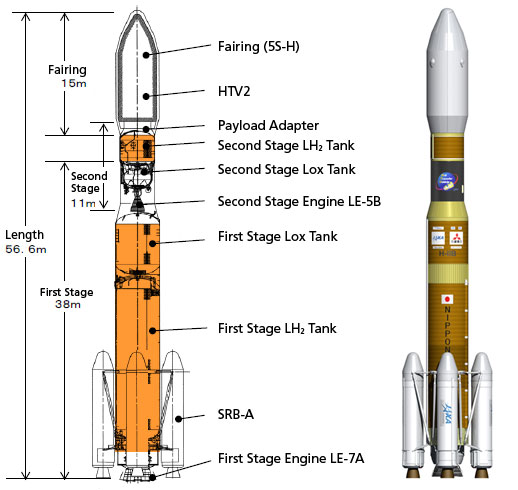
  • Overview of the H-IIB Launch Vehicle:
    pict_h2b_1_e.jpg


    Improvement of 5S-H fairing:
    pict_h2b_2_e.gif
 
Last edited:
JAXA / KOUNOTORI2/H-IIB Launch Veicle No.2 Special Site:
December 1, 2010 Updated

KOUNOTORI2 control and operation simulation revealed to the press
On November 30, JAXA showed part of the control and operation simulation of the KOUNOTORI2 to the media at the Tsukuba Space Center. The KOUNOTORI2 (HTV2) is a cargo transfer vehicle to the International Space Station (ISS.)
The purpose of the simulation was to train and improve operators’ skills. It takes about 20 hours with NASA to simulate events, from the KOUNOTORI2’s arrival at around 12-km beneath the ISS, to its gradual approach to the ISS, to the capture of the KOUNOTORI2 by the ISS robotic arm, and then the docking of the KOUNOTORI2.
 
Just for info, the HTV-2 mission has been extended to 60 days.

Following HTV-2's berthing to Node 2 Nadir, the EP will be extracted and attached to the JEF.

HTV-2 will then be relocated to Node 2 Zenith, due to clearances with STS-133 payloads in the Shuttle PLB.

Once ELC-4 is attached to the ISS and STS-133 is gone, the FHRC & CTC-4 will be transferred from the EP on the JEF to ELC-4.

HTV-2 will then be relocated back to Node 2 Nadir, and the EP re-inserted into the ULC.
 
Last edited:
JAXA:
December 6, 2010 Updated

Cryogenic test date set for H-IIB F2

At the Tanegashima Space Center, JAXA and Mitsubishi Heavy Industries are preparing for the launch of the H-II Transfer Vehicle “KOUNOTORI2” (HTV2, a cargo transporter to the International Space Station) by the H-IIB Launch Vehicle No. 2 (H-IIB F2) on January 20, 2011.
As part of the preparations, a cryogenic test will be held on December 16 (Thursday) 2010. The test is to confirm the functions of the launch vehicle and ground facilities by actually loading propellants onto the launch vehicle in the same manner as on the launch day.
 
Back
Top