Description:
I've posted a little about this project before, but since I am starting to devote more effort to it, I thought it would be worth a thread here to provide some more detailed info. about it.
The Kliper is a Russian conceptual spacecraft which, unfortunately, looks like it will never make if off the drawing board. The most recent info. about it seems to be from around 2006ish when the ESA decided not to fund some development studies.
This is where the real benefit of Orbiter comes in: It doesn't cost gazillions of dollars to develop a spacecraft :thumbup:
The Kliper is "Space Shuttle Junior". It is not designed to carry any significant payload - Just 6 cosmonauts and up to 700kg of equipment. Essentially, a space-ferry for humans.
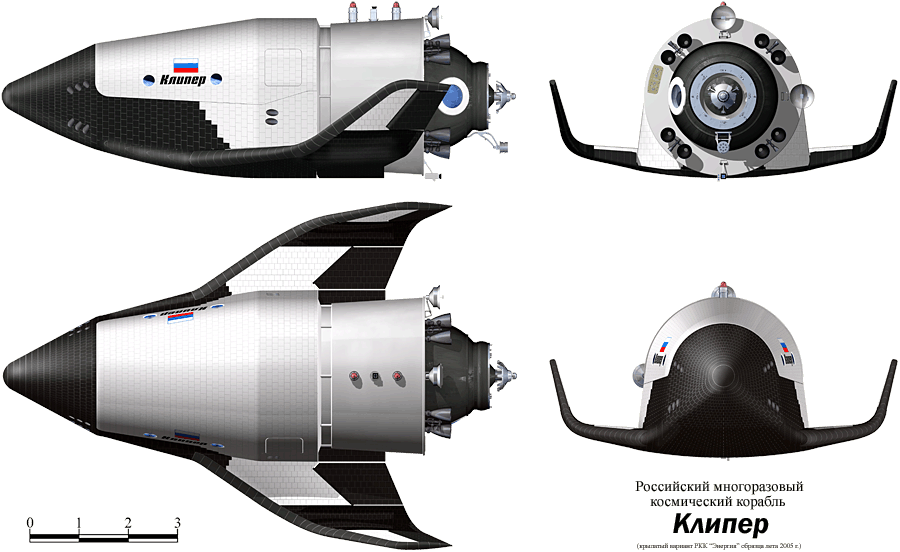
There are many different design proposals around for Kliper, but I have decided to settle on the late 2005 winged version. I chose this model since it had some nice plan-view image which made it easier to model. Apparently, some aerodynamic studies were done in early 2006 which required a major redesign of the airframe due to excessive heating on the leading edges of the wings during re-entry, but I chose to overlook that.
The launch vehicle I have chosen is the (also vapour-craft) Soyuz-3. This is basically a Soyuz-2 on steroids. Once again, I have chosen this vehicle basically because it is easier to find information about it.
For the Launch Escape System, I have gone with the configuration which has the LES mounted on the Launch Vehicle Adaptor. This allows the LES to be used for the final orbital insertion burn, before the LVA is jettisoned, assuming an emergency-free launch. I really like this idea because:
1) It makes good use of otherwise dead weight.
2) It just looks so damned cool.
Status:
At the moment, I have only developed basic 3D models for the spacecraft and launch vehicle. The Kliper spacecraft and adaptor are probably 75% of the way there, with the launch vehicle at about 50%.
Some code has been written, but only enough for basic testing.
Direction:
The big goal for me is a good, realistic aerodynamic model. I am currently checking out various Computational Fluid Dynamics (CFD) packages for this purpose.
One area which interests me is the idea of modelling the drag and lift coefficients in a wide range of configurations using CFD, and then training a Neural Network to recognise the pattern and perform the actual prediction in the code.
Whilst I have a decent amount of Neural Network experience, I am extremely poor in CFD, so if there are some CFD gurus out there who can rescue me, I would very much appreciate it.
I don't want to let down a good spacecraft with a poor flight model.
Screenshots:


I've posted a little about this project before, but since I am starting to devote more effort to it, I thought it would be worth a thread here to provide some more detailed info. about it.
The Kliper is a Russian conceptual spacecraft which, unfortunately, looks like it will never make if off the drawing board. The most recent info. about it seems to be from around 2006ish when the ESA decided not to fund some development studies.
This is where the real benefit of Orbiter comes in: It doesn't cost gazillions of dollars to develop a spacecraft :thumbup:
The Kliper is "Space Shuttle Junior". It is not designed to carry any significant payload - Just 6 cosmonauts and up to 700kg of equipment. Essentially, a space-ferry for humans.
There are many different design proposals around for Kliper, but I have decided to settle on the late 2005 winged version. I chose this model since it had some nice plan-view image which made it easier to model. Apparently, some aerodynamic studies were done in early 2006 which required a major redesign of the airframe due to excessive heating on the leading edges of the wings during re-entry, but I chose to overlook that.
The launch vehicle I have chosen is the (also vapour-craft) Soyuz-3. This is basically a Soyuz-2 on steroids. Once again, I have chosen this vehicle basically because it is easier to find information about it.
For the Launch Escape System, I have gone with the configuration which has the LES mounted on the Launch Vehicle Adaptor. This allows the LES to be used for the final orbital insertion burn, before the LVA is jettisoned, assuming an emergency-free launch. I really like this idea because:
1) It makes good use of otherwise dead weight.
2) It just looks so damned cool.
Status:
At the moment, I have only developed basic 3D models for the spacecraft and launch vehicle. The Kliper spacecraft and adaptor are probably 75% of the way there, with the launch vehicle at about 50%.
Some code has been written, but only enough for basic testing.
Direction:
The big goal for me is a good, realistic aerodynamic model. I am currently checking out various Computational Fluid Dynamics (CFD) packages for this purpose.
One area which interests me is the idea of modelling the drag and lift coefficients in a wide range of configurations using CFD, and then training a Neural Network to recognise the pattern and perform the actual prediction in the code.
Whilst I have a decent amount of Neural Network experience, I am extremely poor in CFD, so if there are some CFD gurus out there who can rescue me, I would very much appreciate it.
I don't want to let down a good spacecraft with a poor flight model.
Screenshots: