My pre-launch report
The passenger of the first Proton flight of the year is pretty big: the SES-4 satellite, the newest member of the satellite fleet of SES S.A. of Luxembourg. Carrying a record-high number of 124 transponders for use across the Atlantic, this 6.2 tonne satellite will provide broadcasting and telecommunication services at the 22 degree West position, enabling usage from the American Pacific coast to the Middle East. And on Boxing Day, this huge box of present for the European company will be lifted into space by a Proton rocket from Baikonur.
The SES-4 mission will be the 1st Proton launch of 2012 and the 373th Proton flight overall.
This will be the first commercial mission of the year for ILS and the 70th ILS Proton mission since the Proton April 1996 first commercial flight.
This will also be the 20th SES satellite launched with Proton. In addition, the SES-4 will be the 21th Space Systems/Loral satellite launched on Proton.
The launch was postponed twice from December 26 and January 28 due to two different technical problems. In both cases the rocket has to be rolled back to the assembly building for repairs.
Launch location:
Baikonur Launch pad no. 200/39 46° 2'23.85"N, 63° 1'54.98"E
Launch dates and times:
[table="head"]{colsp=6}Launch times
Time Zone|
Baikonur / UTC+6
|
Luxembourg / CEST
|
Universal / UTC
|
Washington / EST
|
Los Angeles / PST
Launch time (Primary):
|
01:36:37
|
21:36:37
|
19:36:37
|
14:36:37
|
11:36:37
on:
|
Feb. 15, 2012
|
Feb. 14, 2012
|
Feb. 14, 2012
|
Feb. 14, 2012
|
Feb. 14, 2012
{colsp=6}
[highlight][eventTimer]2012-02-14 19:36:37?before|after;%dd% Days %hh% Hours %mm% Minutes %ss% Seconds %c%[/eventTimer] SES-4 Launch[/highlight]
[/table]
Live Coverage Of The Launch:
PAYLOAD
SES-4 communication satellite:
Mission Summary
SES 4 (formerly known as NSS-14) will be a hybrid satellite featuring 52 × 36 MHz equivalent C-band transponders and 72 × 36 MHz equivalent Ku-band transponders, a substantial increase in the total capacity available at 338 degrees East The state-of-the-art spacecraft has been specifically designed for its orbital location, with C-Band beams serving the eastern hemisphere of Europe/Africa, full America's coverage as well as a global beam to support mobile and maritime customers. Four high power, regional Ku-Band beams will provide service to Europe/Middle East, West Africa, North America and South America with extensive cross-strapping between C- and Ku-band transponders providing enhanced connectivity. Government applications will benefit from sophisticated command encryption. The satellite will be equipped with an ion propulsion system ensuring a minimum life of at least 15 years in orbit.
[table="head"]{colsp=2}Summary
Parameter|
Value
Working Orbit:
|
GEO
Orbital Location:
|
22° West
Coverage:
|
Europe, North America, South America, Middle East
ApA at separation:
|
35786 km
PeA at separation:
|
3714 km
Inc at separation:
|
24.6°
[/table]
[table="head"]Characteristics|
SES-4
Customer:
|
Prime contractor:
|
Platform:
|
- Space Systems / Loral LS-1300
Mass at Separation:
|
Dry Mass:
|
Stabilization:
|
Dimensions (stowed):
|
Batteries:
|
Navigation Payload:
|
- 52 C-band transponders
- 72 Ku-band transponders
Life time:
|
Ku-band coverage:
|
C-band coverage:
|
|
[/table]
Launch Vehicle:
[table="head"]{colsp=2}Characteristics
|[table="head"]{colsp=2}
Proton-M / Briz-M
Prime contractor:
|
GRAU Index:
|
Height:
| 58.2 m with upper stage and payload fairing
Diameter:
| max 7.4 m
Liftoff mass:
| 705 metric tonnes
Payload mass:
| ~22 tonnes at LEO
1st stage:
|
- 6 X RD-275 engines
- Empty 30.6 tonnes
- Propellants 419.41 tonnes (UDMH and NTO)
- Thrust in vacuum 1069.8 tonnes of force
- Thrust at sea level 971.4 tonnes of force
2nd stage:
|
- 1 X RD-0211 engine 3 X RD-0210 engines
- Empty 11.4 tonnes
- Propellants 156.113 tonnes (UDMH and NTO)
- Thrust in vacuum 237.4 tonnes of force
3rd stage:
|
- 1 X RD-0213 engine & 1 X RD-0214 vernier engine
- Empty 3.7 tonnes
- Propellants 46.562 tonnes (UDMH and NTO)
- Thrust in vacuum 59.36 (core) + 3.15 (vernier) tonnes of force
Upper Stage:
|
- GRAU Index: 14S43
- Common Name: Briz-M
- Designer & Manufacturer: Khrunichev Space Centre
- Dimensions: Length 2.654 m, Diameter 4 m
- Empty Mass 2.2 tonnes
- Propellants 6 660 kg UDMH + 13 260 kg N2O4
- Flight time: no less than 24 hours
- Main Engine: 1 X 14D30
- Thrust in vacuum 2.0 tonnes of force
- ISP 328.6 s
- Main engine restarts: up to 8 times
- Precision Manoeuvering Engines: 4 X 11D458
- Thrust in vacuum 400 N each
- ISP 252 s
- RCS Engines: 12 X 17D58E
- Thrust in vacuum 13.3 N each
- ISP 274 s
Payload Fairing:
|
- Diameter 4.35 m
- Length 11.6 m
[/table]
[/table]
The vehicle's
reliability statistics according to
http://www.spacelaunchreport.com/log2011.html#rate:
Code:
================================================================
Vehicle     Successes/Tries Realzd Pred  Consc. Last     Dates
                             Rate  Rate* Succes Fail
================================================================
Proton-M/Briz-M  48    52    .92  .91      6    08/17/11 2001-
SES-4 Ascent Profile
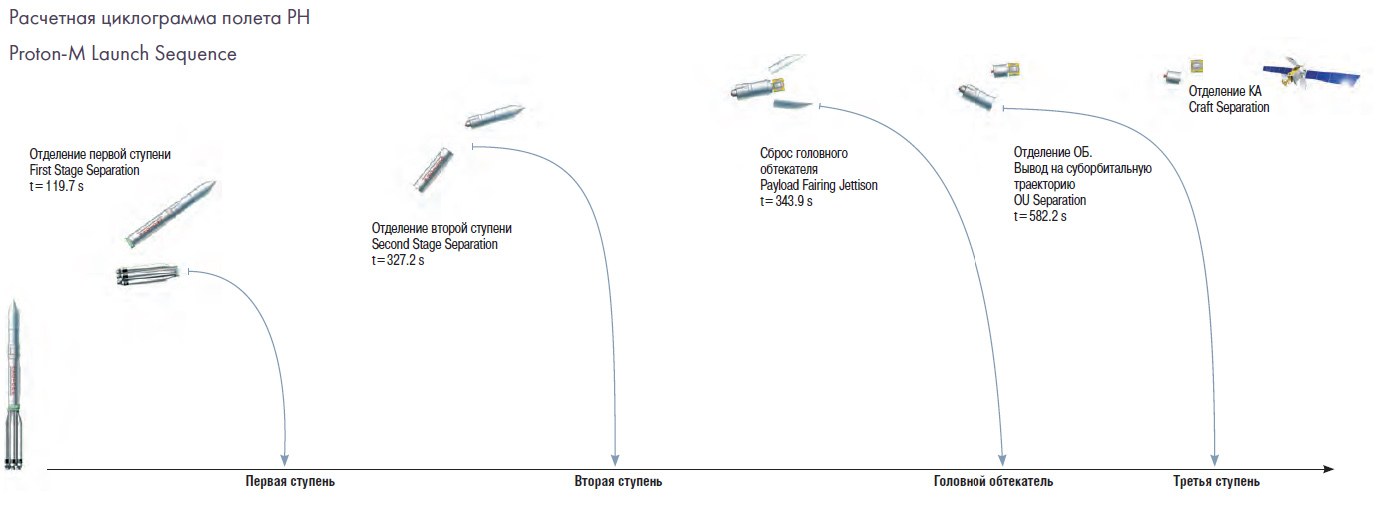
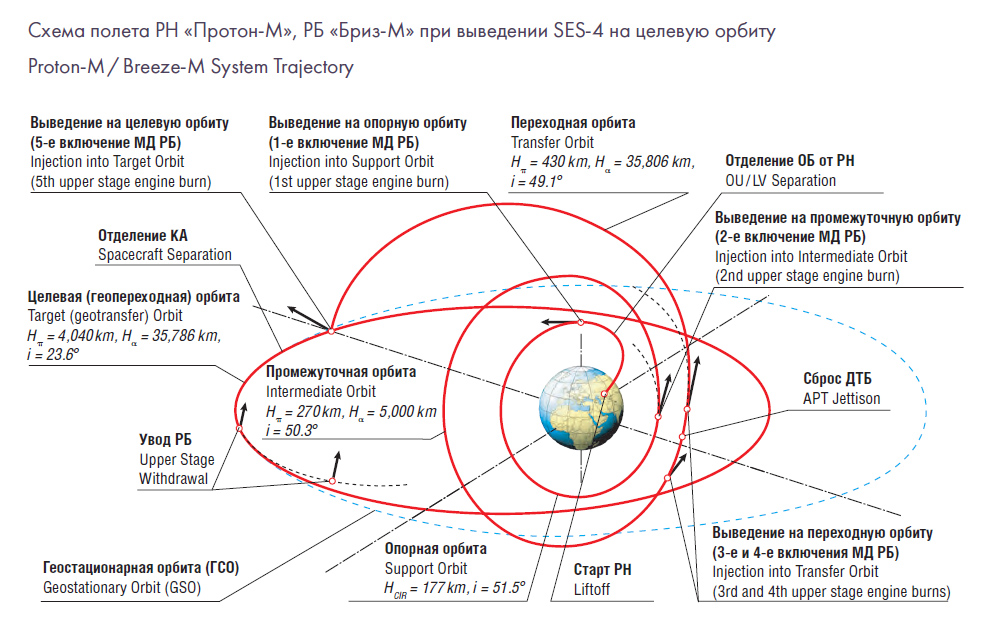
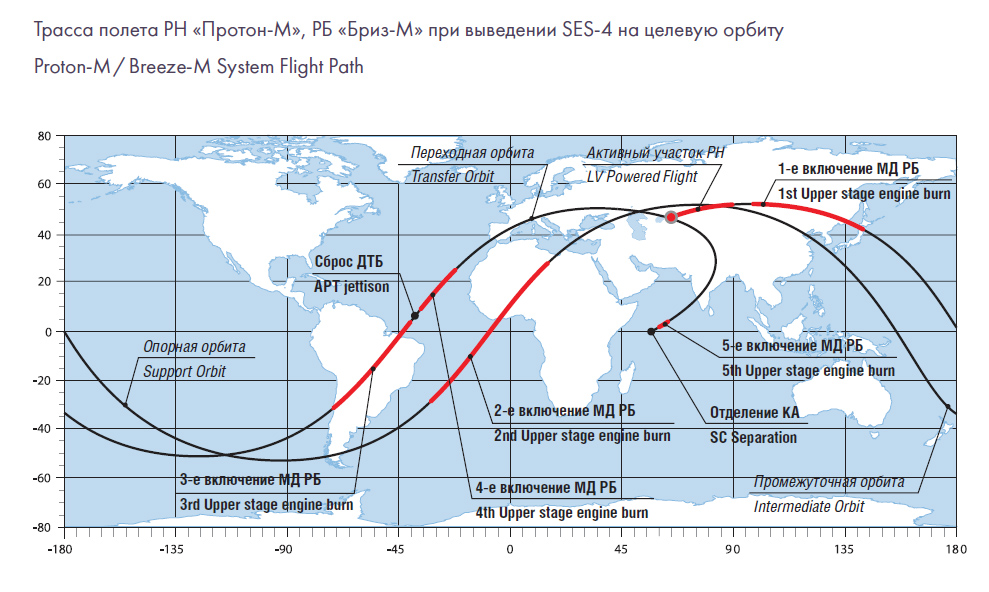
The Proton-M first three stages place the orbital unit (OU), which consists of a Breeze-M upper stage, adapter system and SES-4, into a 51.5° inclination suborbital trajectory.
Proton-M powered flight lasts 582 seconds. The OU powered flight begins at the moment of the third stage separation.
Immediately after the separation of the third stage booster, the Breeze-M stability engines start, damping the angular velocities of the third stage separation and then providing orbital unit orientation and stability during coast flight along a suborbital trajectory to await the first burn. The upper stage follows a five-burn injection profile.
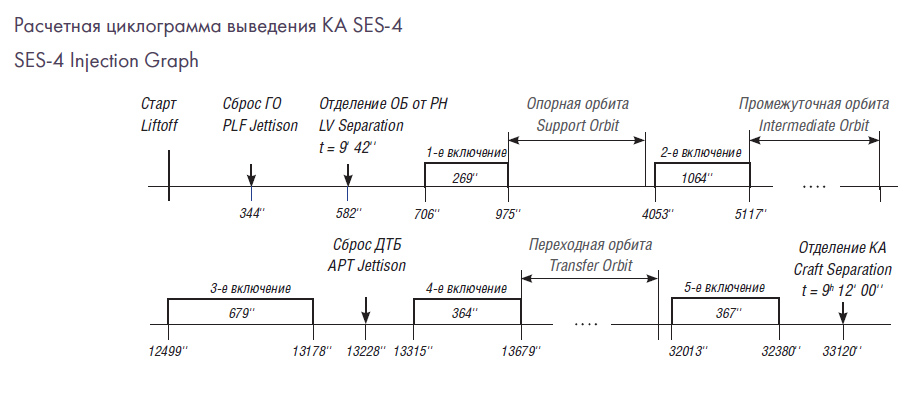
SES-4 Ascent Timeline
[TABLE="head"]Event|Time rel lift-off|Time UTC|Comment
Ignition Start Sequence|-00:00:02.5|19:36:35.5 (Feb 14th)|
Stage 1 Ignition (40% thrust)|-00:00:01.75|19:36:35.25|
Command Stage 1 (100% thrust)|-00:00:00.9|19:36:36.1|
Maximum Dynamic Pressure|00:01:02|19:37:39|
1st/2nd Stage Separation|00:02:00|19:38:37|
2nd/3rd Stage Separation|00:05:27|19:42:04|
Payload Fairing Separation|00:05:47|19:42:24|
3rd Stage/Breeze M Separation|00:09:42|19:46:19|
1st Burn Ignition|00:11:36|19:48:13|
1st Burn Shutdown|00:16:08|19:52:45|1st Burn's Duration 00:04:32
2nd Burn Ignition|01:07:33|20:44:10|
2nd Burn Shutdown|01:25:17|21:01:54|2nd Burn's Duration 00:17:44
3rd Burn Ignition|03:28:17|23:04:54|
3rd Burn Shutdown|03:39:20|23:15:57|3rd Burn's Duration 00:11:03
APT Jettison|03:40:10|23:16:47|
4th Burn Ignition|03:41:37|23:18:14|
4th Burn Shutdown|03:47:55|23:24:32|4th Burn's Duration 00:06:18
5th Burn Ignition|08:53:20|04:29:57(Feb 15th)|
5th Burn Shutdown|08:59:10|04:35:47|5th Burn's Duration 00:05:50
Spacecraft Separation|09:12:00|04:48:37|
[/TABLE]
Weather forecast for Baikonur, Kazakhstan on February 15, 2012 (1 a.m.)
Time|Temps|Wind Chill|Heat Index|Dew Point|Relative Humidity|Precip|Snow|Clouds|Visibility|Wind|Weather
1 AM|-21°C|-21°C|-21°C|-22°C|84%|20%|18%|49%|16KM|NNE 1 m/s|Partly Cloudy
Sunrise/Sunset and associated twilight times for Baikonur on Wednesday, February 15, 2012
Times are local.
Event|Time
Astronomical twilight begins|07 : 10
Nautical twilight begins|07 : 45
Civil twilight begins|08 : 20
Sunrise|08 : 49
Transit (sun is at its highest)|14 : 02
Sunset|19 : 14
Civil twilight ends|19 : 43
Nautical twilight ends|20 : 18
Astronomical twilight ends|20 : 53
References
http://www.federalspace.ru
http://tvroscosmos.ru
http://www.khrunichev.ru
http://www.ilslaunch.com
http://tihiy.fromru.com/Rn/RN_Proton.htm
http://en.ses.com
http://www.ssloral.com/html/satexp/ses4.html
http://www.tsenki.com
http://forum.nasaspaceflight.com
http://www.novosti-kosmonavtiki.ru
http://www.spacelaunchreport.com
http://www.intellicast.com/Local/Forecast.aspx
http://www.good-stuff.co.uk/suntimes/sunmap.php





 lease:


