LOI math?

mjl1966

New member
Joined
Mar 17, 2009
Messages
27
Reaction score
0
Points
0
Hi all, I have what seems to me should be an odd question. I can find tons of information on the math for pretty much everything in a lunar mission profile except the changeover from TLI to LOI. Plenty of sources talk about the maneuver itself and the required delta v, but not the math to actually do it. It's easier to find solutions to martian Hohmann transfers than the burn for LOI.

So, I'm hoping that you guys have it somewhere. If so, please point me to it.

Thanks!
 
To calculate the DV needed for the LOI you need to know your speed at the time when you want to make the burn. I think you can see this in TransX or IMFD as encounter velocity. How to calculate this yourself I'm not sure myself.

Next you need to calculate the orbital speed for the altitude of your closest approach, this can be done with the formula described in the Chapter 'Uniform Circular Motion' at braeunig.us
Example Problem 4.1 has an example for a satellite in Earth Orbit, for the Moon you would have to use the Moon's radius and GM which should be listed in the Basic Constants page

Finally you would subtract this orbital velocity from your encounter velocity and the result will be the required DV.

I hope the more knowledgeable forum members correct me if anything I wrote above is not correct.
 
You need to know the periapsis velocity of the Moon-centered hyperbolic trajectory [math]V_{h_{pe}} [/math] and then subtract the velocity of the parking orbit.

The [math]V_{h_{pe}} [/math] depends on two things; the periselene altitude and the encounter velocity with the Moon. It is given by this equation:
[math]V_{h_{pe}}=\sqrt{V_{enc}^2+V_{esc}^2} [/math] where,
[math]V_{enc}[/math] is the encounter velocity with the Moon
[math]V_{esc}[/math] is the local escape velocity, given by [math]V_{esc}=\sqrt{\frac{2GM_{Moon}}{R_{Moon}+alt}}[/math] where,
[math] M_{Moon} [/math] is the Moon's mass
[math] R_{Moon} [/math] is the Moon's radius
and [math]alt[/math] is the altitude of the periselene.

The [math]V_{enc}[/math] depends on the velocity of the spacecraft at arrival on the Moon's orbital distance from Earth and the flight-path angle φ.

[math]V_{enc} = \sqrt{V_{s}^2+V_{Moon}^2-2V_{s}V_{Moon}cos\phi}[/math] where,
[math]V_{s}[/math] is the velocity of the spacecraft at arrival on the Moon's orbital distance
[math]V_{Moon}[/math] is the Moon's orbital velocity and
φ is the flight-path angle at the intercept point.
For a perfect Hohmann transfer where φ=0° the encounter velocity is simply the Moon's orbital velocity minus the spacecraft's velocity at the apogee of the transfer trajectory: [math] V_{enc} = V_{Moon} -V_{s}[/math] (assuming coplanar orbits).


Now you have everything you need to calculate the Delta-V for the LOI burn:

[math] \Delta V_{LOI} = V_{h_{pe}}-V_{po} [/math] where,
[math] \Delta V_{LOI} [/math] is the LOI burn Delta-V
[math] V_{h_{pe}} [/math] is the hyperbolic trajectory's velocity at periselene
[math] V_{po} [/math] is the orbital velocity of the parking orbit. (Assuming a circular orbit).

The velocity of the parking orbit is given by:
[math] V_{po}=\sqrt{\frac{GM_{Moon}}{R_{Moon}+alt}} [/math] where,
[math] M_{Moon} [/math] is the Moon's mass
[math] R_{Moon} [/math] is the Moon's radius
and [math]alt[/math] is the altitude of the periselene. If you have already calculated the escape velocity for the periselene then it is simply [math]V_{po}=\frac{V_{esc}}{\sqrt{2}}[/math]

For more info have a look here.

 
dgatsoulis, THANK YOU! This is *exactly* what I was asking for. I need to ask a few questions to make sure I'm 100% clear on all the terms.

1. Venc: Is this the velocity of the spacecraft relative to the moon? Or is it something else?

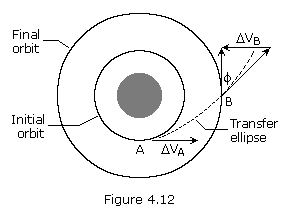
2. The flight-path angle at intercept point is angle between what and what? I note you reference the tangent of the Hohmann transfer where this angle is zero, but I can't quite see what this angle actually is. (Angle between spacecraft trajectory on transfer orbit and lunar orbit?)

3. How do you write all that great math notation in a forum?

Thanks again. This is great stuff.

-MJL

---------- Post added at 06:21 PM ---------- Previous post was at 06:17 PM ----------

To calculate the DV needed for the LOI you need to know your speed at the time when you want to make the burn. I think you can see this in TransX or IMFD as encounter velocity. How to calculate this yourself I'm not sure myself.

Next you need to calculate the orbital speed for the altitude of your closest approach, this can be done with the formula described in the Chapter 'Uniform Circular Motion' at braeunig.us
Example Problem 4.1 has an example for a satellite in Earth Orbit, for the Moon you would have to use the Moon's radius and GM which should be listed in the Basic Constants page

Finally you would subtract this orbital velocity from your encounter velocity and the result will be the required DV.

I hope the more knowledgeable forum members correct me if anything I wrote above is not correct.

Yeah, the rocket and space technology site is fantastic. Unfortunately, I often have trouble knowing what part of all that math applies to a particular situation. Thank you for linking up the circular motion equation to my problem here.
 
2. The flight-path angle at intercept point is angle between what and what? I note you reference the tangent of the Hohmann transfer where this angle is zero, but I can't quite see what this angle actually is. (Angle between spacecraft trajectory on transfer orbit and lunar orbit?)

Exactly. In most cases your transfer trajectory will not be a perfect Hohmann transfer, so when you arrive at the Moon's orbital distance your spacecraft's trajectory is at an angle with the Moon's trajectory.

Have a look at this pic:

fig4-12.gif

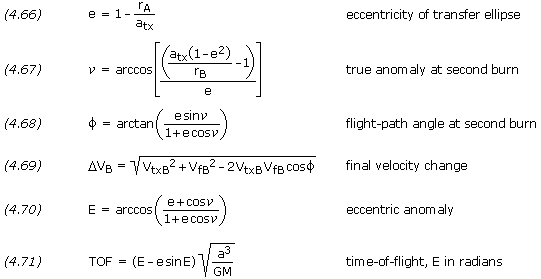
eq4-66.gif


This describes an one tangent burn transfer. The example is about a spacecraft rendezvous, but the same thing applies when going to the Moon.The ΔVB is the Delta-V needed at the intercept point, but in the Moon's case, it's the encounter velocity.

Venc: Is this the velocity of the spacecraft relative to the moon? Or is it something else?

Yes, it is the velocity of the spacecraft relative to the Moon at the intercept point, but it is not to be confused with the periselene velocity.

Think of it like this: If the Moon had negligible mass (i.e was a spacecraft), then the periselene velocity would be equal to the encounter velocity. But because the Moon has its own gravity well, you gain more velocity as you drop deeper inside it. The periselene velocity depends on the encounter velocity and how deep inside the gravity well you fall.
[math] V_{h_{pe}}= \sqrt{V_{enc}^2+V_{esc}^2}[/math]

Exactly the same thing applies to interplanetary trajectories. Here is a pic from a guide that I've been working on, to help with visualization. Don't take the analogy too seriously.


better quality here.

How do you write all that great math notation in a forum?

write between [math] tags, using LaTeX notation.

PHP:
[math] a + b = c [/math]
[math] a + b = c [/math]

PHP:
[math] \alpha + \beta = \gamma [/math]
[math] \alpha + \beta = \gamma [/math]

PHP:
[math] V_{esc} =\sqrt{ \frac{2\cdot G\cdot M}{R}}[/math]
[math] V_{esc} =\sqrt{ \frac{2\cdot G\cdot M}{R}}[/math]

PHP:
[math] \sum_{i=1}^{n}{X_i^2}[/math]
[math] \sum_{i=1}^{n}{X_i^2}[/math]

An alternative is to use this and post the direct link between tags.

[QUOTE="mjl1966, post: 470507, member: 2194"]Thanks again. This is great stuff.[/quote]

Glad to help, :cheers:
 
Back
Top