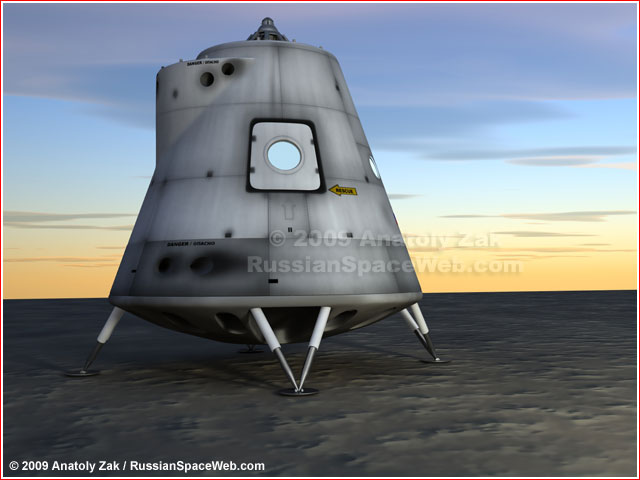
Manned spaceship design unveiled.

The first spacecraft to use "rocket engines to soften landing" is plain wrong. All Russian manned spacecraft since Voskhod use them.
 
acts_land_1.jpg


OMG, I know this reminds me what! :rofl:

 
Here's a different thing. This capsule is supposed to have no parachutes whatsoever, and land using solid fuel thrusters located at the bottom.

No parachutes? I thought it should?

That smells like trouble.
 
Perhaps the designers do too, so they are going to equip this cutie with fighter ejections seats for everyone of the crew.
Ejection seats? Are you being serious? How do six seats get out of that thing without them damaging each other? I would have thought that parachutes and smaller braking SRMs would have been cheaper and less complex than ejection seats.

Also, why landing gear? Couldn't the capsule just settle down on its heat shield?
 
I'll believe it when I see it. There's been a lot more creativity than reality in the Russian program for a long time, due to lack of funding.
 
Ejection seats? Are you being serious? How do six seats get out of that thing without them damaging each other? I would have thought that parachutes and smaller braking SRMs would have been cheaper and less complex than ejection seats.

Also, why landing gear? Couldn't the capsule just settle down on its heat shield?

I am as serious as Energia designers who presented this design at Farnborough. They are going to position the crew (4 or 6 persons) in the camomile petals pattern, legs to center, heads outwards. It's clear that areas behind each of the cosmonauts will be structurally weakened to enable the ejection seat breaking the hull through.

The main jet cushion system will kick in at 100 metres altitude and quickly decelarate the spacecraft to stop at the ground. SRM's are there to provide additional robustness, also they are believed to be safer than Peroxide liquid engines proposed two decades ago for the similar Zarya capsule design.

The legs are there for reusability's sake.

Almost forgot to mention: this capsule will most probably be called Rus' (a traditional name of Russia) and IS the replacement for the rejected Clipper design.
 
I'll believe it when I see it. There's been a lot more creativity than reality in the Russian program for a long time, due to lack of funding.

It's assumed that this design would go as a joint venture with Europe, so here's the trick. If you ask me, I'd rather see a Lunar Soyuz in metal.
 
I can't imagine landing on small SRB's. They aren't throttle-able and seem to be pretty dangerous. Every other capsule since 1961 has used a parachute. In the end the 'chute system may be slightly heaver than an SRB landing system, but definitely much safer.
 
Almost forgot to mention: this capsule will most probably be called Rus' (a traditional name of Russia) and IS the replacement for the rejected Clipper design.

With only the difference that Klipper was far more conventional as this one now.
 
Klipper seemed far more sensible than this, and a real advance toward a meaningful, reusable crew spaceplane. I wonder what lies behind the change in approach? What basic physics drives the choice of a VL rocket rather than something that can glide back with greater cross-range capability?
 
Politics. Klipper did not allow much European work, as Russia did not want to allow ESA to develop those stuff, they can do good - avionics for example. It was already ready as it is.

This one now allows more European inclusions, but I have the feeling, even a ATV with manned capsule is more realistic as this Ontos.
 
Back
Top