
You are using an out of date browser. It may not display this or other websites correctly.
You should upgrade or use an alternative browser.
You should upgrade or use an alternative browser.
Updates Mars Science Laboratory (Curiosity)
- Thread starter Unstung
- Start date

Unstung
Active member
The Mars Science Laboratory team is finally preparing to drive Curiosity over to Mount Sharp. Drilling is finished at Glenelg, however there may be stops for further investigation along the way to the base of the mountain.
JPL: "NASA's Curiosity Mars Rover Nears Turning Point"
JPL: "NASA's Curiosity Mars Rover Nears Turning Point"
NASA's Mars Science Laboratory mission is approaching its biggest turning point since landing its rover, Curiosity, inside Mars' Gale Crater last summer.
Curiosity is finishing investigations in an area smaller than a football field where it has been working for six months, and it will soon shift to a distance-driving mode headed for an area about 5 miles (8 kilometers) away, at the base of Mount Sharp
[...]
Unstung
Active member
Curiosity is now heading towards its target, Mount Sharp which is 8 kilometers away. The rover is a whole 58 meters closer to its destination as of the article's publication! :woohoo:
JPL: "Mars Rover Curiosity Begins Trek Toward Mount Sharp"
JPL: "Mars Rover Curiosity Begins Trek Toward Mount Sharp"
JPL said:With drives on July 4 and July 7, NASA's Mars rover Curiosity has departed its last science target in the "Glenelg" area and commenced a many-month overland journey to the base of the mission's main destination, Mount Sharp.
Unstung
Active member
I'm behind on the news, so I'll throw in two extra articles with new data.
JPL: "Reports Detail Mars Rover Clues to Atmosphere's Past"
JPL: "Curiosity Makes Its Longest One-Day Drive on Mars"
JPL: "Curiosity Mars Rover Gleams in View from Orbiter"
JPL: "Reports Detail Mars Rover Clues to Atmosphere's Past"
MAVEN will make further, direct measurements of Martian atmospheric loss after the spacecraft launches late this year and arrives at Mars in 2014.JPL said:[...]
Curiosity measured the same pattern in isotopes of hydrogen, as well as carbon and oxygen, consistent with a loss of a substantial fraction of Mars' original atmosphere. Enrichment in heavier isotopes in the Martian atmosphere has previously been measured on Mars and in gas bubbles inside meteorites from Mars. Meteorite measurements indicate much of the atmospheric loss may have occurred during the first billion years of the planet's 4.6-billion-year history. The Curiosity measurements reported this week provide more precise measurements to compare with meteorite studies and with models of atmospheric loss.
[...]
JPL: "Curiosity Makes Its Longest One-Day Drive on Mars"
JPL: "Curiosity Mars Rover Gleams in View from Orbiter"
Mattyv
Rocket Scientist in Training
Unstung
Active member
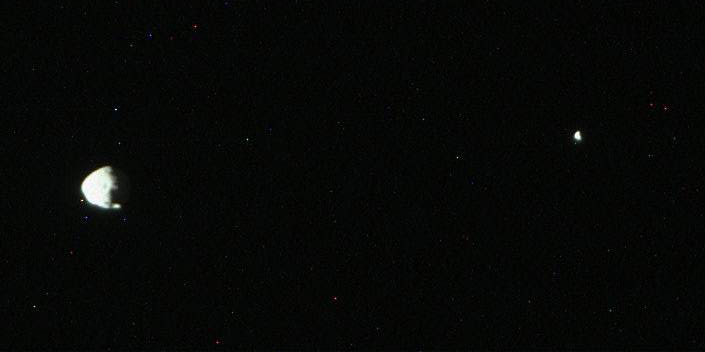

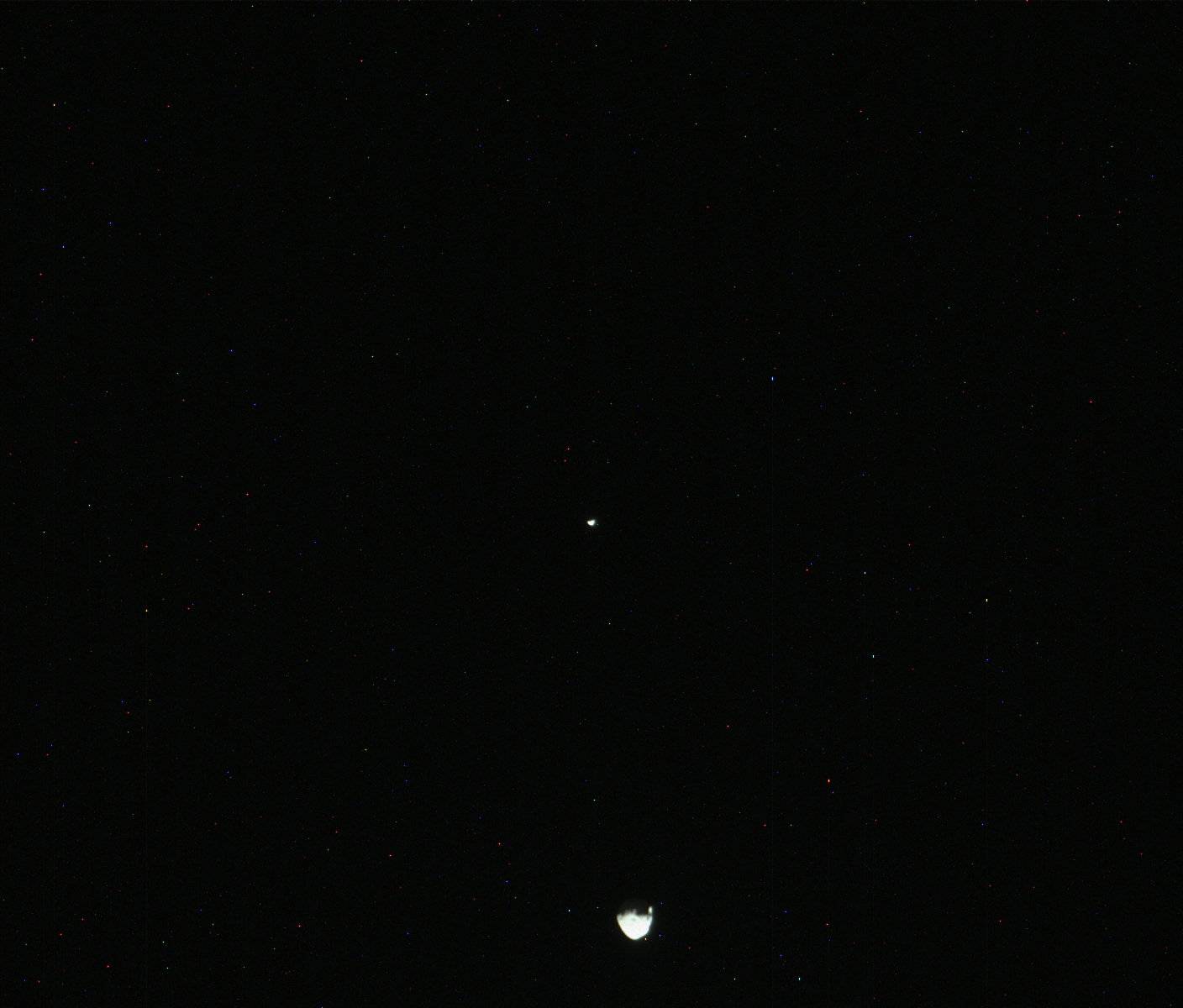

Always interesting to see what Mars' moons look like from its surface. And with that glow, it looks like a frame from an old sci-fi movie.

RGClark
Mathematician
- Joined
- Jan 27, 2010
- Messages
- 1,635
- Reaction score
- 1
- Points
- 36
- Location
- Philadelphia
- Website
- exoscientist.blogspot.com
SwRI study finds liquid water flowing above and below frozen Alaskan sand dunes, hints of a wetter Mars.
San Antonio TX (SPX) Apr 01, 2013
Recent measurements of air temperature and pressure recorded by the Mars Science Laboratory on the Curiosity Rover, which landed in Gale Crater last August, suggest that liquid water potentially would be stable there during the warmest portion of each day.
http://www.marsdaily.com/reports/Sw...an_sand_dunes_hints_of_a_wetter_Mars_999.html
Nice article here:
How The World's Saltiest Pond Gets Its Salt; Implications For Water On Mars.
by Staff Writers
Providence RI (SPX) Feb 11, 2013

A camera installed above Don Juan Pond in Antarctica's McMurdo Dry Valleys took 16,000 images in two months, documenting geological processes in real time. The processes that keep Don Juan Pond liquid in Antarctica could be at work on Mars as well. Credit: Geological Sciences/Brown University.
http://www.marsdaily.com/reports/Ho..._Salt_Implications_For_Water_On_Mars_999.html
It discusses the famous Don Juan Pond in Antarctica that manages to remain liquid all year round despite subfreezing temperatures.
In addition to snow melt, the researchers observations suggest nearby areas of high salt content suck water vapor out of the air during peaks of high humidity. Because of the freezing point depression characteristic of salts this water vapor can then condense to liquid even in subfreezing temperatures.
The researchers observed water tracks in these high salt regions and expect that this seeps underground and flows underground into Don Juan Pond.
Because of the high amount of salts on Mars this process could also happen there. Then we would want to look for such tracks during peaks of high humidity on Mars. MSL Curiosity does have humidity sensors but it's unclear whether they have reported reliable readings yet.
The author of this blog discusses the problems with the MSL humidity sensors:
SANITY CHECK FOR RELATIVE HUMIDITY AT MSL CURIOSITY.
http://davidaroffman.com/photo4_32.html
The author of the blog seems to have a particular point of view (for instance he believes the pressures on Mars are much higher than expected) still he discusses in depth the readings reported by NASA from the various Mars spacecraft.
Bob Clark
Last edited:
Unstung
Active member
JPL: "NASA Curiosity Rover Detects No Methane on Mars"
Universe Today: "Curiosity Rover Finds No Methane On Mars. What’s Happening?"
SPACE.com: "Mars Mystery Deepens: Curiosity Rover Finds No Sign of Methane"
The roving laboratory performed extensive tests to search for traces of Martian methane. Whether the Martian atmosphere contains traces of the gas has been a question of high interest for years because methane could be a potential sign of life, although it also can be produced without biology.
"This important result will help direct our efforts to examine the possibility of life on Mars," said Michael Meyer, NASA's lead scientist for Mars exploration. "It reduces the probability of current methane-producing Martian microbes, but this addresses only one type of microbial metabolism. As we know, there are many types of terrestrial microbes that don't generate methane."
Curiosity analyzed samples of the Martian atmosphere for methane six times from October 2012 through June and detected none. Given the sensitivity of the instrument used, the Tunable Laser Spectrometer, and not detecting the gas, scientists calculate the amount of methane in the Martian atmosphere today must be no more than 1.3 parts per billion. That is about one-sixth as much as some earlier estimates. Details of the findings appear in the Thursday edition of Science Express.
[...]
Universe Today: "Curiosity Rover Finds No Methane On Mars. What’s Happening?"
[table="head;width=400"]
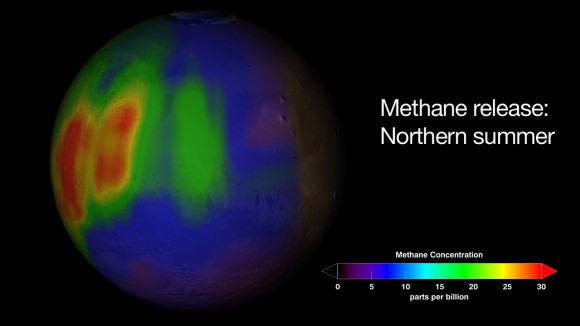
This image shows concentrations of Methane reported on Mars in 2009, from an Earth-based observatory. Credit: NASA
[/table]SPACE.com: "Mars Mystery Deepens: Curiosity Rover Finds No Sign of Methane"
Last edited:

Does anyone know the method of detection used in the 2009 methane observations? Has it been re-observed from Earth since then?

- Joined
- Oct 30, 2009
- Messages
- 14,019
- Reaction score
- 4
- Points
- 0
The Planetary Society Blog: More fancy Phobos and Deimos photography by Curiosity

On sol 393 at 9:43 p.m. local time (September 14, 2013), Curiosity watched Phobos and Deimos pass each other in the sky. Like our moon, Deimos orbits Mars more slowly than Mars rotates, so appears to move from east to west across the sky. But Phobos orbits Mars more than three times per Mars day, and thus rises in the west and sets in the east.
NASA / JPL / MSSS / Emily Lakdawalla

Sixteen images captured at about 9:50 p.m. local time on sol 393 (September 14, 2013) watch Phobos pass into Mars' shadow, entering eclipse. Although in shadow, Phobos is still faintly lit by Mars twilight.
NASA / JPL / MSSS / Emily Lakdawalla
NASA / NASA JPL:
NASA Rover Inspects Pebbly Rocks at Martian Waypoint
September 23, 2013
PASADENA, Calif. -- NASA's Mars rover Curiosity has resumed a trek of many months toward its mountain-slope destination, Mount Sharp. The rover used instruments on its arm last week to inspect rocks at its first waypoint along the route inside Gale Crater.
The location, originally chosen on the basis of images taken from NASA's Mars Reconnaissance Orbiter, paid off with investigation of targets that bear evidence of ancient wet environments.
"We examined pebbly sandstone deposited by water flowing over the surface, and veins or fractures in the rock," said Dawn Sumner of University of California, Davis, a Curiosity science team member with a leadership role in planning the stop. "We know the veins are younger than the sandstone because they cut through it, but they appear to be filled with grains like the sandstone."
This Waypoint 1 site at an outcrop called "Darwin" is the first of up to five waypoint stops planned along the route of about 5.3 miles (8.6 kilometers) between the "Glenelg" area, where Curiosity worked for the first half of 2013, and an entry point to the lower slope of Mount Sharp, the mission's main destination. It is about one-fifth of the way along the route. The rover departed Waypoint 1 on Sept. 22 with a westward drive of about 75 feet (22.8 meters).
Curiosity's science team planned the waypoints to collect information about the geology between Glenelg and Mount Sharp. Researchers want to understand relationships between what the mission already discovered at Glenelg and what it may find in the multiple layers of Mount Sharp. Analysis of drilled samples from veined "Yellowknife Bay" rocks in the Glenelg area provided evidence for a past lakebed environment with conditions favorable for microbial life. That means the mission has fulfilled its principal science goal.
"We want to understand the history of water in Gale Crater," Sumner said. "Did the water flow that deposited the pebbly sandstone at Waypoint 1 occur at about the same time as the water flow at Yellowknife Bay? If the same fluid flow produced the veins here and the veins at Yellowknife Bay, you would expect the veins to have the same composition. We see that the veins are different, so we know the history is complicated. We use these observations to piece together the long-term history."
Researchers set the top priority for the Waypoint 1 stop to be examination of a conglomerate rock outcrop, such as the pebbly sandstone. The veins were a bonus.
"As often happens, the closer we get, the more is revealed," said Kenneth Williford of NASA's Jet Propulsion Laboratory, Pasadena, Calif., a Curiosity science team member active in planning use of the rover's arm. The first specific location at Waypoint 1 for parking the rover and using the instruments on its arm was selected because images taken from nearly a football-field's length away showed outcrops that looked like conglomerate. Once Curiosity approached that location, new images showed the veins, so a second location for use of the arm was added to the plan.
The rover spent one day using its arm at the first location and three more using its arm from the second location. On all four of these "contact-science" days, the investigations employed two instruments that are mounted in the turret at the end of the arm: the Alpha Particle X-ray Spectrometer, which identifies chemical elements present in a target, and the Mars Hand Lens Imager, which shows targets' textures, shapes and colors.
Another device on the turret still holds some powder from a rock that Curiosity drilled into for sample collection at Yellowknife Bay four months ago. The laboratory instruments inside the rover have already analyzed portions from this sample, but researchers have options of many different instrument settings for doing further analyses. In weeks ahead, additional portions from the sieved powder being held in the arm may be delivered for those analyses. The powder is a precious scientific resource, but it also presents a special challenge for use of the spectrometer and camera on the turret.
"We don't want to put the turret in a position that gets the sample material onto the back side of the sieve, because that could clog pores in the sieve," said JPL's Matt Robinson, lead engineer for Curiosity's robotic arm operations. "We have to consider the orientation of the turret during all of the moves for reaching the target, not just its orientation at the target."
Despite this challenge, the team used the arm instruments intensively at Waypoint 1. On Sept. 19, the rover examined five targets with the spectrometer and camera on the arm. The next day, from the same location, it examined three more. The team did leave some potential targets unexamined, to hasten back on the drive to Mount Sharp, as planned.
"There's a trade-off," Williford said, "between wanting to reach Mount Sharp as soon as we can and wanting to chew on rocks all along the way. Our team of more than 450 scientists has set the priority on getting to Mount Sharp, with these few brief waypoint stops."
{...}
NASA/JPL - Mars Exploration Program: NASA Rover Inspects Pebbly Rocks at Martian Waypoint
SpaceRef: Curiosity Rover Inspects Pebbly Rocks at Waypoint
Phys.org: NASA rover inspects pebbly rocks at Martian waypoint
SPACE.com: NASA's Curiosity Rover Finds More Signs that Ancient Mars Had Water
The Planetary Society Blog: Dawn on Mars: Waypoint 1 Mysteries
On sol 393 at 9:43 p.m. local time (September 14, 2013), Curiosity watched Phobos and Deimos pass each other in the sky. Like our moon, Deimos orbits Mars more slowly than Mars rotates, so appears to move from east to west across the sky. But Phobos orbits Mars more than three times per Mars day, and thus rises in the west and sets in the east.
NASA / JPL / MSSS / Emily Lakdawalla
Sixteen images captured at about 9:50 p.m. local time on sol 393 (September 14, 2013) watch Phobos pass into Mars' shadow, entering eclipse. Although in shadow, Phobos is still faintly lit by Mars twilight.
NASA / JPL / MSSS / Emily Lakdawalla
NASA / NASA JPL:
NASA Rover Inspects Pebbly Rocks at Martian Waypoint
September 23, 2013
PASADENA, Calif. -- NASA's Mars rover Curiosity has resumed a trek of many months toward its mountain-slope destination, Mount Sharp. The rover used instruments on its arm last week to inspect rocks at its first waypoint along the route inside Gale Crater.
The location, originally chosen on the basis of images taken from NASA's Mars Reconnaissance Orbiter, paid off with investigation of targets that bear evidence of ancient wet environments.
"We examined pebbly sandstone deposited by water flowing over the surface, and veins or fractures in the rock," said Dawn Sumner of University of California, Davis, a Curiosity science team member with a leadership role in planning the stop. "We know the veins are younger than the sandstone because they cut through it, but they appear to be filled with grains like the sandstone."
This Waypoint 1 site at an outcrop called "Darwin" is the first of up to five waypoint stops planned along the route of about 5.3 miles (8.6 kilometers) between the "Glenelg" area, where Curiosity worked for the first half of 2013, and an entry point to the lower slope of Mount Sharp, the mission's main destination. It is about one-fifth of the way along the route. The rover departed Waypoint 1 on Sept. 22 with a westward drive of about 75 feet (22.8 meters).
Curiosity's science team planned the waypoints to collect information about the geology between Glenelg and Mount Sharp. Researchers want to understand relationships between what the mission already discovered at Glenelg and what it may find in the multiple layers of Mount Sharp. Analysis of drilled samples from veined "Yellowknife Bay" rocks in the Glenelg area provided evidence for a past lakebed environment with conditions favorable for microbial life. That means the mission has fulfilled its principal science goal.
"We want to understand the history of water in Gale Crater," Sumner said. "Did the water flow that deposited the pebbly sandstone at Waypoint 1 occur at about the same time as the water flow at Yellowknife Bay? If the same fluid flow produced the veins here and the veins at Yellowknife Bay, you would expect the veins to have the same composition. We see that the veins are different, so we know the history is complicated. We use these observations to piece together the long-term history."
Researchers set the top priority for the Waypoint 1 stop to be examination of a conglomerate rock outcrop, such as the pebbly sandstone. The veins were a bonus.
"As often happens, the closer we get, the more is revealed," said Kenneth Williford of NASA's Jet Propulsion Laboratory, Pasadena, Calif., a Curiosity science team member active in planning use of the rover's arm. The first specific location at Waypoint 1 for parking the rover and using the instruments on its arm was selected because images taken from nearly a football-field's length away showed outcrops that looked like conglomerate. Once Curiosity approached that location, new images showed the veins, so a second location for use of the arm was added to the plan.
[table="head;width=675"]{colsp=3}
 |
| |
|
This mosaic of four images taken by the Mars Hand Lens Imager (MAHLI) camera on NASA's Mars rover Curiosity shows detailed texture in a ridge that stands higher than surrounding rock. The rock is at a location called "Darwin," inside Gale Crater. Exposed outcrop at this location, visible in images from the High Resolution Imaging Science Experment (HiRISE) camera on NASA's Mars Reconnaissance Orbiter, prompted Curiosity's science team to select it as the mission's first waypoint for several days during the mission's long trek from the "Glenelg" area to Mount Sharp.
Click on images for details
||This mosaic of four images taken by the Mars Hand Lens Imager (MAHLI) camera on NASA's Mars rover Curiosity shows detailed texture in a ridge that stands higher than surrounding rock. The rock is at a location called "Darwin," inside Gale Crater. Exposed outcrop at this location, visible in images from the High Resolution Imaging Science Experment (HiRISE) camera on NASA's Mars Reconnaissance Orbiter, prompted Curiosity's science team to select it as the mission's first waypoint for several days during the mission's long trek from the "Glenelg" area to Mount Sharp.
Image Credit: NASA/JPL-Caltech/MSSS
|This mosaic of nine images, taken by the Mars Hand Lens Imager (MAHLI) camera on NASA's Mars rover Curiosity, shows detailed texture in a conglomerate rock bearing small pebbles and sand-size particles.Credit: NASA/JPL-Caltech/MSSS
|NASA's Mars rover Curiosity used a new technique, with added autonomy for the rover, in placement of the tool-bearing turret on its robotic arm during the 399th Martian day, or sol, of the mission. This image from the rover's front Hazard Avoidance Camera (Hazcam) on that sol shows the position of the turret during that process, with the Alpha Particle X-ray Spectrometer (APXS) instrument placed close to the target rock.Credit: NASA/JPL-Caltech
[/table]The rover spent one day using its arm at the first location and three more using its arm from the second location. On all four of these "contact-science" days, the investigations employed two instruments that are mounted in the turret at the end of the arm: the Alpha Particle X-ray Spectrometer, which identifies chemical elements present in a target, and the Mars Hand Lens Imager, which shows targets' textures, shapes and colors.
Another device on the turret still holds some powder from a rock that Curiosity drilled into for sample collection at Yellowknife Bay four months ago. The laboratory instruments inside the rover have already analyzed portions from this sample, but researchers have options of many different instrument settings for doing further analyses. In weeks ahead, additional portions from the sieved powder being held in the arm may be delivered for those analyses. The powder is a precious scientific resource, but it also presents a special challenge for use of the spectrometer and camera on the turret.
"We don't want to put the turret in a position that gets the sample material onto the back side of the sieve, because that could clog pores in the sieve," said JPL's Matt Robinson, lead engineer for Curiosity's robotic arm operations. "We have to consider the orientation of the turret during all of the moves for reaching the target, not just its orientation at the target."
Despite this challenge, the team used the arm instruments intensively at Waypoint 1. On Sept. 19, the rover examined five targets with the spectrometer and camera on the arm. The next day, from the same location, it examined three more. The team did leave some potential targets unexamined, to hasten back on the drive to Mount Sharp, as planned.
"There's a trade-off," Williford said, "between wanting to reach Mount Sharp as soon as we can and wanting to chew on rocks all along the way. Our team of more than 450 scientists has set the priority on getting to Mount Sharp, with these few brief waypoint stops."
{...}
NASA/JPL - Mars Exploration Program: NASA Rover Inspects Pebbly Rocks at Martian Waypoint
SpaceRef: Curiosity Rover Inspects Pebbly Rocks at Waypoint
Phys.org: NASA rover inspects pebbly rocks at Martian waypoint
SPACE.com: NASA's Curiosity Rover Finds More Signs that Ancient Mars Had Water
The Planetary Society Blog: Dawn on Mars: Waypoint 1 Mysteries
- Joined
- Oct 30, 2009
- Messages
- 14,019
- Reaction score
- 4
- Points
- 0
NASA:
Curiosity's SAM Instrument Finds Water and More in Surface Sample
Sept 26, 2013
The first scoop of soil analyzed by the analytical suite in the belly of NASA's Curiosity rover reveals that fine materials on the surface of the planet contain several percent water by weight. The results were published today in Science as one article in a five-paper special section on the Curiosity mission.
"One of the most exciting results from this very first solid sample ingested by Curiosity is the high percentage of water in the soil," said Laurie Leshin, lead author of one paper and dean of the School Science at Rensselaer Polytechnic Institute. "About 2 percent of the soil on the surface of Mars is made up of water, which is a great resource, and interesting scientifically." The sample also released significant carbon dioxide, oxygen and sulfur compounds when heated.
Curiosity landed in Gale Crater on the surface of Mars on Aug. 6, 2012, charged with answering the question: "Could Mars have once harbored life?" To do that, Curiosity is the first rover on Mars to carry equipment for gathering and processing samples of rock and soil. One of those instruments was employed in the current research: the Sample Analysis at Mars (SAM) instrument suite, which includes a gas chromatograph, a mass spectrometer and a tunable laser spectrometer. These tools enable SAM to identify a wide range of chemical compounds and determine the ratios of different isotopes of key elements.
"This work not only demonstrates that SAM is working beautifully on Mars, but also shows how SAM fits into Curiosity's powerful and comprehensive suite of scientific instruments," said Paul Mahaffy, principal investigator for SAM at NASA's Goddard Space Flight Center in Greenbelt, Md. "By combining analyses of water and other volatiles from SAM with mineralogical, chemical and geological data from Curiosity's other instruments, we have the most comprehensive information ever obtained on Martian surface fines. These data greatly advance our understanding surface processes and the action of water on Mars."
Thirty-four researchers, all members of the Mars Science Laboratory Science Team, contributed to the paper.
In this study, scientists used the rover's scoop to collect dust, dirt and finely grained soil from a sandy patch known as Rocknest. Researchers fed portions of the fifth scoop into SAM. Inside SAM, the "fines"—the dust, dirt and fine soil—were heated to 1,535 degrees F (835 C).
Baking the sample also revealed a compound containing chlorine and oxygen, likely chlorate or perchlorate, previously found near the north pole on Mars. Finding such compounds at Curiosity's equatorial site suggests they could be distributed more globally. The analysis also suggests the presence of carbonate materials, which form in the presence of water.
In addition to determining the amount of the major gases released, SAM also analyzed ratios of isotopes of hydrogen and carbon in the released water and carbon dioxide. Isotopes are variants of the same chemical element with different numbers of neutrons, and therefore different atomic weights. SAM found that the ratio of some isotopes in the soil is similar to the ratio found in atmospheric samples analyzed earlier, indicating that the surface soil has interacted heavily with the atmosphere.
"The isotopic ratios, including hydrogen-to-deuterium ratios and carbon isotopes, tend to support the idea that as the dust is moving around the planet, it's reacting with some of the gases from the atmosphere," Leshin said.
SAM can also search for trace levels of organic compounds. Although several simple organic compounds were detected in the experiments at Rocknest, they aren't clearly Martian in origin. Instead, it is likely that they formed during the high-temperature experiments, when the heat decomposed perchlorates in the Rocknest samples, releasing oxygen and chlorine that then reacted with terrestrial organics already present in the SAM instrument.
A related paper, published in the Journal of Geophysical Research-Planets, details the findings of perchlorates and other chlorine-bearing compounds in the Rocknest sample. This paper is led by Daniel Glavin, a Mars Science Laboratory Science Team member at Goddard.
Glavin notes that SAM has the ability to perform another kind of experiment to address the question of whether organic molecules are present in the Martian samples. The SAM suite includes nine fluid-filled cups which hold chemicals that can react with organic molecules if present in the soil samples. "Because these reactions occur at low temperatures, the presence of perchlorates will not inhibit the detection of Martian organic compounds," said Glavin.
The combined results shed light on the composition of the planet's surface, while offering direction for future research.
"Mars has kind of a global layer, a layer of surface soil that has been mixed and distributed by frequent dust storms. So a scoop of this stuff is basically a microscopic Mars rock collection," said Leshin. "If you mix many grains of it together, you probably have an accurate picture of typical Martian crust. By learning about it in any one place you're learning about the entire planet."
{...}
NASA JPL / NASA:
Science Gains From Diverse Landing Area of Curiosity
Sept 26, 2013
PASADENA, Calif. -- NASA's Curiosity rover is revealing a great deal about Mars, from long-ago processes in its interior to the current interaction between the Martian surface and atmosphere.
Examination of loose rocks, sand and dust has provided new understanding of the local and global processes on Mars. Analysis of observations and measurements by the rover's science instruments during the first four months after the August 2012 landing are detailed in five reports in the Sept. 27 edition of the journal Science.
A key finding is that water molecules are bound to fine-grained soil particles, accounting for about 2 percent of the particles' weight at Gale Crater where Curiosity landed. This result has global implications, because these materials are likely distributed around the Red Planet.
Curiosity also has completed the first comprehensive mineralogical analysis on another planet using a standard laboratory method for identifying minerals on Earth. The findings about both crystalline and non-crystalline components in soil provide clues to the planet's volcanic history.
Information about the evolution of the Martian crust and deeper regions within the planet comes from Curiosity's mineralogical analysis of a football-size igneous rock called "Jake M." Igneous rocks form by cooling molten material that originated well beneath the crust. The chemical compositions of the rocks can be used to infer the thermal, pressure and chemical conditions under which they crystallized.
"No other Martian rock is so similar to terrestrial igneous rocks," said Edward Stolper of the California Institute of Technology, lead author of a report about this analysis. "This is surprising because previously studied igneous rocks from Mars differ substantially from terrestrial rocks and from Jake M."
The other four reports include analysis of the composition and formation process of a windblown drift of sand and dust, by David Blake of NASA's Ames Research Center at Moffett Field, Calif., and co-authors.
Curiosity examined this drift, called Rocknest, with five instruments, preforming an onboard laboratory analysis of samples scooped up from the Martian surface. The drift has a complex history and includes sand particles with local origins, as well as finer particles that sample windblown Martian dust distributed regionally or even globally.
The rover is equipped with a laser instrument to determine material compositions from some distance away. This instrument found that the fine-particle component in the Rocknest drift matches the composition of windblown dust and contains water molecules. The rover tested 139 soil targets at Rocknest and elsewhere during the mission's first three months and detected hydrogen -- which scientists interpret as water -- every time the laser hit fine-particle material.
"The fine-grain component of the soil has a similar composition to the dust distributed all around Mars, and now we know more about its hydration and composition than ever before," said Pierre-Yves Meslin of the Institut de Recherche en Astrophysique et Planétologie in Toulouse, France, lead author of a report about the laser instrument results.
A laboratory inside Curiosity used X-rays to determine the composition of Rocknest samples. This technique, discovered in 1912, is a laboratory standard for mineral identification on Earth. The equipment was miniaturized to fit on the spacecraft that carried Curiosity to Mars, and this has yielded spinoff benefits for similar portable devices used on Earth. David Bish of Indiana University in Bloomington co-authored a report about how this technique was used and its results at Rocknest.
X-ray analysis not only identified 10 distinct minerals, but also found an unexpectedly large portion of the Rocknest composition is amorphous ingredients, rather than crystalline minerals. Amorphous materials, similar to glassy substances, are a component of some volcanic deposits on Earth.
Another laboratory instrument identified chemicals and isotopes in gases released by heating the Rocknest soil in a tiny oven. Isotopes are variants of the same element with different atomic weights. These tests found water makes up about 2 percent of the soil, and the water molecules are bound to the amorphous materials in the soil.
"The ratio of hydrogen isotopes in water released from baked samples of Rocknest soil indicates the water molecules attached to soil particles come from interaction with the modern atmosphere," said Laurie Leshin of Rensselaer Polytechnic Institute in Troy, N.Y., lead author of a report about analysis with the baking instrument.
Baking and analyzing the Rocknest sample also revealed a compound with chlorine and oxygen, likely chlorate or perchlorate, which previously was known to exist on Mars only at one high-latitude site. This finding at Curiosity's equatorial site suggests more global distribution.
Data obtained from Curiosity since the first four months of the rover's mission on Mars are still being analyzed. NASA's Jet Propulsion Laboratory, a division of Caltech in Pasadena, Calif., manages the mission for NASA's Science Mission Directorate in Washington. The mission draws upon international collaboration, including key instrument contributions from Canada, Spain, Russia and France.
{...}
Discovery News:
Phys.org:
Science Daily: NASA Mars Rover Curiosity Finds Water in First Sample of Planet Surface
SpaceRef: Water for Future Mars Astronauts?
Universe Today:
Curiosity's SAM Instrument Finds Water and More in Surface Sample
Sept 26, 2013
The first scoop of soil analyzed by the analytical suite in the belly of NASA's Curiosity rover reveals that fine materials on the surface of the planet contain several percent water by weight. The results were published today in Science as one article in a five-paper special section on the Curiosity mission.
"One of the most exciting results from this very first solid sample ingested by Curiosity is the high percentage of water in the soil," said Laurie Leshin, lead author of one paper and dean of the School Science at Rensselaer Polytechnic Institute. "About 2 percent of the soil on the surface of Mars is made up of water, which is a great resource, and interesting scientifically." The sample also released significant carbon dioxide, oxygen and sulfur compounds when heated.
Curiosity landed in Gale Crater on the surface of Mars on Aug. 6, 2012, charged with answering the question: "Could Mars have once harbored life?" To do that, Curiosity is the first rover on Mars to carry equipment for gathering and processing samples of rock and soil. One of those instruments was employed in the current research: the Sample Analysis at Mars (SAM) instrument suite, which includes a gas chromatograph, a mass spectrometer and a tunable laser spectrometer. These tools enable SAM to identify a wide range of chemical compounds and determine the ratios of different isotopes of key elements.
"This work not only demonstrates that SAM is working beautifully on Mars, but also shows how SAM fits into Curiosity's powerful and comprehensive suite of scientific instruments," said Paul Mahaffy, principal investigator for SAM at NASA's Goddard Space Flight Center in Greenbelt, Md. "By combining analyses of water and other volatiles from SAM with mineralogical, chemical and geological data from Curiosity's other instruments, we have the most comprehensive information ever obtained on Martian surface fines. These data greatly advance our understanding surface processes and the action of water on Mars."
Thirty-four researchers, all members of the Mars Science Laboratory Science Team, contributed to the paper.
In this study, scientists used the rover's scoop to collect dust, dirt and finely grained soil from a sandy patch known as Rocknest. Researchers fed portions of the fifth scoop into SAM. Inside SAM, the "fines"—the dust, dirt and fine soil—were heated to 1,535 degrees F (835 C).
Baking the sample also revealed a compound containing chlorine and oxygen, likely chlorate or perchlorate, previously found near the north pole on Mars. Finding such compounds at Curiosity's equatorial site suggests they could be distributed more globally. The analysis also suggests the presence of carbonate materials, which form in the presence of water.
In addition to determining the amount of the major gases released, SAM also analyzed ratios of isotopes of hydrogen and carbon in the released water and carbon dioxide. Isotopes are variants of the same chemical element with different numbers of neutrons, and therefore different atomic weights. SAM found that the ratio of some isotopes in the soil is similar to the ratio found in atmospheric samples analyzed earlier, indicating that the surface soil has interacted heavily with the atmosphere.
"The isotopic ratios, including hydrogen-to-deuterium ratios and carbon isotopes, tend to support the idea that as the dust is moving around the planet, it's reacting with some of the gases from the atmosphere," Leshin said.
[table="head;width=450"]{colsp=2}
 |
|
The Sample Analysis at Mars instrument suite, prior to its installation on the Curiosity rover.
Click on images for details
 |
|The Sample Analysis at Mars instrument suite, prior to its installation on the Curiosity rover.
Image Credit: NASA Goddard
|The Sample Analysis at Mars instrument suite found water in the dust, dirt and fine soil from the Rocknest site on Mars. (This file photo shows trenches Curiosity dug in October 2012.)Image Credit: NASA/JPL-Caltech/MSSS
[/table]SAM can also search for trace levels of organic compounds. Although several simple organic compounds were detected in the experiments at Rocknest, they aren't clearly Martian in origin. Instead, it is likely that they formed during the high-temperature experiments, when the heat decomposed perchlorates in the Rocknest samples, releasing oxygen and chlorine that then reacted with terrestrial organics already present in the SAM instrument.
A related paper, published in the Journal of Geophysical Research-Planets, details the findings of perchlorates and other chlorine-bearing compounds in the Rocknest sample. This paper is led by Daniel Glavin, a Mars Science Laboratory Science Team member at Goddard.
Glavin notes that SAM has the ability to perform another kind of experiment to address the question of whether organic molecules are present in the Martian samples. The SAM suite includes nine fluid-filled cups which hold chemicals that can react with organic molecules if present in the soil samples. "Because these reactions occur at low temperatures, the presence of perchlorates will not inhibit the detection of Martian organic compounds," said Glavin.
The combined results shed light on the composition of the planet's surface, while offering direction for future research.
"Mars has kind of a global layer, a layer of surface soil that has been mixed and distributed by frequent dust storms. So a scoop of this stuff is basically a microscopic Mars rock collection," said Leshin. "If you mix many grains of it together, you probably have an accurate picture of typical Martian crust. By learning about it in any one place you're learning about the entire planet."
{...}
NASA JPL / NASA:
Science Gains From Diverse Landing Area of Curiosity
Sept 26, 2013
PASADENA, Calif. -- NASA's Curiosity rover is revealing a great deal about Mars, from long-ago processes in its interior to the current interaction between the Martian surface and atmosphere.
Examination of loose rocks, sand and dust has provided new understanding of the local and global processes on Mars. Analysis of observations and measurements by the rover's science instruments during the first four months after the August 2012 landing are detailed in five reports in the Sept. 27 edition of the journal Science.
A key finding is that water molecules are bound to fine-grained soil particles, accounting for about 2 percent of the particles' weight at Gale Crater where Curiosity landed. This result has global implications, because these materials are likely distributed around the Red Planet.
Curiosity also has completed the first comprehensive mineralogical analysis on another planet using a standard laboratory method for identifying minerals on Earth. The findings about both crystalline and non-crystalline components in soil provide clues to the planet's volcanic history.
Information about the evolution of the Martian crust and deeper regions within the planet comes from Curiosity's mineralogical analysis of a football-size igneous rock called "Jake M." Igneous rocks form by cooling molten material that originated well beneath the crust. The chemical compositions of the rocks can be used to infer the thermal, pressure and chemical conditions under which they crystallized.
"No other Martian rock is so similar to terrestrial igneous rocks," said Edward Stolper of the California Institute of Technology, lead author of a report about this analysis. "This is surprising because previously studied igneous rocks from Mars differ substantially from terrestrial rocks and from Jake M."
The other four reports include analysis of the composition and formation process of a windblown drift of sand and dust, by David Blake of NASA's Ames Research Center at Moffett Field, Calif., and co-authors.
Curiosity examined this drift, called Rocknest, with five instruments, preforming an onboard laboratory analysis of samples scooped up from the Martian surface. The drift has a complex history and includes sand particles with local origins, as well as finer particles that sample windblown Martian dust distributed regionally or even globally.
[table="head;width=675"]{colsp=3}
 |
| |
|
Click on images for details
||Target: Jake Matijevic Rock
This image shows where NASA's Curiosity rover aimed two different instruments to study a rock known as "Jake Matijevic."Image Credit: NASA/JPL-Caltech/MSSS
|Curiosity's First Scoop of Mars, in Vibration Movie
This video clip shows the first Martian material collected by the scoop on the robotic arm of NASA's Mars rover Curiosity, being vibrated inside the scoop after it was lifted from the ground.Image Credit: NASA/JPL-Caltech/MSSS
|Curiosity's Location During First Scooping
This 360-degree scene shows the surroundings of the location where NASA's Mars rover Curiosity arrived on the 59th Martian day, or sol, of the rover's mission on Mars (Oct. 5, 2012).Image Credit: NASA/JPL-Caltech
[/table]The rover is equipped with a laser instrument to determine material compositions from some distance away. This instrument found that the fine-particle component in the Rocknest drift matches the composition of windblown dust and contains water molecules. The rover tested 139 soil targets at Rocknest and elsewhere during the mission's first three months and detected hydrogen -- which scientists interpret as water -- every time the laser hit fine-particle material.
"The fine-grain component of the soil has a similar composition to the dust distributed all around Mars, and now we know more about its hydration and composition than ever before," said Pierre-Yves Meslin of the Institut de Recherche en Astrophysique et Planétologie in Toulouse, France, lead author of a report about the laser instrument results.
A laboratory inside Curiosity used X-rays to determine the composition of Rocknest samples. This technique, discovered in 1912, is a laboratory standard for mineral identification on Earth. The equipment was miniaturized to fit on the spacecraft that carried Curiosity to Mars, and this has yielded spinoff benefits for similar portable devices used on Earth. David Bish of Indiana University in Bloomington co-authored a report about how this technique was used and its results at Rocknest.
X-ray analysis not only identified 10 distinct minerals, but also found an unexpectedly large portion of the Rocknest composition is amorphous ingredients, rather than crystalline minerals. Amorphous materials, similar to glassy substances, are a component of some volcanic deposits on Earth.
Another laboratory instrument identified chemicals and isotopes in gases released by heating the Rocknest soil in a tiny oven. Isotopes are variants of the same element with different atomic weights. These tests found water makes up about 2 percent of the soil, and the water molecules are bound to the amorphous materials in the soil.
"The ratio of hydrogen isotopes in water released from baked samples of Rocknest soil indicates the water molecules attached to soil particles come from interaction with the modern atmosphere," said Laurie Leshin of Rensselaer Polytechnic Institute in Troy, N.Y., lead author of a report about analysis with the baking instrument.
Baking and analyzing the Rocknest sample also revealed a compound with chlorine and oxygen, likely chlorate or perchlorate, which previously was known to exist on Mars only at one high-latitude site. This finding at Curiosity's equatorial site suggests more global distribution.
Data obtained from Curiosity since the first four months of the rover's mission on Mars are still being analyzed. NASA's Jet Propulsion Laboratory, a division of Caltech in Pasadena, Calif., manages the mission for NASA's Science Mission Directorate in Washington. The mission draws upon international collaboration, including key instrument contributions from Canada, Spain, Russia and France.
{...}
Discovery News:
Phys.org:
- 'Jake_M': Unusual Mars rock described
- Mars rover Curiosity finds water in first sample of planet surface
- Martian chemical complicates hunt for life's clues
- Science benefits from diverse landing area of NASA mars rover
- Water for future Mars astronauts? Diversity of Martian soils leaves scientists thirsty for more
Science Daily: NASA Mars Rover Curiosity Finds Water in First Sample of Planet Surface
SpaceRef: Water for Future Mars Astronauts?
Universe Today:
- Joined
- Oct 30, 2009
- Messages
- 14,019
- Reaction score
- 4
- Points
- 0
The Planetary Society Blog: Yes, there seems to be a hole in Curiosity's left front wheel, and no, that's not a problem

- Joined
- Oct 11, 2009
- Messages
- 3,488
- Reaction score
- 407
- Points
- 123
- Location
- Utrecht
- Website
- www.spaceflightnewsapi.net
Spaceflight101.com: Curiosity back on the Road after completing Science at Waypoint 1
Following a short break of nine Sols at its first Waypoint along the route to Mount Sharp inside Gale Crater, NASA's Curiosity rover has resumed its journey making steady driving progress to reach Waypoint 2.
Arriving at Waypoint 1 on Sol 392, MSL took some time to perform contact science operations at an outcrop called Darwin. This area was of interest to scientists because it appeared lighter-toned on images taken from orbit and rover images confirmed that the area stood out against the darker surface that surrounds it. This region exposes layers of rock that could reveal the inner makeup and history of the plains on the floor of Gale Crater which is obviously of great interest.
Curiosity first used its Mast Cameras on Sols 392 and 393 to provide scientists with a close-up look at Darwin allowing teams to plan contact science operations. On Sol 393, Curiosity performed some astro-photographing, acquiring a spectacular sequence of images showing Mars moon Phobos entering shadow as it passed overhead.
Sols 394 and 395 were dedicated to contact science operations. Curiosity deployed its robotic arm and used the MAHLI instrument to capture ultra close-up images of several areas on Darwin. APXS, the Alpha Particle X-Ray Spectrometer was used multiple times to collect data in order to determine the composition of Darwin. MastCam images of more distant areas were taken on Sol 395.
A final set of MAHLI and APXS operations at this location was performed on Sol 396 along with targeted ChemCam operations to conduct laser-induced breakdown spectroscopy on Darwin. In the afternoon hours, MSL completed a short 10-meter drive to its next location at Waypoint 1.
{...}
- Joined
- Oct 30, 2009
- Messages
- 14,019
- Reaction score
- 4
- Points
- 0
Universe Today: Penny For Your Martian Thoughts: This Is How A Coin Looks After 14 Months On The Red Planet

A 1909 penny being carried by the Mars Curiosity rover is caked with dust on Oct. 2, 2013, after 14 months on Mars. Credit: NASA/JPL-Caltech/MSSS/Planetary Science Institute
A 1909 penny being carried by the Mars Curiosity rover is caked with dust on Oct. 2, 2013, after 14 months on Mars. Credit: NASA/JPL-Caltech/MSSS/Planetary Science Institute

MaverickSawyer
Acolyte of the Probe
Damn, :ninja:'d AGAIN!!!!
- Joined
- Oct 30, 2009
- Messages
- 14,019
- Reaction score
- 4
- Points
- 0
The Planetary Society Blog:
Science Daily: Curiosity Confirms Origins of Martian Meteorites
Phys.org: Curiosity confirms origins of Martian meteorites
SpaceRef: Curiosity Confirms Origins of Martian Meteorites
AmericaSpace: NASA Rover Confirms Mars Origin of Some Meteorites
Universe Today: Was This Ridge Habitable? Mars Curiosity Eyes Nearby Mountain:
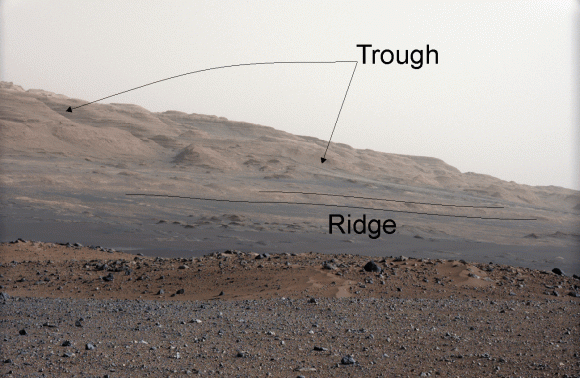
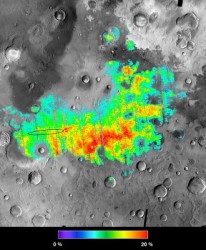
Colors map percentages of hematite in the surface materials in Meridiani Planum on Mars from 5 percent (aqua) to 25 percent (red). Opportunity landed within the black oval. MER scientists say the rocks there had once been drenched in water. Credit: NASA
Science Daily: Curiosity Confirms Origins of Martian Meteorites
Phys.org: Curiosity confirms origins of Martian meteorites
SpaceRef: Curiosity Confirms Origins of Martian Meteorites
AmericaSpace: NASA Rover Confirms Mars Origin of Some Meteorites
Universe Today: Was This Ridge Habitable? Mars Curiosity Eyes Nearby Mountain:
Colors map percentages of hematite in the surface materials in Meridiani Planum on Mars from 5 percent (aqua) to 25 percent (red). Opportunity landed within the black oval. MER scientists say the rocks there had once been drenched in water. Credit: NASA

- Joined
- Apr 14, 2012
- Messages
- 2,585
- Reaction score
- 0
- Points
- 36
The Planetary Society Blog:
Science Daily: Curiosity Confirms Origins of Martian Meteorites
Thats funny. In the article about the curiosity SAM hardware, they mention a Michael Wong... could that be the same one who runs stardestroyer.net?
Similar threads

- Replies
- 12
- Views
- 7K


- Replies
- 7
- Views
- 6K


- Replies
- 0
- Views
- 2K
- Replies
- 5
- Views
- 4K