Updates MESSENGER Mission News

MESSENGER Mission News

March 8, 2012

http://messenger.jhuapl.edu


--------------------------------------------------------------------------------


MESSENGER Team Delivers Data from First Full Mercury Solar Day to Planetary Data System


Data collected during MESSENGER’s third through sixth month in orbit around Mercury were released to the public today by the Planetary Data System (PDS), an organization that archives and distributes all of NASA’s planetary mission data. With this release, data are now available to the public for the first full Mercury solar day of MESSENGER orbital operations.


Calibrated data from all seven of MESSENGER’s science instruments, plus radio science data from the spacecraft telecommunications system, are included in this release. The science results have shed light on many aspects of Mercury, including its global magnetic field, the dynamics of its exosphere, its surface composition, its geological evolution, and its interior structure.


The images included in this release provide monochrome views at 250 meters per pixel and eight-color image sets at 1 kilometer per pixel. Apart from small gaps, many of which have already been filled by subsequent imaging, these images cover the entire planet under lighting conditions ideal either for assessing the form of Mercury’s surface features or for determining the color and compositional variations across the planet.


For more than two decades, NASA has required all of its planetary missions to archive data in the PDS, an active archive that makes available well-documented, peer-reviewed data to the research community. The PDS includes eight university/research center science teams, called discipline nodes, each of which specializes in a specific area of planetary data. The contributions from these nodes provide a data-rich source for scientists, researchers, and developers.

The data for this delivery are archived and available online at http://pds.nasa.gov/subscription_service/SS-20120308.html, and all of the MESSENGER data archived at the PDS thus far are available at http://pds.nasa.gov. As of this release, MESSENGER will have delivered 1.7 terabytes of raw and calibrated data to the PDS, including more than 62,355 images (of which 49,275 are from orbit). The team will submit four more PDS deliveries at six-month intervals from MESSENGER’s primary orbital mission and its extended mission.

The MESSENGER team has created a software tool with which the public can view data from this delivery. ACT-REACT-QuickMap provides an interactive Web interface to MESSENGER data. Developed by Applied Coherent Technology Corporation, the software allows users to examine global mosaics constructed with high-resolution images from this and previous PDS deliveries.

The tool also provides weekly updates of coverage for surface-observing instruments, as well as the status of specially targeted MDIS observations. Information is also available that can be used to locate MESSENGER data products at the PDS. QuickMap can be accessed via links on each of the MESSENGER websites at http://messenger.jhuapl.edu/ and http://www.nasa.gov/messenger. The MDIS mosaics can be downloaded from http://messenger.jhuapl.edu/the_mission/mosaics.html.


“This latest release marks another important milestone in the sharing of MESSENGER data with planetary scientists and the public,” adds MESSENGER Principal Investigator Sean Solomon, of the Carnegie Institution of Washington. “Mercury has presented us with many mysteries to date, and solving those mysteries will take new ideas and new analyses from throughout the scientific community.”


--------------------------------------------------------------------------------


MESSENGER (MErcury Surface, Space ENvironment, GEochemistry, and Ranging) is a NASA-sponsored scientific investigation of the planet Mercury and the first space mission designed to orbit the planet closest to the Sun. The MESSENGER spacecraft launched on August 3, 2004, and entered orbit about Mercury on March 18, 2011 (UTC), to begin its primary mission – a yearlong study of its target planet. MESSENGER’s extended mission begins on March 18, 2012. Dr. Sean C. Solomon, of the Carnegie Institution of Washington, leads the mission as Principal Investigator. The Johns Hopkins University Applied Physics Laboratory built and operates the MESSENGER spacecraft and manages this Discovery-class mission for NASA.


--------------------------------------------------------------------------------
 
Universe Today: A Peek at a Pitch-Black Pit

EN0234752446M.nomap_.png

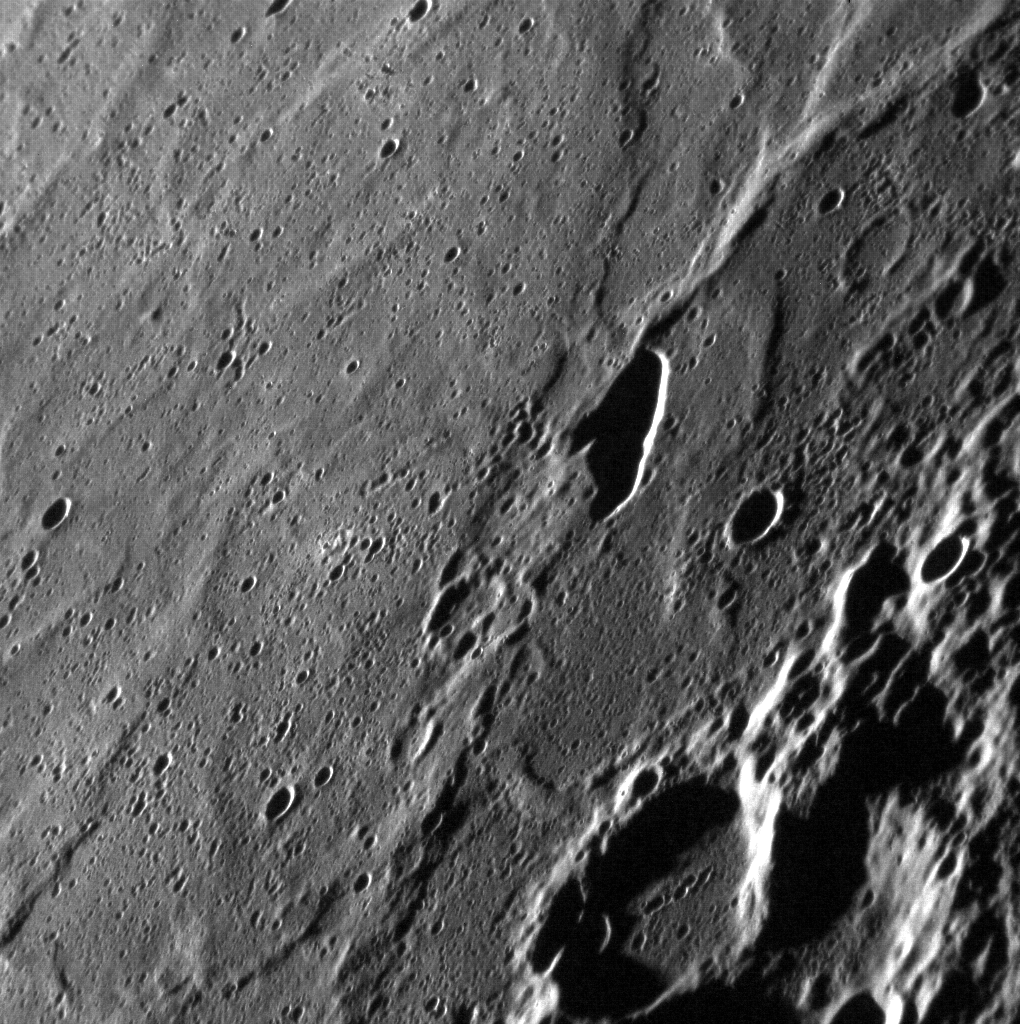
A dark, rimless pit crater within the crater Tolstoj on Mercury​
 
SPACE.com: Mercury Surprises: Tiny Planet Has Strange Innards and Active Past

Discovery News: Mystery Rising Within Mercury


JHUAPL:
MESSENGER Provides New Look at Mercury's Landscape, Metallic Core, and Polar Shadows

MESSENGER completed its one-year primary mission on March 17. Since moving into orbit about Mercury a little over one year ago, the spacecraft has captured nearly 100,000 images and returned data that have revealed new information about the planet, including its topography, the structure of its core, and areas of permanent shadow at the poles that host the mysterious polar deposits.

The latest findings are presented in two papers published online in Science Express today, and in 57 papers presented this week at the 43rd Lunar and Planetary Science Conference in The Woodlands, Texas. Team members at the meeting will also preview MESSENGER's extended mission, set to run to March 2013. Presentation materials are available on the web at http://messenger.jhuapl.edu/news_room/presscon11.html.

"The first year of MESSENGER orbital observations has revealed many surprises," says MESSENGER Principal Investigator Sean C. Solomon, of the Carnegie Institution of Washington. "From Mercury's extraordinarily dynamic magnetosphere and exosphere to the unexpectedly volatile-rich composition of its surface and interior, our inner planetary neighbor is now seen to be very different from what we imagined just a few years ago. The number and diversity of new findings being presented this week to the scientific community in papers and presentations provide a striking measure of how much we have learned to date."

Mercury's Landscape

Ranging observations from MESSENGER's Mercury Laser Altimeter (MLA) have provided the first-ever precise topographic model of the planet's northern hemisphere and characterized slopes and surface roughness over a range of spatial scales. From MESSENGER's eccentric, near-polar orbit, the MLA illuminates surface areas as wide as 15 to 100 meters, spaced about 400 meters apart.

The spread in elevations is considerably smaller than those of Mars or the Moon, notes MESSENGER Co-investigator Maria T. Zuber, author of one of the papers published in Science Express. According to Zuber, of the Massachusetts Institute of Technology, the most prominent feature is an extensive area of lowlands at high northern latitudes that hosts the volcanic northern plains. Within this lowland region is a broad topographic rise that formed after the volcanic plains were emplaced.

At mid-latitudes, the interior of the Caloris impact basin -- 1,500 kilometers wide -- has been modified so that part of the basin floor now stands higher than the rim, Zuber says. "The elevated portion of the floor of Caloris appears to be part of a quasi-linear rise that extends for approximately half the planetary circumference at mid-latitudes," she writes. "Collectively, these features imply that long-wavelength changes to Mercury's topography occurred after the earliest phases of the planet's geological history."

A Surprising Core

Scientists have also come up with the first precise model of Mercury's gravity field which, when combined with the topographic data and earlier information of the planet's spin state, shed light on the planet's internal structure, the thickness of its crust, the size and state of its core, and its tectonic and thermal history.

Mercury's core is huge for the planet's size, about 85% of the planetary radius, even larger than previous estimates. The planet is sufficiently small that at one time many scientists thought the interior should have cooled to the point that the core would be solid. However, subtle dynamical motions measured from Earth-based radar combined with parameters of the gravity field, as well as observations of the magnetic field that signify an active core dynamo, indicate that Mercury's core is at least partially liquid.

"MESSENGER's observations of the gravity field have let us peer inside Mercury and get the first good look at its largest component -- the core," says Case Western Reserve University's Steven A. Hauck II, coauthor of one of the papers published in Science Express.

Scientists sought to unravel the mystery of the size and state of Mercury's core by studying its effect on long-wavelength variations in the planet's gravity field, and recent results point to a much different interior structure for Mercury from that expected.

"Mercury's core may not look like any other terrestrial planetary core," Hauck says. "The structure certainly is different from that of Earth, which has a metallic, liquid outer core sitting above a solid inner core. Mercury appears to have a solid silicate crust and mantle overlying a solid, iron sulfide outer core layer, a deeper liquid core layer, and possibly a solid inner core."

These findings will have implications for how Mercury's magnetic field is generated and for understanding how the planet evolved thermally, Hauck adds.

Polar Shadows

A chief goal of MESSENGER's primary mission was to understand the nature of the radar-bright deposits at the poles of Mercury. The leading proposal since the deposits were discovered has been that radar-bright material consists dominantly of frozen water ice.

"We've never had the imagery available before to see the surface where these radar-bright features are located," says Nancy L. Chabot, instrument scientist for MESSENGER's Mercury Dual Imaging System (MDIS) at the Johns Hopkins University Applied Physics Laboratory (APL). "MDIS images show that all the radar-bright features near Mercury's south pole are located in areas of permanent shadow, and near Mercury's north pole such deposits are also seen only in shadowed regions, results consistent with the water-ice hypothesis."

This finding is not definitive proof that those deposits are water ice, says Chabot, who is presenting her results at LPSC. And some of the radar-bright deposits are located in craters that provide thermally challenging environments to the water-ice theory. For instance, for the radar-bright material in many of the craters to be water ice would require that there be a thin layer of insulation to keep it colder than the surface, Chabot says.

But the MDIS images, combined with ongoing analysis of data from MESSENGER's Neutron Spectrometer and the MLA, will provide a more complete picture of the nature of the deposits.

Extending the Discoveries

MESSENGER's second year at Mercury will build upon these and other results from the primary mission phase, emphasizes MESSENGER Project Scientist Ralph L. McNutt Jr., of APL. "The second year of orbital operations will not be a simple continuation of the primary mission," he says. "Extended mission themes will include more comprehensive measurement of the magnetosphere and exosphere during a period of more active Sun, greater focus on observations at low spacecraft altitudes, and a greater variety of targeted observations."

"MESSENGER has already fundamentally changed our view of this innermost planet," he adds. "With the extension of the MESSENGER mission, many more discoveries can be expected."
 
MESSENGER Mission News
April 5, 2012
http://messenger.jhuapl.edu/


MESSENGER Images Debut on "The Big Bang Theory"

Tonight, images from MESSENGER's Mercury Dual Imaging System will make their debut on the CBS sitcom, "The Big Bang Theory." The award-winning comedy centers on five characters: roommates Sheldon Cooper and Leonard Hofstadter, two physicists who work at the California Institute of Technology; and Sheldon's and Leonard's equally geeky and socially awkward friends and co-workers, aerospace engineer Howard Wolowitz and astrophysicist Rajesh Koothrappali; and Penny, a blonde waitress and aspiring actress who lives across the hall.

Much of the show focuses on science, particularly physics. The characters frequently banter about scientific theories or news and make science-related jokes.

"The MESSENGER team is thrilled by the decision of the producers and writers of 'The Big Bang Theory' to weave some of the spacecraft's latest images of Mercury into this week's episode," says MESSENGER Principal Investigator Sean Solomon, of the Carnegie Institution of Washington. "We look forward to seeing how the images figure in the story line and camera shots, and we hope that interest in the MESSENGER mission is broadened by this exposure on one of the most popular series now on television."

MESSENGER's images will appear in an episode entitled, The Hawking Excitation. When Wolowitz gets to work with Stephen Hawking, Sheldon is willing to do anything to meet his hero. The show airs tonight at 8:00 p.m. EDT on CBS!


Engineer Keeps MESSENGER Software Grounded in Quality

Eric Melin's interest in engineering and science was sparked by his father and mother, who worked as a chemical engineer and a chemist, respectively. But it was the technological leap in computer processing in the early 1990s that propelled him into the field of software development. As MESSENGER's lead ground software engineer, Melin overseas the spacecraft's command and telemetry. Read more about his critical role on the mission here.

{...}
 
MESSENGER Mission News
April 16, 2012
http://messenger.jhuapl.edu/


MESSENGER Adjusts Orbit for a Closer Look at Mercury

The MESSENGER mission successfully completed the first of two maneuvers designed to reduce the spacecraft's orbital period about Mercury. This new trajectory will pave the way for more detailed measurements and targeted observations of the Sun's closest neighbor.

The spacecraft was 124 million kilometers (77 million miles) from Earth when the 188-second maneuver began at 3:13 p.m. EDT. Mission controllers at the Johns Hopkins University Applied Physics Laboratory (APL) in Laurel, Md., verified the start of the maneuver 6 minutes and 53 seconds later, when the first signals indicating spacecraft thruster activity reached NASA's Deep Space Network tracking station in Goldstone, Calif.

This maneuver -- which adjusted the orbital period from 11 hours, 36 minutes to 9 hours, 5 minutes -- was designed to deplete the remaining oxidizer of the spacecraft's propulsion system in a final firing of the large bi-propellant thruster. A second maneuver, scheduled for the evening of April 20, will use the spacecraft's monopropellant system to complete the transition to an 8-hour orbit.

The strategy to complete this transition involves the execution by the MESSENGER flight team of carefully planned command sequences, says MESSENGER Mission Design Lead James McAdams of APL. "The first orbit-correction maneuver consumed the remaining oxidizer, which is one of two propellants used for the higher-efficiency large thruster," he explains. Although such an "oxidizer depletion" maneuver is not uncommon, new procedures had to be developed and tested to make this MESSENGER critical event possible and safe to perform.

After Friday's maneuver, the 8-hour orbit will remain highly eccentric, with MESSENGER travelling between 278 kilometers (172 miles) and 10,314 kilometers (6,409 miles) above Mercury's surface. Reducing the orbital period will increase from two to three the number of revolutions the spacecraft will make about the planet each day, increasing the time that the spacecraft will spend closer to the surface, says MESSENGER Mission Systems Engineer Eric Finnegan, of APL.

The additional time at lower altitude, he says, will enhance the science return. It will amplify the effectiveness of the high-energy spectrometers used to determine the composition of the planet's surface and will increase the number of altitude profiles that the laser altimeter will be able to make in the northern hemisphere of the planet, allowing for more detailed topographic maps. Operations at this lower altitude will also enable higher-resolution imaging of Mercury's southern hemisphere.

"The MESSENGER engineering and operations teams have once again made a critical maneuver look easy," says MESSENGER Principal Investigator Sean C. Solomon, of the Carnegie Institution of Washington. "The Science Team is now looking forward to being able to address a host of scientific questions on the composition, geological evolution, and environment of Mercury that have been raised by earlier orbital observations. With our new orbit, it feels as though we're embarking on a new mission."

{...}


The Planetary Society Blog: MESSENGER Mission Update: First burn performed to lower extended mission altitude

Spaceflight Now: MESSENGER spacecraft lowers orbit around Mercury
 
Universe Today: MESSENGER Reveals Mercury’s Colors

EW0240854865G.3band.editJPM.jpg

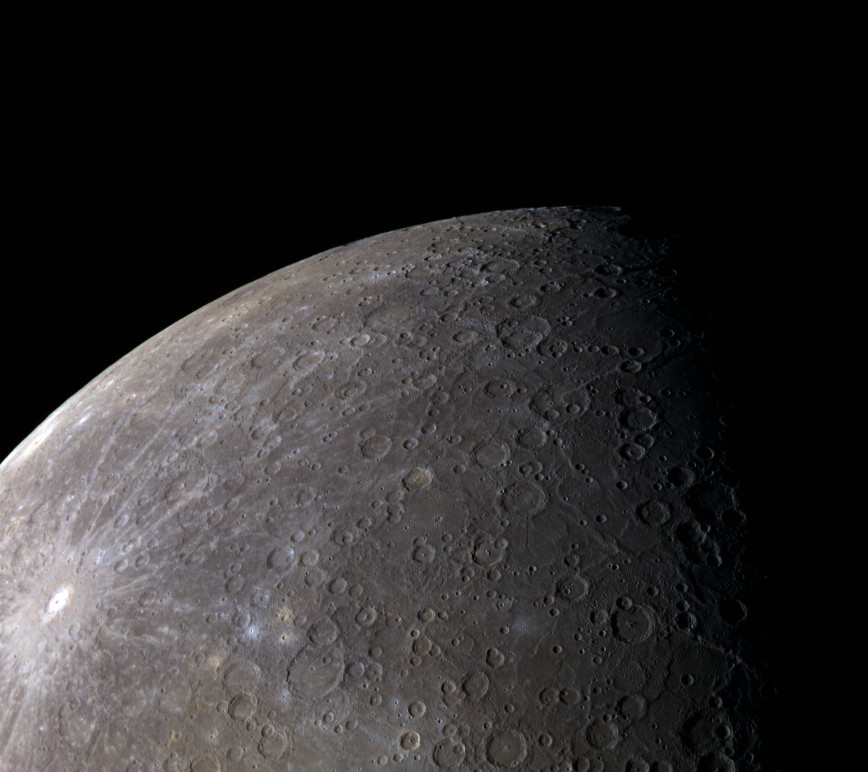
MESSENGER image of Mercury, acquired with its Wide Angle Camera on March 21, 2012.

The image above, a composite of Wide Angle Camera images acquired in 996, 748 and 433 nanometers for red, green and blue, shows a semi-lit limb of Mercury with the bright rayed crater Debussy visible at left.


color_mosaic_sinu2.png

Sinusoidal equal area projection map of Mercury from MESSENGER's VIRS instrument.​


JHUAPL:

MESSENGER Mission News
April 20, 2012
http://messenger.jhuapl.edu/


MESSENGER Settles into Eight-Hour Orbit Around Mercury, Poised for New Discoveries

MESSENGER mission controllers at the Johns Hopkins University Applied Physics Laboratory (APL) in Laurel, Md., conducted the second of two maneuvers required to reduce the spacecraft's orbital period about Mercury. The first maneuver, completed on Monday, shortened the orbital period from 11.6 to 9.1 hours and consumed the remaining oxidizer, one of two propellants that fuel the higher-efficiency large thruster. With today's maneuver, accomplished with the spacecraft's four medium-sized thrusters, MESSENGER is now in the 8-hour orbit from which it will operate for the next year.

MESSENGER was 133 million kilometers (83 million miles) from Earth when the 4-minute maneuver began at 7:05 p.m. EDT. Mission controllers at APL verified the start of the maneuver 7 minutes and 23 seconds later, after the first signals indicating spacecraft thruster activity reached NASA's Deep Space Network tracking station in Canberra, Australia.

The shorter orbit will allow MESSENGER's science team to address new questions about Mercury's composition, geological evolution, and environment that were raised by discoveries made during the first year of orbital operations.

"For instance," says APL's Patrick Peplowski, "during the first year of orbital operations, MESSENGER's Gamma-Ray Spectrometer and X-Ray Spectrometer provided the first measurements of the abundances of many elements on Mercury's surface, including magnesium, sulfur, calcium, and potassium. The eight-hour orbit gives us more observing time at low altitudes, which will permit measurements of variations in surface composition on shorter spatial scales. Such information will give us new insight into the chemical and geological processes by which Mercury's crust was formed."

An animation of the maneuvers that guided MESSENGER into its new orbit is available online at http://messenger.jhuapl.edu/the_mission/movies/OCM7and8_transition_to_8hour_orbit.mp4.
 
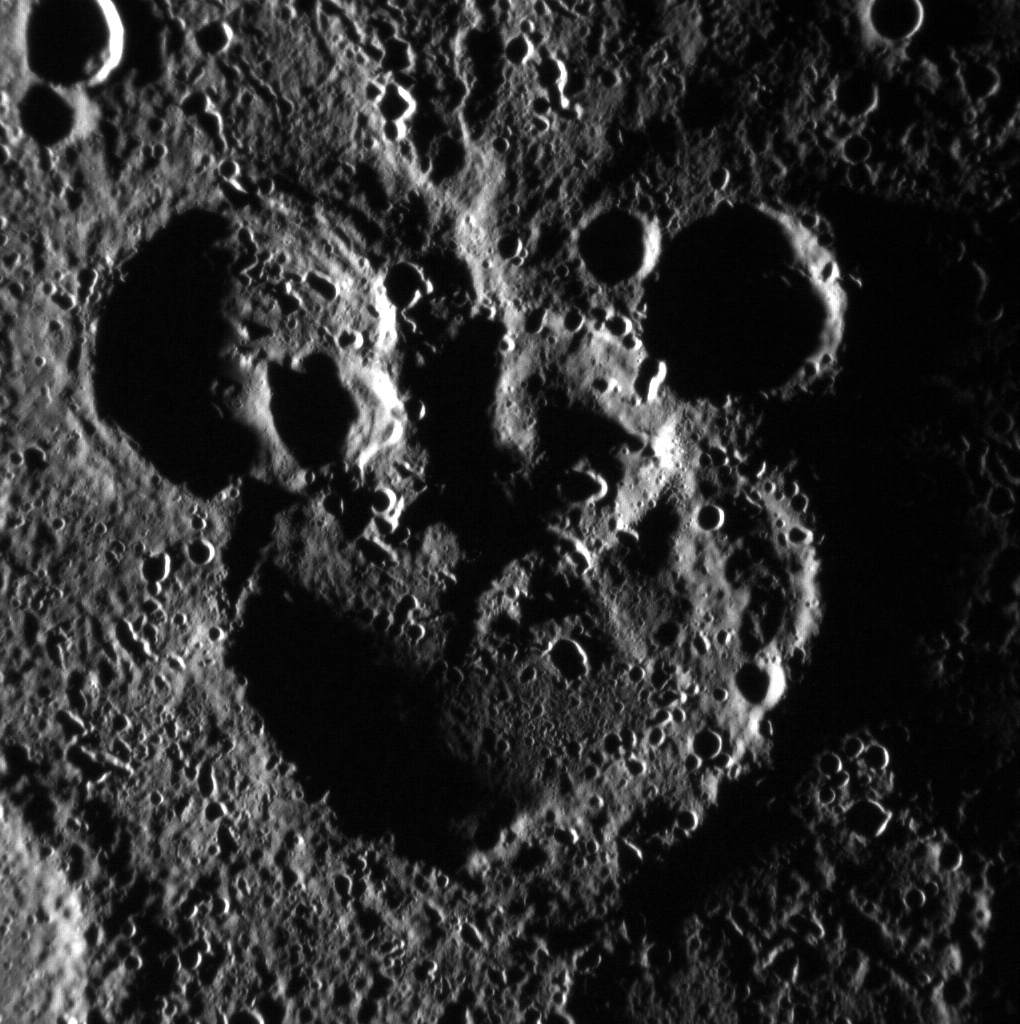
The International Astronomical Union (IAU) recently approved a proposal from the MESSENGER Science Team to assign 23 new names to impact craters on Mercury. The IAU has been the arbiter of planetary and satellite nomenclature since its inception in 1919. In keeping with the established naming theme for craters on Mercury, all of the newly designated features are named after famous deceased artists, musicians, or authors.

http://messenger.jhuapl.edu/news_room/details.php?id=219

Would have thought Andy Warhol made his own crater?

N.
 
MESSENGER Mission News
May 8, 2012
http://messenger.jhuapl.edu/


MESSENGER Gains Deputy Principal Investigator

Vancouver, B.C. -- Larry Nittler, a staff scientist in the Department of Terrestrial Magnetism of the Carnegie Institution of Washington, has been named deputy principal investigator of the MESSENGER mission. MESSENGER Principal Investigator Sean Solomon, of CIW, delivered the announcement this morning at the first plenary of the 26th meeting of the MESSENGER Science Team meeting in Vancouver, B.C.

Solomon, a research scientist and director emeritus at CIW, has led NASA's orbiting exploration of the planet Mercury since its inception. In July, he will assume the directorship of Columbia University's Lamont-Doherty Earth Observatory.

Nittler received a bachelor's degree in Physics from Cornell University in 1991, and a Ph.D. in Physics from Washington University in 1996. After a two-year postdoctoral fellowship at CIW, he took a position as an astrophysicist at NASA's Goddard Space Flight Center, where he worked on the Near Earth Asteroid Rendezvous mission to the asteroid 433 Eros. His analysis of NEAR measurements helped provide the first chemical analyses of a minor planet.

Nittler returned to Carnegie as a staff scientist in 2001. In addition to remote-sensing geochemical measurements, his research focuses on the laboratory study of extraterrestrial materials, including meteorites and interplanetary dust particles, to understand the formation of the solar system, the galaxy, and the universe and to identify the materials involved. In particular, he has led investigations of the analysis of samples returned by NASA's Stardust and Genesis missions.

"I'm delighted that Larry has agreed to shoulder new responsibilities for the MESSENGER mission," says Solomon. "He's been a Participating Scientist on MESSENGER for the past five years, he's served as deputy chair of the Science Team's Geochemistry Discipline Group for the past four, and he is leading the analysis of X-Ray Spectrometer observations of Mercury's surface composition. That he is now taking on a still larger role will enable a smooth transition in the partitioning of mission management tasks even as I assume additional duties in a new position."

"I'm honored and excited to take on this expanded role in MESSENGER," says Nittler. "It's a wonderful opportunity to help ensure the continued success of a ground-breaking planetary mission."
 
NewScientist: Magnetic space whirlpools give Mercury a plasma shower:
To the list of scary things in space you can now add giant magnetic vortices. Huge swirls at the edge of Mercury's magnetosphere – where the planet's magnetic field meets the energetic charged particles of the solar wind – help shower the planet in solar plasma.

Kelvin-Helmholtz waves occur at the boundary between two fluids, such as two different bodies of air in Earth's atmosphere. They are most visible on Earth in the form of strange wave-like clouds.

KH waves also occur in the magnetospheres of some planets, and NASA's Messenger spacecraft found them around Mercury.

A new study of Messenger's data suggests the waves are larger than thought – two to three times the size of their terrestrial counterparts – and occur 10 to 30 times more frequently too.

Messenger also detected solar plasma in Mercury's magnetosphere linked to the KH waves, suggesting the large waves shuttle plasma towards the planet.

"KH waves are more important for mass and energy transfer than we imagined," says Torbjörn Sundberg at NASA's Goddard Space Flight Center in Greenbelt, Maryland.

{...}


Journal of Geophysical Research: MESSENGER orbital observations of large-amplitude Kelvin-Helmholtz waves at Mercury's magnetopause
 
...I must have missed the memo that says Mercury has a magnetic field. Huh.
 
We knew nearly nothing about that planet. MESSENGER is learning us a lot of things about it, mapped most of the surface, and its not finished. Another very successful unmanned mission. :thumbup:
 
Back
Top