

- Joined
- Feb 13, 2008
- Messages
- 5,398
- Reaction score
- 8
- Points
- 0
- Location
- Khimki
- Website
- tigerofsiberia.livejournal.com
The prime objective of the EUMETSAT Polar System (EPS) Metop mission series is to provide continuous, long-term datasets, in support of operational meteorological and environmental forecasting and global climate monitoring.
The EPS programme consists of a series of three polar orbiting Metop satellites, to be flown successively for more than 14 years, from 2006, together with the relevant ground facilities. Each satellite has a nominal lifetime in orbit of five years, with a six month overlap between the consecutive satellites (i.e. between Metop-A and Metop-B, and between Metop-B and Metop-C), providing more than 14 years of service. The European and American satellites carry a set of identical sensors: AVHRR/3 and the ATOVS suite consisting of AMSU-A, HIRS/4 and MHS. NOAA provides most of the joint instruments on board the satellites and EUMETSAT has developed and provides NOAA with the Microwave Humidity Sounder (MHS). In addition, the Metop satellites carry a set of European sensors, IASI, ASCAT, GOME-2 and GRAS, aimed at improving atmospheric soundings, as well as measuring atmospheric ozone and near-surface wind vectors over the ocean.


Launch location:
Baikonur Launch pad no. 31/6 45°59'46.16"N, 63°33'51.29"E

[table="head"]{colsp=5}Launch times
Time Zone|Australia - Sydney/AEST|Baikonur (UTC+6)|Moscow / MSKS (UTC+4)/|Universal / UTC|Washington / EDT
Launch time:|4:28:40 a.m.|22:28:40|20:28:40|16:28:40|12:28:40 p.m.
on:|Sep 18, 2012|Sep 17, 2012|Sep 17, 2012|Sep 17, 2012|Sep 17, 2012
{colsp=5}[highlight][eventTimer]2012-09-18 16:28:40?before|after;%dd% Days %hh% Hours %mm% Minutes %ss% Seconds %c%[/eventTimer] MetOp-B Launch[/highlight][/table]
Live Coverage Of The Launch:
ESA Webcast
http://www.esa.int/esaLP/SEMZD7AYT6H_LPmetop_0.html
Eumetsat live webcast
http://www.livestream.com/metop?utm_source=lsplayer&utm_medium=embed&utm_campaign=footerlinks
Arianespace Webcast
http://www.eumetsat.int/Metop-B/index.html
TSENKI video streams (Russian + English)
http://www.tsenki.com/broadcast/broadcast/
Launch Press Kit:
http://www.arianespace.com/images/launch-kits/launch-kit-pdf-eng/Metop-B-presskit.pdf
PAYLOAD
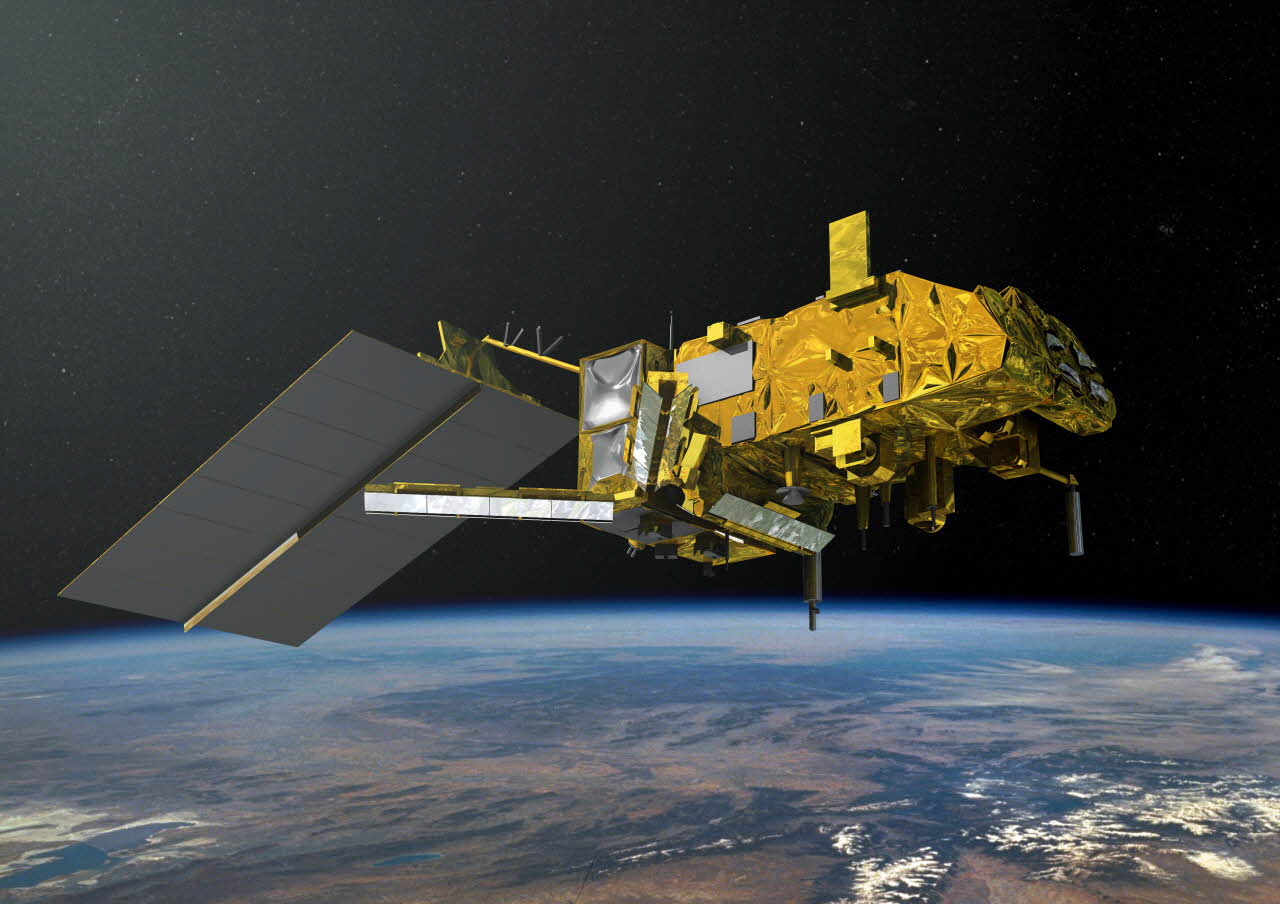
MetOp-B satellite.
Spacecraft Overview
The Metop satellites are Europe’s first operational meteorological satellites in polar orbit. They constitute the space segment of the EUMETSAT
Polar System (EPS) delivering data for numerical weather prediction (NWP) – the basis of modern weather forecasting – and climate and
environmental monitoring. Flying at an altitude of 817 km, each Metop satellite carries the same sophisticated suite of instruments providing
fine-scale global data, which can only be gathered in the low Earth orbit, such as vertical profiles of atmospheric temperature and moisture, wind
speed and direction at the ocean surface, and some atmospheric trace gases. Observations from Metop-A have significantly improved weather
forecasts up to 10 days ahead. These forecasts are essential to protect life and limit damage to property, but they also benefit the weathersensitive
sectors of the European economy, especially energy, transportation, construction, agriculture and tourism. The three Metop satellites,
launched sequentially, will provide continuous data until 2020. The first satellite, Metop-A, was launched in 2006, and the third and final
satellite, Metop-C, is scheduled for launch at the end of 2017. ESA is responsible for the development of the three Metop satellites fulfilling
EUMETSAT requirements, with major instruments provided by CNES and NOAA. ESA also carries out operations for the Launch and Early Orbit
Phase to place the satellites in polar orbit, before handing them over to EUMETSAT for exploitation. The Metop satellites are built by EADS
Astrium as the prime contractor. EUMETSAT develops all ground systems required to deliver products and services to users and to respond to
their evolving needs, and operates the full system for the benefit of users. EUMETSAT also procures all Metop launch services. The EPS
programme is Europe’s contribution to the Initial Joint Polar System (IJPS), with the US National Oceanic and Atmospheric Administration
(NOAA).
[table="head"]Characteristics|
[/table]
Launch Vehicle:
[table="head"]{colsp=2}Characteristics
 |[table="head"]{colsp=2}

[/table]
[/table]
The launch vehicle's reliability standings
According to http://www.spacelaunchreport.com/log2011.html#rate:
Launch Profile

After lift-off from the Baikonur Cosmodrome, the flight of the three lower stages of
the Soyuz launch vehicle will last for 8 min. and 48 sec. At this time, the separation
between the Soyuz third stage and the nose module consisting of the Fregat upper
stage and its Metop-B payload will occur, putting the Fregat upper stage into orbit.
Ground track over the Western Russia

The three lower Soyuz stages fall back down to Earth.
The Fregat upper stage (which carries the spacecraft) will then fire its own engine,
taking the nose module into a transfer orbit above the Earth. After this first burn, the
Fregat upper stage will control the nose module’s direction towards the Sun to
maintain proper thermal conditions for the Metop-B spacecraft during the following
coast phase, which lasts for about 45 minutes.
At the correct point on this orbit, Fregat will fire again, to reach the Sun-Synchronous
Orbit. The upper stage will then turn the nose module to stabilize it and will release
the Metop-B spacecraft. Separation will occur 1 hour 08 min. after lift-off.

The planned orbital parameters at separation are the following:
Semi Major Axis:|7 172 km
Orbit inclination:|98.74°
Eccentricity:|0.00286
The nominal mission duration (from lift-off to the last spacecraft separation) is
1 hour, 09 minutes.
Weather forecast for Baikonur, Kazakhstan for September 17, 2012 (10 p.m.)
Time|Temps|Wind Chill|Heat Index|UV Index|Dew Point|Relative Humidity|Precip|Snow|Clouds|Visibility|Wind|Weather
10 PM|19°C|19°C|19°C|0 Low|7°C|47%|0%|0%|1%|16KM|S 1mph|
 Clear
Clear
Source References
http://www.esa.int/
http://www.eumetsat.int
http://www.starsem.com
http://www.thalesgroup.com
http://www.federalspace.ru
http://forum.nasaspaceflight.com
http://www.novosti-kosmonavtiki.ru
http://www.tvroscosmos.ru
http://www.tsenki.com
http://www.spacelaunchreport.com
http://www.intellicast.com/Local/Forecast.aspx
The EPS programme consists of a series of three polar orbiting Metop satellites, to be flown successively for more than 14 years, from 2006, together with the relevant ground facilities. Each satellite has a nominal lifetime in orbit of five years, with a six month overlap between the consecutive satellites (i.e. between Metop-A and Metop-B, and between Metop-B and Metop-C), providing more than 14 years of service. The European and American satellites carry a set of identical sensors: AVHRR/3 and the ATOVS suite consisting of AMSU-A, HIRS/4 and MHS. NOAA provides most of the joint instruments on board the satellites and EUMETSAT has developed and provides NOAA with the Microwave Humidity Sounder (MHS). In addition, the Metop satellites carry a set of European sensors, IASI, ASCAT, GOME-2 and GRAS, aimed at improving atmospheric soundings, as well as measuring atmospheric ozone and near-surface wind vectors over the ocean.
Launch location:
Baikonur Launch pad no. 31/6 45°59'46.16"N, 63°33'51.29"E
[table="head"]{colsp=5}Launch times
Time Zone|Australia - Sydney/AEST|Baikonur (UTC+6)|Moscow / MSKS (UTC+4)/|Universal / UTC|Washington / EDT
Launch time:|4:28:40 a.m.|22:28:40|20:28:40|16:28:40|12:28:40 p.m.
on:|Sep 18, 2012|Sep 17, 2012|Sep 17, 2012|Sep 17, 2012|Sep 17, 2012
{colsp=5}[highlight][eventTimer]2012-09-18 16:28:40?before|after;%dd% Days %hh% Hours %mm% Minutes %ss% Seconds %c%[/eventTimer] MetOp-B Launch[/highlight][/table]
Live Coverage Of The Launch:
ESA Webcast
http://www.esa.int/esaLP/SEMZD7AYT6H_LPmetop_0.html
Eumetsat live webcast
http://www.livestream.com/metop?utm_source=lsplayer&utm_medium=embed&utm_campaign=footerlinks
Arianespace Webcast
http://www.eumetsat.int/Metop-B/index.html
TSENKI video streams (Russian + English)
http://www.tsenki.com/broadcast/broadcast/
Launch Press Kit:
http://www.arianespace.com/images/launch-kits/launch-kit-pdf-eng/Metop-B-presskit.pdf
PAYLOAD
MetOp-B satellite.
Spacecraft Overview
The Metop satellites are Europe’s first operational meteorological satellites in polar orbit. They constitute the space segment of the EUMETSAT
Polar System (EPS) delivering data for numerical weather prediction (NWP) – the basis of modern weather forecasting – and climate and
environmental monitoring. Flying at an altitude of 817 km, each Metop satellite carries the same sophisticated suite of instruments providing
fine-scale global data, which can only be gathered in the low Earth orbit, such as vertical profiles of atmospheric temperature and moisture, wind
speed and direction at the ocean surface, and some atmospheric trace gases. Observations from Metop-A have significantly improved weather
forecasts up to 10 days ahead. These forecasts are essential to protect life and limit damage to property, but they also benefit the weathersensitive
sectors of the European economy, especially energy, transportation, construction, agriculture and tourism. The three Metop satellites,
launched sequentially, will provide continuous data until 2020. The first satellite, Metop-A, was launched in 2006, and the third and final
satellite, Metop-C, is scheduled for launch at the end of 2017. ESA is responsible for the development of the three Metop satellites fulfilling
EUMETSAT requirements, with major instruments provided by CNES and NOAA. ESA also carries out operations for the Launch and Early Orbit
Phase to place the satellites in polar orbit, before handing them over to EUMETSAT for exploitation. The Metop satellites are built by EADS
Astrium as the prime contractor. EUMETSAT develops all ground systems required to deliver products and services to users and to respond to
their evolving needs, and operates the full system for the benefit of users. EUMETSAT also procures all Metop launch services. The EPS
programme is Europe’s contribution to the Initial Joint Polar System (IJPS), with the US National Oceanic and Atmospheric Administration
(NOAA).
[table="head"]Characteristics|
MetOp-B
Picture:
|
Customer:
|- ESA & European Organisation for the Exploitation of Meteorological Satellites (EUMETSAT)
Prime contractor:
|- EADS Astrium
Mass at Separation:
|- 4085 kg
Stabilization:
|- 3 axis stabilized
Dimensions:
|- 6.3 m high, 2.5 m by 2.5 m wide (in-Orbit configuration 17.6 m x 6.6 m x 5.0 m)
Batteries:
|- 1 813 W power demand
Life time:
|- 5 years
Instruments:
|- IASI - Infrared Atmospheric Sounding Interferometer
- GOME-2 - Global Ozone Monitoring Experiment–2
- MHS - Microwave Humidity Sounder
- ASCAT - Advanced Scatterometer
- GRAS - Global navigation satellite systems radio occultation GNSS Receiver for Atmospheric Sounding
- AMSU-A1 and A2 Advanced Microwave Sounding Units
- HIRS/4 High Resolution Infrared Sounder
- AVHRR Advanced Very High Resolution Radiometer
- A-DCS Advanced Data Collection System
- SEM-2 Space Environment Monitor
- SARP-3 Search And Rescue Processor
- SARR Search And Rescue Repeater
[/table]
Launch Vehicle:
[table="head"]{colsp=2}Characteristics
Soyuz-2.1a
Prime contractor:
|- Samara Space Sentre (Energia Holding enterprise)

GRAU Index:
|- 14A14
Height:
| 51.1 mDiameter:
| max 10.3 mLiftoff mass:
| 313 metric tonnesPayload mass:
| up to 6830 kg (a launch to LEO from Plesetsk)1st stage (boosters B, V, G, D):
|- 4 X RD-107 engines
- Propellants (T-1 Kerosene and LOX)
- Thrust/ISP in vacuum - / 320.2 s
- Thrust/ISP at sea level 85.6 tonnes / 263.3 s
2nd stage (core A):
|- 1 X RD-108 engine
- Propellants (T-1 Kerosene and LOX)
- Thrust/ISP in vacuum 94 tonnes / 320.6 s
- Thrust/ISP at sea level 80.8 tonnes / 257.7 s
3rd stage (block I):
|- 1 X RD-0110 engine
- Propellants (T-1 Kerosene and LOX)
- Thrust/ISP in vacuum 30.38 tonnes / 326 s
Upper Stage:
|
- GRAU Index: -
- Common Name: Fregat (meaning Frigate)
- Designer & Manufacturer: Lavochkin Association (NPO)
- Dimensions: Length 2.4 m, Diameter (max) 3.350 m
- Empty Mass 930 kg
- Propellants 5250 kg max
- Main Engine: 1 X S5.92
- Thrust in vacuum 2.0 tonnes of force (full power)
- Thrust in vacuum 1.4 tonnes of force (small power)
- ISP 333.2 s
Payload Fairing:
|- Diameter 3.7 m
- Length 7.7 m
[/table]
[/table]
The launch vehicle's reliability standings
According to http://www.spacelaunchreport.com/log2011.html#rate:
Code:
================================================================
Vehicle     Successes/Tries Realzd Pred  Consc. Last     Dates
                             Rate  Rate* Succes Fail
================================================================
Soyuz 2-1a/Fregat 8     9#   .89  .82      6    5/21/09  2006-

# Does not include one successful suborbital Soyuz 2-1a test
flight performed in 2004.After lift-off from the Baikonur Cosmodrome, the flight of the three lower stages of
the Soyuz launch vehicle will last for 8 min. and 48 sec. At this time, the separation
between the Soyuz third stage and the nose module consisting of the Fregat upper
stage and its Metop-B payload will occur, putting the Fregat upper stage into orbit.
Ground track over the Western Russia
The three lower Soyuz stages fall back down to Earth.
The Fregat upper stage (which carries the spacecraft) will then fire its own engine,
taking the nose module into a transfer orbit above the Earth. After this first burn, the
Fregat upper stage will control the nose module’s direction towards the Sun to
maintain proper thermal conditions for the Metop-B spacecraft during the following
coast phase, which lasts for about 45 minutes.
At the correct point on this orbit, Fregat will fire again, to reach the Sun-Synchronous
Orbit. The upper stage will then turn the nose module to stabilize it and will release
the Metop-B spacecraft. Separation will occur 1 hour 08 min. after lift-off.
The planned orbital parameters at separation are the following:
Orbit inclination:|98.74°
Eccentricity:|0.00286
1 hour, 09 minutes.
Weather forecast for Baikonur, Kazakhstan for September 17, 2012 (10 p.m.)
10 PM|19°C|19°C|19°C|0 Low|7°C|47%|0%|0%|1%|16KM|S 1mph|
Source References
http://www.esa.int/
http://www.eumetsat.int
http://www.starsem.com
http://www.thalesgroup.com
http://www.federalspace.ru
http://forum.nasaspaceflight.com
http://www.novosti-kosmonavtiki.ru
http://www.tvroscosmos.ru
http://www.tsenki.com
http://www.spacelaunchreport.com
http://www.intellicast.com/Local/Forecast.aspx


