Multi-Language product labelling in your country.

Turbinator

New member
Joined
Dec 12, 2009
Messages
1,145
Reaction score
0
Points
0
Location
Tellurian

As someone who lives in Canada, that video clip is quite relevant. Every time I pick up a product in store, or every time I need to read cooking instructions on products at home; I always seem to get the French side. And every time I have a bottled drink on my table, the French side of the label is facing me. Always. :lol: I don't mind actually, I am very proud of the fact that my country has 2 official languages.

How is product labelling done in your country? In Canada every single product has two 'faces', one English one French.

Sometimes they cleverly combine English and French on one face, I can't find any proper pictures other than the simple one I found here, but it demonstrates the point:

product-of-canada-label2.jpg


.​
 
Last edited:
Well, I'm from Brazil, and there pretty much every product is labelled in portuguese AND spanish... not because Brazil speaks spanish, but because those products also go out to other countries in South America, and they can't be bothered to make different labels for each country :lol:

Cheers
 
Here, we don't have two sides. We have 5 :lol:. I don't usually notice these things, but grabing a pack of batteries, I can see English, French, German, Italian, Greek, Dutch and Spanish. Curiously, no Portuguese.
And that's how it is with much of the products here. Instruction manuals almost always come with these languages, not always with our own language :S (except of course for the national products)
 
Depends. For simple, everyday items, it's English and Spanish. Sometimes French. Though depending on the item, I've seen a single item with more than 15 languages (English, French, Spanish, German, Chinese, Korean, Japanese, Polish, Hebrew to name a few). So it just depends, but the more complex something is, typically the more languages attached. And I love the Simpsons clip, that show is awesome :cheers:
 
Living here in NB, the only officially bilingual province in this officially bilingual country (:P) I've come to notice that the French labels are almost always facing outwards on the shelves in stores. But then again, I was shopping in Dieppe, where 'bilingual' means 'French and possibly some English.' :rolleyes:
 
Most products in Slovenia are labeled in Slovenian on the front - except for brand names, logos,... but the back side has brief instructions in many languages. Mostly those spoken in the Balkan and Slovenia's neighboring nations. Depends on where the product is marketed to...
 
Except of Russian we have additional labelling on the half of post-soviet countries languages like Ukrainean, Kazakh, Georgian, Uzbek and god knows what else. Sometimes there are so many languages on one label that you can hardly read these letters because they had to make them as small as possible to fit them all. Or it can be plain Russian. Or Chinese :lol:
 
How is product labelling done in your country? In Canada every single product has two 'faces', one English one French.

Only two? :lol:

Switzerland has three official languages to start with, and a lot of immigrants and tourists, so most product descriptions come in 10 or even more languages (among not rarely there is exotic stuff like chinese).

Hmmm... first the milk in bags thread, now this. Today seems to be official "Switzerland pwns Canada"-day! :cheers:
 
In finland everything has to have text in both swedish and finnish by law (bi lingual country), but most of the time there are other languages as well like german, french. english or so.

Don't know about other countries, but in finland if you take lets say a yoghurt that states it's banana or something you have to have the percentage showing how much in consists of said ingredient
 
In franchise supermarkets, most stuff has labels in Rumanian, Magyar, Bolgarian and a few other Balkan/eastern European languages. Sometimes, the Serbian labels are only included on a sticker, as an afterthought.
 
Don't know about other countries, but in finland if you take lets say a yoghurt that states it's banana or something you have to have the percentage showing how much in consists of said ingredient

Hah, the recent progress in Russia is that now you cannot name your product 'Milk' if there's no milk in it...
 
Whilst we have one official language the local councils have had to wake up to the multi-ethnicity of the people that live inside their boundaries. Therefore, all government documentation is in English but there is nearly always a page at the page that has the same paragraph in about 20 languages that basically says 'you can get a copy of this document in these languages'.
 
Mostly Dutch and French, because the products get shipped to Belgium where they speak 2 languages.
I used to live in Belgium where they actually have 3 languages (but it's only a tiny bit at the south-east where they speak German and no-one cares about them).

Things were labelled in both languages, but a lot of things were labelled twice in each language, as if you had French first and then Flemish, it would imply that French was more important than Flemish. So to counteract this they would put it on four times, first in French, then in Flemish. Then, to make sure that the Flembos didn't get all emo on them, they'd do it again - this time Flemish first and then French. So on a carton of milk (no bags of milk you weird Canadian freaks) you'd have:

Lait
Melk
Melk
Lait.

Then if that wasn't bad enough, they'd do the opposite on the other side of the carton just to even it out:

Melk
Lait
Lait
Melk

Weird
 
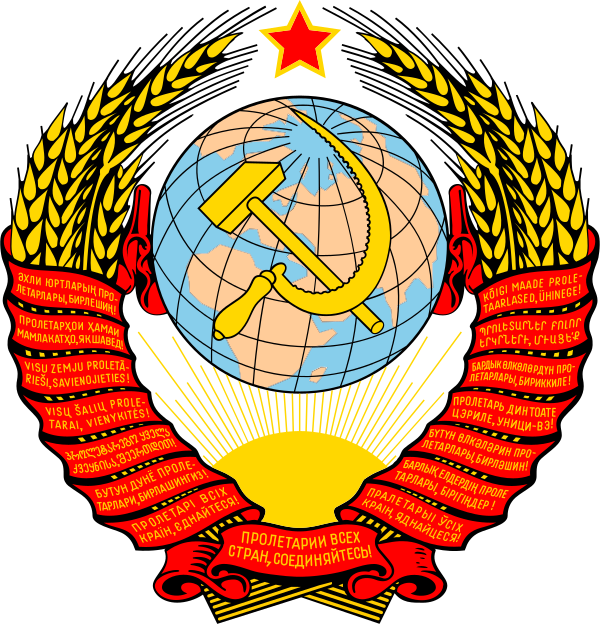
Correct labeling of a product in all languages of a multi-national country can sometimes be driven to the ultimate level:

600px-Coat_of_arms_of_the_Soviet_Union.svg.png


I've forgot about it!:facepalm:

---------- Post added at 21:20 ---------- Previous post was at 21:11 ----------

I used to live in Belgium ....

Lait
Melk
Melk
Lait.

Then if that wasn't bad enough, they'd do the opposite on the other side of the carton just to even it out:

Melk
Lait
Lait
Melk

Weird

This is the WEIRDEST thing I've heard today about milk.
 
Back
Top