Question Multiplayer Star-Trek with LCARS panels

EndeavourCmdr

Addon Developer
Addon Developer
Joined
Dec 17, 2010
Messages
76
Reaction score
2
Points
8
Location
Renton, WA
So today I was doing a little coding on some LCARS panels, just to help me learn a few new things in C#. That got me thinking about Orbiter of course, and now I'd like to ask a question.

I see a lot of addons out now involving Star Trek. Orbiter also has the ability for external programs to interface with its API. Would anyone be interested in an addon which lets mutiple players share control of an Orbiter vessel, via LCARS conn stations like in Star Trek TNG and Voyager?

I can build the LCARS panels for each of the stations, IE: Helm, Security, Engineering, Comm, Scientific, etc... and I am pretty sure that I am adept enough at coding to make them all interface and work together. The only parts that I would need help with would be getting this to actually matter in an Orbiter addon.

Would there be sufficient interest in such an project?
 
sure, sounds interesting to me, I attempted something similar but with automatic LCARS layout, was pretty complicated.
 
This sound nice, but I wouldn't jump directly into multiplayer mode with this, as it gets complex quite fast. What about creating your LCARS-style interfaces as simple MFDs first?
 
This sound nice, but I wouldn't jump directly into multiplayer mode with this, as it gets complex quite fast. What about creating your LCARS-style interfaces as simple MFDs first?

Actually it would be far easier for me to implement the panels as C# Windows Forms based controls, external to Orbiter itself. I am already familiar with the System.Drawing class and the Matrix class, so instead of having to learn a new API, I could just use native Windows API functions.

---------- Post added at 06:39 PM ---------- Previous post was at 06:38 PM ----------

sure, sounds interesting to me, I attempted something similar but with automatic LCARS layout, was pretty complicated.

Would you mind elaborating on this a bit Urwumpe? I'd be very interested to hear how you were implementing it.
 
Actually it would be far easier for me to implement the panels as C# Windows Forms based controls, external to Orbiter itself. I am already familiar with the System.Drawing class and the Matrix class, so instead of having to learn a new API, I could just use native Windows API functions.

WinForms is no native Windows API, but a .NET API. Orbiter uses native Windows API, but can use .NET Forms through mixed-mode glue-assemblies, too. See here.

That said, you could also use something like orb:connect to interface to Orbiter from a .NET application.

regards,
Face
 
Would you mind elaborating on this a bit Urwumpe? I'd be very interested to hear how you were implementing it.

I tried finding a system to turn generic structured data of a spacecraft (systems, crew, environment) into LCARS style displays, capable of getting configured by the user in terms of visibility and priorities. have an early Java prototype here, but the output is still poor and not really readable. the layout is lacking some more relations to structure itself useful.
 
One problem I see with the "fun" factor here--none of the Star Trek ships for Orbiter are complex enough to justify having more than one person controlling them, much less a whole bridge crew. In-universe, the ship is a massively complex combination of parts, and you need that bridge crew to keep everything running smoothly. In Orbiter, the ship is a pretty model with a very powerful rocket on the back and (in some cases) a light show for "weapons."

Making LCARS-style panels for every station might not be that difficult, but simulating the ship's systems fully enough so that most of the functions on those panels actually do something--there's the difficult part.
 
Making LCARS-style panels for every station might not be that difficult, but simulating the ship's systems fully enough so that most of the functions on those panels actually do something--there's the difficult part.

Exactly what my concern was. I wonder if this would end up requiring development of a brand-new, highly-functional USS Enterprise.....

I'd be interested honestly in something like that, even though I'm not that much of a trekkie. The LCARs system has always interested me, and there are enough systems to worry about that something like this might be fun - and doable.
 
Exactly what my concern was. I wonder if this would end up requiring development of a brand-new, highly-functional USS Enterprise.....

Sounds like development hell to me and then how do you get people together to use the ship? I've seen OMP sessions for VSA's that were supposed to have four people have major problems getting just one person in ontime - not OMP's fault but the fault of the VSA's.

I'd be interested honestly in something like that, even though I'm not that much of a trekkie. The LCARs system has always interested me, and there are enough systems to worry about that something like this might be fun - and doable.

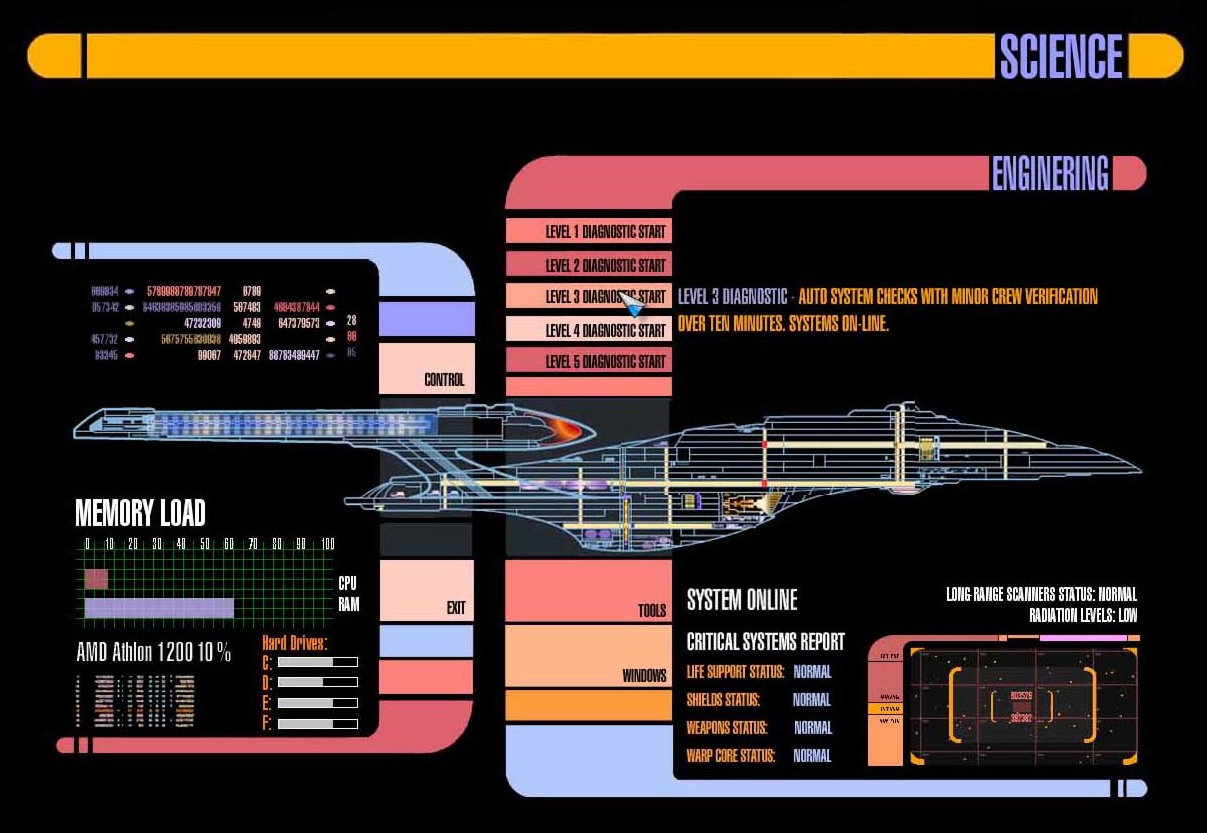
LCARS layout steals a lot of screen real estate for menus and headings which would be better spent displaying data. I am not a fan of LCARS layouts because, to me, they go against common sense and are far too clunky.
 
LCARS layout steals a lot of screen real estate for menus and headings which would be better spent displaying data. I am not a fan of LCARS layouts because, to me, they go against common sense and are far too clunky.

I dislike too crowded displays, but the typical LCARS displays from the TNG franchise is not done for humans to work with, really rather fancy than useful.
 
A crowded interface would be an actual aircraft/manned spacecraft interface.

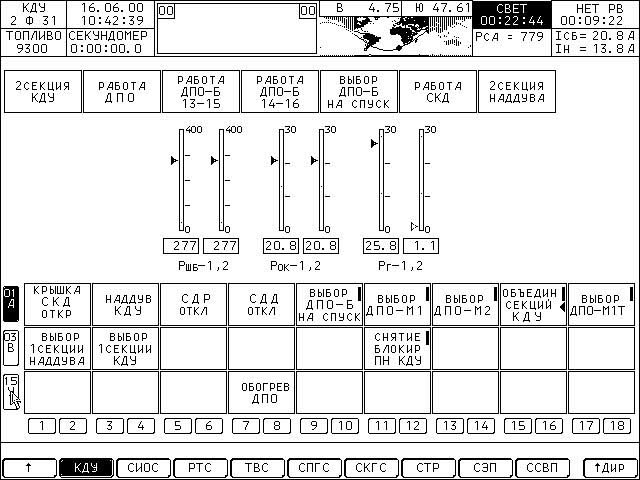
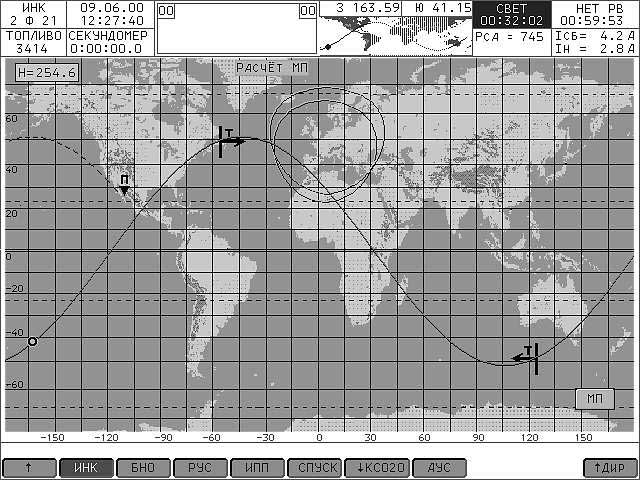
no, not really - only NASA does that. Russia does better stuff there.
 
A crowded interface would be an actual aircraft/manned spacecraft interface.

Huh? Explain that please because a typical Shuttle glass cockpit display is busy but not crowded:

cockpit.jpg


Modern glass cockpit (737) - the pinnacle of simplicity and relevant information for phase of flight:

737-glass-cockpit.jpg
 
Last edited:
Must be all those switches, knobs, keypads, and bars/numbers on the screens.

(but we're getting too :offtopic: in here anyway)
 
Must be all those switches, knobs, keypads, and bars/numbers on the screens.

Most flightdecks operate on a darkend cockpit idea, that is that they stay OFF unless there is an issue. The layout is clean, simple and obviously people are trained to understand it.

(but we're getting too :offtopic: in here anyway)

Not at all, we are talking about LCARS and screen layouts. LCARS is cluttered - imagine TransX or IMFD using that as a layout.

ingr_lcars_sovereign.jpg
 
What does all that Russian mean? In all those boxes?

I admit though, the random numbers in LCARS are just there to look cool.
 
I admit though, the random numbers in LCARS are just there to look cool.

You're missing the point. The whole of LCARS is just there to look cool and futuristic. See this:

The LCARS graphical user interface was designed by scenic art supervisor and technical consultant Michael Okuda. The original design concept was influenced by a request from Gene Roddenberry that the instrument panels not have a great deal of activity on them. This minimalized look was designed to give a sense that the technology was much more advanced than in the original Star Trek.[2] The early display panels were made out of colored Plexiglas with light behind them, a technique that can produce complex-looking displays cheaply. As the show progressed, use of animations increased. Most were displayed on video equipment built into the sets.[citation needed]
On Star Trek: The Next Generation, many of the buttons were labeled with the initials of members of the production crew, and were referred to as "Okudagrams."[1]
When Michael Okuda was asked about the design of the LCARS display, he responded "I came up with the LCARS style in part because of Gene Roddenberry's directive that he wanted his new Enterprise to be so advanced that it looked simple and clean. The other part of the LCARS style was that it had to be something that could be manufactured quickly and easily on a television budget."
([ame="http://en.wikipedia.org/wiki/LCARS"]LCARS - Wikipedia, the free encyclopedia[/ame])

LCARS is a studio prop, not a proper user interface. Its primary purpose is to make the set look like it's doing something funky handwavium, but in reality, trying to use the stuff is just frustrating and useless. I've seen a couple of attempts to make it work on touch-devices (PALM or iPad or similar) and while it looks good and touches fine, there's just too much screen space being completely wasted.

I too prefer the darkened cockpit ideal. There's no need for attention to be drawn to an element unless the element REQUIRES your attention because something is wrong. It reduces cockpit / flight deck clutter fantastically.
 
Back
Top