Updates NASA’S First Asteroid Deflection Mission-Double Asteroid Redirection Test (DART)

The interpolated video someone is likely to stitch together is going to be amazing.

 
I mean, really NASA, the folks who are watching this are self-selected geeks. GIVE US THE DATA!!!

Yes.
In God we trust, all others bring data.
I want to see an overlay on the cam feed with range, range-rate, pitch, roll, yaw, and more.

JPL did raise the bar quite high...
 
Rocks visible in Didymos!
Predicted miss distance: 17 meters!
:hailprobe:
 
Rocks visible every where.... the end is near....
 
Big pile of rubble... and IMPACT! :hailprobe:
 
Interesting to see that the little seemed to have its own rock orbiting just off its surface. or it could just be a big rock peeking out of the shadow.
 
Last edited:
I'm sure the engineers that in the 60s that went thru several crashes trying to land their probes on the Moon or Mars are probably a bit torn with the celebrations of a crash... :unsure:
 
Scott Manleys summary (so far):
 
The ATLAS observations were most impressive. That little asteroid took a good wallop. It will be interesting seeing the numbers that come out of this event. Now, cummon guys ... Launch Hera!
 
Physical properties of asteroid Dimorphos as derived from the DART impact
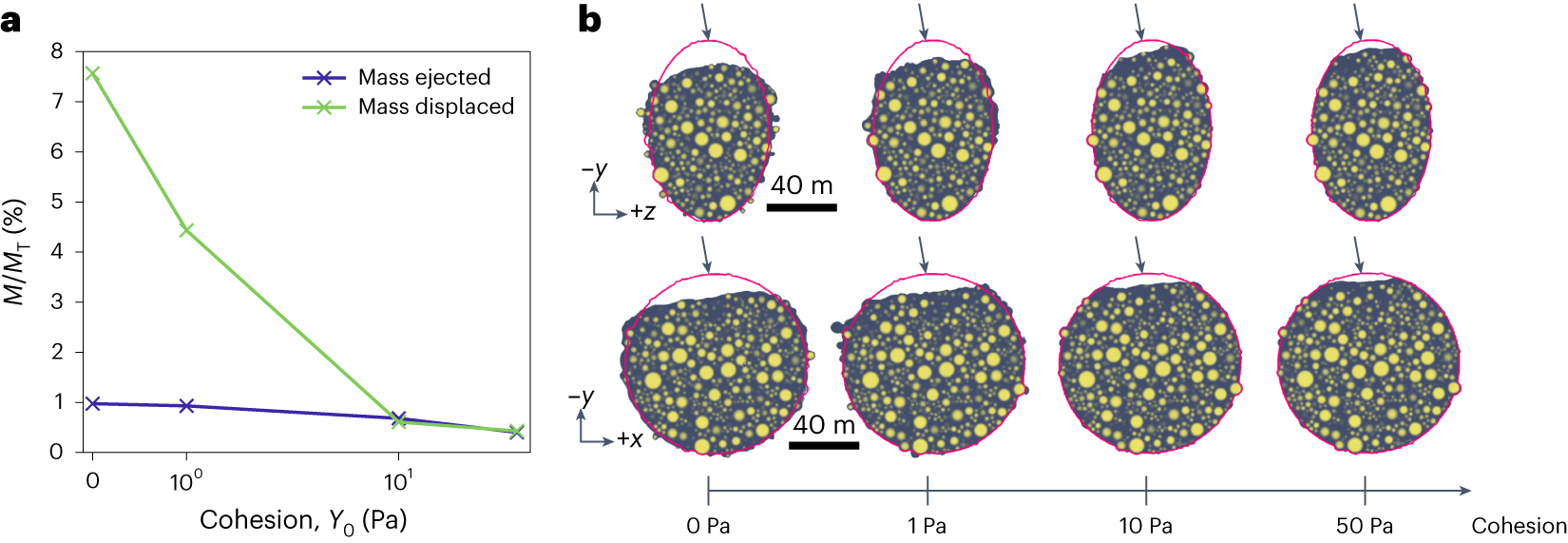
On 26 September 2022, NASA’s Double Asteroid Redirection Test (DART) mission successfully impacted Dimorphos, the natural satellite of the binary near-Earth asteroid (65803) Didymos. Numerical simulations of the impact provide a means to find the surface material properties and structures of the target that are consistent with the observed momentum deflection efficiency, ejecta cone geometry and ejected mass. Our simulation that best matches the observations indicates that Dimorphos is weak, with a cohesive strength of less than a few pascals, like asteroids (162173) Ryugu and (101955) Bennu. We find that the bulk density of Dimorphos ρB is lower than ~2,400 kg m−3 and that it has a low volume fraction of boulders (≲40 vol%) on the surface and in the shallow subsurface, which are consistent with data measured by the DART experiment. These findings suggest that Dimorphos is a rubble pile that might have formed through rotational mass shedding and reaccumulation from Didymos. Our simulations indicate that the DART impact caused global deformation and resurfacing of Dimorphos. ESA’s upcoming Hera mission may find a reshaped asteroid rather than a well-defined crater.
41550_2024_2200_Fig4_HTML.png

https://www.nature.com/articles/s41550-024-02200-3
 
Back
Top