News Nasa Finds 7 Rocky planets in 1 star system

They didn't just find them. They already got 360 degrees footage from surface on one of them. :P :lol:
An astral travel with an astral camera?
 
Hm, the star is only 2300K. Isn't that too low spectrally to support photosynthesis?
 
Hm, the star is only 2300K. Isn't that too low spectrally to support photosynthesis?

That corresponds to a peak emission in the infrared ~1.200 microns. Visible wavelengths are shorter than .700 microns, but there might still be enough emission in the visible red to be usable for photosynthesis. All depends on overall spectral irradiation as to whether there is enough energy to be usable. Plants might grow really, really slowly.
 
Last edited:
Wouldn't the dark (cold) side freeze out a lot of the atmosphere, especially its water?

Depends on the thermodynamics of the planet - for example weather systems. If it has liquid water, can ocean currents distribute enough heat?

Maybe such a planet has not two frozen poles, but just one.
 
That corresponds to a peak emission in the infrared ~1.200 microns. Visible wavelengths are shorter than .700 microns, but there might still be enough emission in the visible red to be usable for photosynthesis. All depends on overall spectral irradiation as to whether there is enough energy to be usable. Plants might grow really, really slowly.

I wonder what color could be the hypothetical vegetation. Black?
 
I wonder what color could be the hypothetical vegetation. Black?

Something like 3% of the star's emission would be in the visible spectrum (vs. ~40% of the sun's emission). The closer proximity would affect the illumination levels, but it would probably still be pretty dim.
 
As sorindafabico alluded to, this is a shockingly Kerbal-like system... :shifty:

On a serious matter, I don't think the thread title is fair: "Nasa Finds 7 Rocky planets in 1 star system"

Spitzer was only part of the overall effort. The team was international and included contributions by the Very Large Telescope, etc.
 
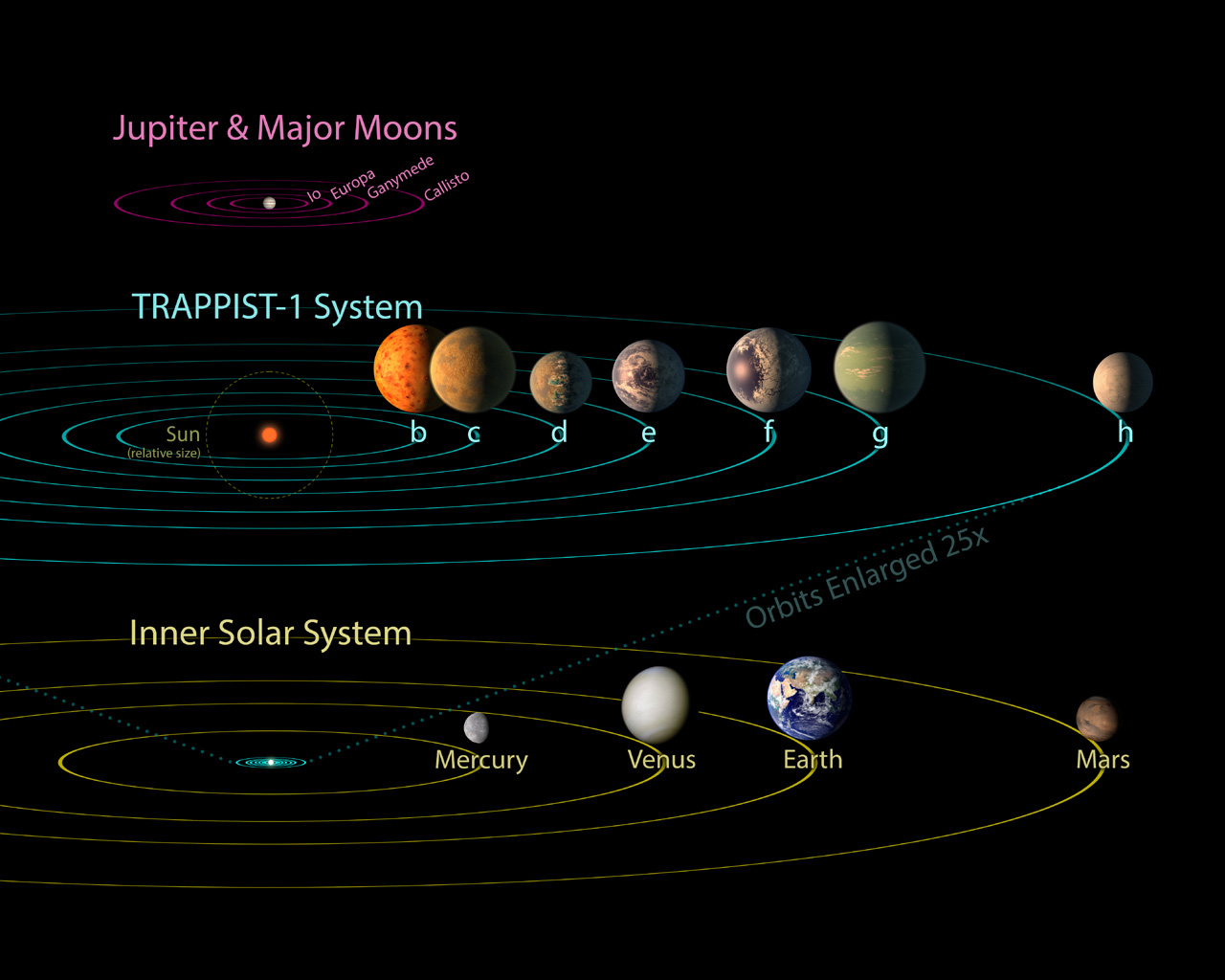
A nice JPL graphic showing the diminutive scale of the TRAPPIST-1 system:

PIA21428_hires.jpg

http://www.jpl.nasa.gov/spaceimages/details.php?id=PIA21428
 
Very interesting. I hope the JWST will give more detailed information on this.

We are certainly living an interesting era. A few decades ago exoplanets were in the domain of fantasy or sci-fi. Now not only we know they exist, but that they are very common. Crazy.

Next step is to actually get there. Not for our century I think, but doable. Even if we don't manage to break some laws of physics, a behemoth assembly which can house several generations and a lot of spare parts is still an option.
 
We are certainly living an interesting era. A few decades ago exoplanets were in the domain of fantasy or sci-fi. Now not only we know they exist, but that they are very common. Crazy.

True, but sincerely, even decades before the discovery of the first exoplanet, would be strange to think that the Solar System was unique. I know that anthropocentrism dies hard, but... :)
 
It was widely believed exoplanets were common before one was actually confirmed; if anything people were too optimistic about it, especially science fiction writers. Evidence: any episode of Star Trek.
 
Never thought science fiction writers too optimistic regarding exoplanets. I was sure they were as common as grains of sand.
 
Back
Top