Nasa may drop Ares 1-Y flight

The Constellation program is becoming a joke. It is underfunded and over-hyped. That has been a NASA trait for some time. Show videos of this cool Ares I and Ares V rocket and all the things it can do, then tell everyone that it will be ready in 2025. WTF man! We went to the moon in a decade! If people were serious about space exploration, we would have had a base on the moon 10 years ago, and we would have been launching missions from there already to Mars and beyond.

I'm frustrated and actually feel for NASA's directors. We are about to lose our status as a serious space-faring nation, and we are going to hand the keys over to ISS to the Russians. Either let NASA do something, and soon, or sell everything in a clearance sale. All rockets must go!

I'm frustrated, frustrated, frustrated at how this nation appears to be going down the drain.
 
I'm with Moonwalker on the exposure of the TPS to damage during launch. It's not the design of the TPS that puts it in harm's way, it's the design of the stack on which it launches, which I believe was Moonwalker's original point. As long as there are chunks of ice and foam falling off the tank (and I'm not talking about the ones that break of during liftoff, but later in launch), I don't feel the launch configuration is completely safe. Whether the size is significant or not, chunks of ice & foam striking the orbiter are never a good thing. That's my $.02 worth.
 
STS lacks a launch escape system, but that does not make Ares-I some sort of safety holy grail, because (AFAIK) all rockets since Gemini have had a LAS of some sort.

All rockets since Vostok had a Launch Escape system (except for Voshkod AFAIK), but that's the point: a LES should be standard equipment when you're sitting on a controlled bomb.
Gemini didn't have a standard LES but it did have ejection seats, which however would only be useful for a limited flight region. Still, they'd get you out of the fireball should the Titan decide to go all 4th of July under your tail end.
 
It was. It's just that it had a great big hole in it.

The hole (just) caused the crew and Orbiter to be lost. The TPS did become non-protective (just) by one hole.

That isn't the point. I'm using it as an example.

There are a lot of examples on how the Shuttle system could have been safer from the beginning. But history isn't changeable. There is foam loss and an unprotected TPS.

As do all rockets. And I wouldn't call "scary" a technical spaceflight term. ;)

Scary is not a technical spaceflight term but a term that can be used to describe potential events during launch from the viewpoint of a rocket "passenger".

Although your wording is slightly...odd, I'm actually doing nothing other then agreeing with you on that point. STS lacks a launch escape system, but that does not make Ares-I some sort of safety holy grail, because (AFAIK) all rockets since Gemini have had a LAS of some sort.

Ares won't be the safest, but safer than the Shuttle and as safe as Soyuz and Shenzhou. To return to capsule-design is the first step.
 
The hole (just) caused the crew and Orbiter to be lost. The TPS did become non-protective (just) by one hole.

Any TPS becomes non-protective from (just) one hole.

There are a lot of examples on how the Shuttle system could have been safer from the beginning. But history isn't changeable. There is foam loss and an unprotected TPS.

I didn't use that as an example of how the shuttle program could have been better. I used it as an example to demonstrate that foam strikes do not affect the arrival of the payload to orbit.

Scary is not a technical spaceflight term but a term that can be used to describe potential events during launch from the viewpoint of a rocket "passenger".

Yes. But you will be scared on any launch vehicle. The shuttle is not (as) safe as a capsule design with a LES.
It is an exceptional design, and Orion safety improvements over it do not make Orion exceptional.

Ares won't be the safest, but safer than the Shuttle and as safe as Soyuz and Shenzhou.

Yes, but Soyus and Shenzhou are safer then Shuttle. Orion is not exceptional.


To return to capsule-design is the first step.

Capsule design is not a be-all, end all solution to spaceflight. Spaceplanes can do things that capsules cannot, and capsules can do things that spaceplanes cannot (in this case, do lunar returns etc). The misfortunes of the STS are due to that particular design, not the fact that it was a spaceplane. It's like saying passenger aircraft should revert to ford trimotors because the Comet suffered explosive decompression.
 
The vibration issues are not related to the complete first stage powered flight. It's related to the very last seconds shortly before separation. The first 115 seconds of the flight are expected to be smooth.

Let me correct your sentence, because they are otherwise an outright lie:

"I expect the first 115 seconds of flight to be smooth."

You can expect a lot, what is not true...reality is different though.

The NASA figures for the launch environment are not at all saying, it is going to be smooth for 115 seconds. The vibrations will actually be extremely rough for ANY kind of launch vehicle during the first 115 seconds. At 115 seconds, the cut-off sensing circuit of the Ares I autopilot will be activated, the thrust and vibrations are already trailing off.

The most critical part will be the time around 85 seconds in the simulated vibration environment (it is not the real one yet), which will have the strongest oscillations, before the thrust slowly trails off to compensate for quickly increasing acceleration.

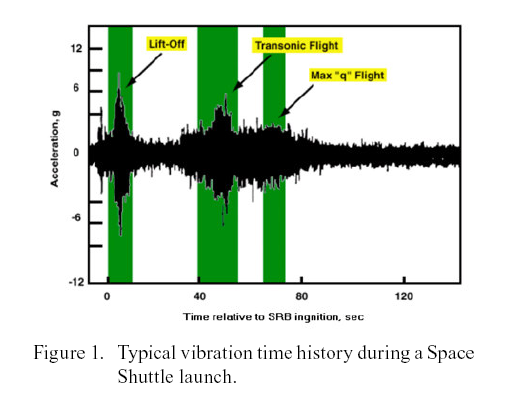
Even the space shuttle has 6G vibrations INSIDE the cabin, which is not that extreme compared to other launchers (The shuttle is smooth, compared to a Soyuz or Saturn V ride), the Ares I will maybe have 20G vibrations undamped, the whole system of dampers will maybe reduce this to 10G.

Compared to the expected values for the Ares I, even solid rocket launch vehicles like Taurus or Minotaur are harmless - and these have the highest standards of all commercial launch vehicles for vibrations, even the Dnepr ICBM is smoother.

ShuttleVibrations.png
 
Last edited:
Any TPS becomes non-protective from (just) one hole.

Which contradicts your previous statement, which was that the TPS of Columbia was protective.

I used it as an example to demonstrate that foam strikes do not affect the arrival of the payload to orbit.

Even worse, it effects the ability of the crew to return home with that vehicle.

Yes, but Soyus and Shenzhou are safer then Shuttle. Orion is not exceptional.

Orion is not exceptional but safer than the Shuttle, carried into space on top of something like Ares I, or V.

Capsule design is not a be-all, end all solution to spaceflight. Spaceplanes can do things that capsules cannot, and capsules can do things that spaceplanes cannot (in this case, do lunar returns etc). The misfortunes of the STS are due to that particular design, not the fact that it was a spaceplane. It's like saying passenger aircraft should revert to ford trimotors because the Comet suffered explosive decompression.

I think we all know the differences between capsule design and plane design. But NASA is going to return to the Moon and go to Mars later on. Spaceplanes are totally out of focus.

Urwumpe: neither me, nor you for sure, but the engineers who are working on Ares I expect a relatively smooth ride within the first 115 seconds into the flight of Ares I. They don't expect the ride to be significantly different to a Shuttle ride until burnout and what potentially might happen at that moment. The rest is up to you.
 
Which contradicts your previous statement, which was that the TPS of Columbia was protective.

No. It was protective, aside from the fact that there was a hole in it.

Even worse, it effects the ability of the crew to return home with that vehicle.

I said nothing about "affecting the return of the crew". I said it does not affect the ability of the payload to reach orbit. If you were to replace the STS orbiter with a cargo pod, and put a satellite into that pod, it would be able to reach orbit even with a foam strike.
Orion is not exceptional but safer than the Shuttle, carried into space on top of something like Ares I, or V.

Yes, and Soyuz is safer, and Shenzou is safer. Heck, Apollo was probably safer then STS. Orion may be safer then STS, but it is not exceptional compared to other existing capsule systems.

But NASA is going to return to the Moon and go to Mars later on.

Yes, for which a capsule design is superior, as I explained.

Spaceplanes are totally out of focus.

At the moment they are- at least by NASA. Just because they are not being focused on does not mean that they are a useless concept.

It's one thing to make a counterargument that makes no sense, it's another to make a counterargument that has nothing to do with the original argument you are trying to counter, as you've done here.
 
Last edited:
Thread closed after deteriorating into the usual pointless circular arguments. Please guys, take it out back.

---------- Post added at 08:20 ---------- Previous post was at 08:15 ----------

Thread re-opened. Please try to keep the discussion more fruitful. No-one wants to read through pages and pages of circular arguments just to find the small bits of real information.
 
They're talking about I-X prime, 2012 or early 2013.
5 seg SRB, dummy uperstage.
 
Urwumpe: neither me, nor you for sure, but the engineers who are working on Ares I expect a relatively smooth ride within the first 115 seconds into the flight of Ares I. They don't expect the ride to be significantly different to a Shuttle ride until burnout and what potentially might happen at that moment.

Again, say names, reports or articles or have the honesty to say that this is your personal stomach feeling or shut up. You have the choice. Stop using weasel words like "Anonymous engineers say...". You are not arguing with idiots here, who are easily impressed by unnamed scientists.

The rest is up to you.

Here I go. Only because you think you can argue without facts here, I don't need to follow your example...

Would be really nice if you can name ANY NASA or ATK engineer who supports your claims, since all technical reports by NASA and ATK say exactly the opposite - the measured vibration levels of the 5 segment SRM are actually over two times higher than the vibrations of the 4 segment SRM in general.

http://ntrs.nasa.gov/archive/nasa/casi.ntrs.nasa.gov/20040085907_2004090305.pdf

http://ntrs.nasa.gov/archive/nasa/casi.ntrs.nasa.gov/20090023641_2009022948.pdf

http://ntrs.nasa.gov/archive/nasa/casi.ntrs.nasa.gov/19960029274_1996051395.pdf

I still search for reports that address the extrapolated in-flight vibration levels of the damped Ares I, but since this is current research, chances are low for finding more than preliminary results.
 
Last edited:
Pilots don't actually do anything on ascent.

On the Shuttle they do. They have to press a button to make the ADI display LVLH attitudes. And of course the OMS-1/OMS-2 maneuvers.

But compared to the Saturns, astronauts have nothing to do on the Shuttle during ascent. It is all automatic unless things get really bad.
 
@Urwumpe: Space Shuttle vibration levels might be interesting and well known, but they don't say how Ares I and/or Orion vibration levels will exactly look like at the end. No offence, but that's guesswork by desk research. Interesting but not conclusive on Ares I and Orion.

When NASA engineers and people are talking about an expected relatively smooth ride until 115 seconds, which they did (on TV and in articles), you can guess that this is a comparison to a Shuttle ride, which just as you pointed out, is relatively smooth (comapred to others). That engineers expect a smooth ride from liftoff to 115 seconds is something you could read in NASA articels, on nasaspaceflight.com and other sources. The following is just one of it, a relatively new one: http://blogs.nasa.gov/cm/blog/Constellation/posts/post_1244149653134.html
 
Do you actually read the articles?

Since the Gemini era, NASA spacecraft designers used a limit of .25g peak as a safe threshold against these problematic longitudinal pressure oscillations. Based on increased fidelity gained through the crew situational awareness test series, the Constellation Program expects to set a new threshold, limiting the maximum peak to .7g, with a mean vibration level to not exceed .21g's rms (root mean square) for any five second period during first stage flight.

In your link, they just said that they more than doubled the Gemini era threshold (0.7 vs 0.25 g) so Ares I does not violate older NASA standards. They excuse this by saying that a NASA study resulted in instruments still being read by astronauts at 0.7g vibrations.

They don't say at all, that it will be a smooth ride, they actually expect the very opposite.

And if you would have read my links, you might have noticed that they compared 4 segment SRB against a 5 segment engineering model (preliminary 5 segment SRB used in early test firings). With the calculated vibration levels being exceeded by the actual measured vibration levels during the test.

I suspect you really mean other sources...
 
"For Ares I, engineers expect a smooth ride up from liftoff to 115 seconds"

That's the sentence you're trying to quibble over (it's in the article).

An old Gemini era threshold might not be the last and only one forever...

Compared to what "might" happen at or after 115 seconds, the Ares I ascent is going to be smooth.
 
Last edited:
Make it a full quote:

For Ares I, engineers expect a smooth ride up from liftoff to 115 seconds, but as the first stage nears burnout, thrust oscillations could pose a problem for a few seconds impairing the crew’s ability to read displays and respond to what they see.

Not just that the article is contradicting itself - higher vibration thresholds are not smooth, but the opposite, the complete sentence is also not the same as your partial quote.
 
NASA takes too long to develop anything to a usable stage. I hope Virgin and the other private entrepreneurs can do something to open the whole thing up.

Even the tests they do on Earth to extricate Spirit from it's sand trap take forever!!! Move rovers wheels 5 rotations and spend the rest of the day analysing the resulting data! give me a break!

Too slow, too cautious, too restrictive "eggs in one basket" approach. Send 10 rovers at once so the whole 10 year development cycle is not wasted if one of them gets bogged or lands upsidedown.

And for goodness sake, someone invent antigrav quick!!!
 
NASA takes too long to develop anything to a usable stage. I hope Virgin and the other private entrepreneurs can do something to open the whole thing up.

Even the tests they do on Earth to extricate Spirit from it's sand trap take forever!!! Move rovers wheels 5 rotations and spend the rest of the day analysing the resulting data! give me a break!

Too slow, too cautious, too restrictive "eggs in one basket" approach. Send 10 rovers at once so the whole 10 year development cycle is not wasted if one of them gets bogged or lands upsidedown.

It's not NASA that makes things slow. It's the whole space industry. And it's done for a good reason.

Spirit is on another planet. If you break it, you lose it, and there are no others in the pipeline. You've spent millions of dollar getting Spirit to that planet, you don't risk it because some guy on the internet is impatient.

With rockets, you don't cut corners, either. Especially if they are manned. It's too easy to blow one up, lose the rocket, the payload, and any people aboard.

Risk is two-dimensional: Probabilty of failure on the X-axis, and consequences of failure on the y-axis. With rockets and spacecraft, you can't do too much about the y-axis; most failures are catastrophic. So that leaves you with control over the x-axis, which must be minimized by thorough testing, modeling, training, preparation, design reviews, etc. Wash, rinse, repeat, until you're certain you can trust the thing once it leaves the launchpad.

Can they do it cheaper? Probably. But faster? Not for the same money. Even SpaceX's Falcon 9 and Virgin Galactic's Spaceship 2 are taking longer than you'd like, because the stakes are just too high for that kind of cavalier attitude. Wreck Spaceship 2 just once and that's the end of that whole venture.

And for goodness sake, someone invent antigrav quick!!!

......

---------- Post added at 09:13 PM ---------- Previous post was at 09:06 PM ----------

Do you actually read the articles?

Since the Gemini era, NASA spacecraft designers used a limit of .25g peak as a safe threshold against these problematic longitudinal pressure oscillations. Based on increased fidelity gained through the crew situational awareness test series, the Constellation Program expects to set a new threshold, limiting the maximum peak to .7g, with a mean vibration level to not exceed .21g's rms (root mean square) for any five second period during first stage flight. ...

So, as with the shuttle, they are dumbing down the safety standards?

("We don't need no stinking abort options, we'll just trust the shuttle stack not to fail...")

What was the reason for the Gemini standard, I wonder. I'm betting NASA did a lot of testing back in the day to come up with these standards. The fact that they are "old" does not invalidate them in the least. Facts are not fashionable.

 
MOD NOTE: Thread reopened again for ON-TOPIC discussions about Ares I-Y.


---------- Post added 11-11-09 at 09:45 AM ---------- Previous post was 11-10-09 at 02:19 PM ----------

I'm betting NASA did a lot of testing back in the day to come up with these standards. The fact that they are "old" does not invalidate them in the least. Facts are not fashionable.

They did, there is quite a bit of documentation on the amount of testing that went into everything they launched and whilst facts don't change as they get older they can be more refined as we now have the ability to monitor and record a much wider range of conditions to a higher degree of sensitivity.

Of course, the big problem with testing is that it *COSTS*....
 
Back
Top