Updates NASA New Horizons Mission Updates

The PI's Perspective.

Late in Cruise, and a Binary Ahoy.


New Horizons has just completed a summer of intensive activities and entered hibernation on Aug. 20. The routine parts of the activities included thorough checkouts of all our backup systems (result: they work fine!) and of all our scientific instruments (they work fine too!). We also updated our onboard fault protection (a.k.a. “autonomy”) software, collected interplanetary cruise science data, and tracked the spacecraft for hundreds of hours to improve our trajectory knowledge. Added to this mix of routine summer wake-up activities for New Horizons were two major activities that had never been performed before.
More...http://pluto.jhuapl.edu/overview/piPerspective.php

N.
 
JHU APL: The Sounds of New Horizons:
October 21, 2013

What does New Horizons say when it calls home? Nothing, without the help of software that transforms zeros and ones from New Horizons’ computers into images, instrument readings, or useful information on the spacecraft’s status. Those datasets are then transmitted to Earth by the telecommunications (radio) system aboard New Horizons.

But if our Pluto-bound spacecraft could talk, it would sound something like the “tune” members of the New Horizons communications team created from actual ranging signals that New Horizons traded with NASA Deep Space Network (DSN) receiving stations earlier this year. (Listen to New Horizons)

{...}
 
The Sounds of New Horizons embedded in a YouTube video:
 
JHU APL: On the Path to Pluto, 5 AU and Closing:
October 25, 2013

Pluto isn’t quite the next exit on New Horizons’ voyage through the outer solar system, but the destination is definitely getting closer. Today the NASA spacecraft speeds to within five astronomical units (AU) of Pluto – which is less than five times the distance between the Earth and the sun, or about 460 million miles.

"It's exciting to be closing in on the Pluto system,” says Alan Stern, New Horizons principal investigator from Southwest Research Institute, Boulder, Colo. “The encounter begins in January 2015 – just over 14 months from now. You can really feel the energy level rising on this mission!"

{...}

AmericaSpace: That Friday Feelin': New Horizons to Pass Key Distance Milestone Today on Journey to Pluto
 
The Planetary Society: New Horizons: Updates From the April 2014 Science Team Meeting

In summary, the New Horizons team is still looking for another Kupier Belt Object to fly by in an extended mission. There are far fewer background stars this year, fortunately, so finding a candidate KBO would be easier.

The rest of the article discusses Pluto science, including what might be replenishing Pluto's nitrogen atmosphere, and how New Horizons will study Pluto better than Voyager 2's observations of a similar object, Triton. For more details, read the above blog post.

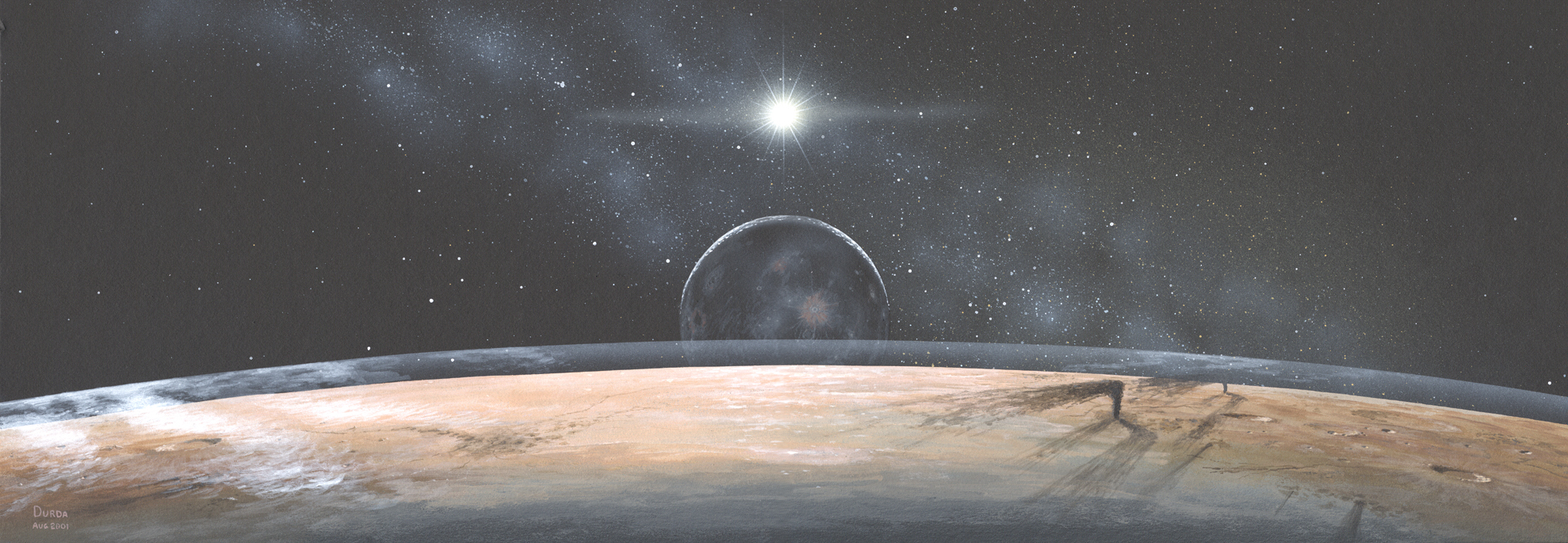
20130802_newhorizons_durda_big.jpg
 
The New Horizons team was able to acquire observing time with Hubble, greatly increasing the chance for the Pluto explorer to flyby a newly discovered Kuiper Belt Object (KBO) that is within the spacecraft's reach. According to Emily Lakdawalla from The Planetary Society, Hubble has a 94% chance of success in finding a suitable KBO, compared to 38% for ground based observatories. The search window lasts for two months, then another observation a year later is required to determine the object's orbit so New Horizons can be programmed to change its trajectory in time.

ScienceInsider: "Hubble telescope to look for follow-on target for Pluto-bound probe"
New Horizons, NASA’s mission to the outer solar system, has been given a large chunk of time on the Hubble Space Telescope to assist an increasingly desperate search for an icy object the spacecraft can study after it hurtles past Pluto in July 2015, NASA headquarters announced today.

The mission team has so far been unable to find a suitable Kuiper belt object (KBO) for follow-up study, but needs to as soon as possible so that it can plan orbital adjustments with its limited supply of fuel.

Beginning this week, the mission team will get 40 orbits of Hubble time from the discretionary budget of the director of the Space Telescope Science Institute (STScI) in Baltimore, Maryland, which operates the telescope. It takes the telescope 97 minutes to orbit Earth, but because Earth blocks intended targets for much of this time, each orbit is worth about an hour of observation.

Researchers will use the time to search a quarter of the space within the realm of the spacecraft’s thrusters. A Time Allocation Committee (TAC) of 18 astronomers gave the New Horizons team an additional 120 orbits to search the remaining space if the initial search turns up a reasonable number of KBO candidates. And if a prime candidate is found, the team will get 30 more orbits of time for precision studies to nail down the KBO orbit. “This program was strongly supported by the TAC, whether they were cosmologists, solar system or exoplanet people,” says Neill Reid, the head of the science mission office at STScI. “This is the one chance to go visit there.”

One major problem has been that the bright, star-filled center of the Milky Way is directly behind the search area, making it difficult for faint KBOs to stand out. The mission team has already been granted dozens of nights of time on some of the largest ground-based telescopes on Earth, to no avail. Reid says the team should have improved chances with Hubble because of its sharper vision, and also because the background sky as seen from space is a bit darker. But success is by no means a given—KBOs have turned out to be far less numerous than mission scientists thought when New Horizons launched in 2006. “It depends on whether the solar system is going to cooperate or not,” Reid says. “They made a good case that they had done as much as they could from the ground.”

With fierce competition for Hubble time, some observers worried that the TAC might dismiss the large request from the New Horizons team. But the dilemma even got the attention of the Senate subcommittee in charge of science appropriations, chaired by Senator Barbara Mikulski (D–MD), whose state includes both the STScI and the Johns Hopkins University Applied Physics Laboratory, which operates the New Horizons mission. The lawmakers backed an expanded KBO survey in a report accompanying the NASA spending bill that Mikulski’s committee approved earlier this month. “The Committee strongly supports surveying the accessible region of space that the New Horizons spacecraft will be able to transit,” the panel wrote, “in order to determine if potential targets of opportunity exist that the spacecraft can explore.”

Horizon.jpg

The Planetary Society: "Hubble to the rescue! The last-ditch effort to discover a Kuiper belt target for New Horizons"
NPR: "Hubble To Search For Last Stop On Pluto Probe's Itinerary"
Astronomy Magazine: "Hubble to begin search beyond Pluto for a New Horizons mission target"

While at Pluto, New Horizons will search for a potential underground ocean in Charon, Pluto's largest moon.

Astronomy Magazine: "Cracks in Pluto’s moon could indicate it once had an underground ocean"
If the icy surface of Pluto's giant moon Charon is cracked, analysis of the fractures could reveal its interior was warm, perhaps warm enough to have maintained a subterranean ocean of liquid water, according to a new NASA-funded study.

[...]

In Charon's case, this study finds that a past high eccentricity could have generated large tides, causing friction and surface fractures. The moon is unusually massive compared to its planet, about one-eighth of Pluto's mass, a solar system record. It is thought to have formed much closer to Pluto, after a giant impact ejected material off the planet's surface. The material went into orbit around Pluto and coalesced under its own gravity to form Charon and several smaller moons.

Initially, there would have been strong tides on both worlds as gravity between Pluto and Charon caused their surfaces to bulge toward each other, generating friction in their interiors. This friction would have also caused the tides to slightly lag behind their orbital positions. The lag would act like a brake on Pluto, causing its rotation to slow while transferring that rotational energy to Charon, making it speed up and move farther away from Pluto.

"Depending on exactly how Charon's orbit evolved, particularly if it went through a high-eccentricity phase, there may have been enough heat from tidal deformation to maintain liquid water beneath the surface of Charon for some time," said Rhoden. "Using plausible interior structure models that include an ocean, we found it wouldn't have taken much eccentricity (less than 0.01) to generate surface fractures like we are seeing on Europa."

"Since it's so easy to get fractures, if we get to Charon and there are none, it puts a very strong constraint on how high the eccentricity could have been and how warm the interior ever could have been," said Rhoden. "This research gives us a head start on the New Horizons arrival — what should we look for and what can we learn from it. We're going to Pluto and Pluto is fascinating, but Charon is also going to be fascinating."

Based on observations from telescopes, Charon's orbit is now in a stable end state: a circular orbit with the rotation of both Pluto and Charon slowed to the point where they always show the same side to each other. Its current orbit is not expected to generate significant tides, so any ancient underground ocean may be frozen by now, according to Rhoden.

[...]
 
Science Shorts: Annual Checkout Makes for Great Pluto Preparation

In the first installment of a new blog series from the New Horizons Science Team, Deputy Project Scientist Kim Ennico writes how the annual spacecraft systems checkout may not be the Pluto flyby, but the data the team collects this summer will play a big role in next year’s science returns.

http://pluto.jhuapl.edu/overview/ScienceShorts.php
 
And to update regarding Hubble search for follow-on KBOs for New Horizons, the team used its discretionary time in June to establish that Hubble could be used to find new KBOs not visible from ground-based telescopes, so they'll get a run of 120 orbits through August to actually find a potential target:

HubbleSite: "Hubble to Proceed with Full Search for New Horizons Targets"

NASA's Hubble Space Telescope has been given the go-ahead to conduct an intensive search for a suitable outer solar system object that the New Horizons (NH) spacecraft could visit after the probe streaks though the Pluto system in July 2015.

Hubble observations will begin in July and are expected to conclude in August.

Assuming a suitable target is found at the completion of the survey and some follow-up observations are made later in the year, if NASA approves, New Horizons' trajectory can be modified in the fall of 2015 to rendezvous with the target Kuiper Belt object (KBO) three to four years later.

The Kuiper Belt is a debris field of icy bodies left over from the solar system's formation 4.6 billion years ago. Though the belt was hypothesized in a 1951 science paper by astronomer Gerard Kuiper, no Kuiper Belt objects were found until the early 1990s. So far over 1,000 KBOs have been cataloged, though it's hypothesized many more KBOs exist.

The approval for additional observing time for the needle-in-a-haystack search is based on the analysis of a set of pilot observations obtained with the Space Telescope Science Institute (STScI) director's discretionary time on Hubble. After a swift and intensive data analysis of approximately 200 Hubble images, the NH team met the pilot-program criterion of finding a minimum of two KBOs.

"Once again the Hubble Space Telescope has demonstrated the ability to explore the universe in new and unexpected ways," said John Grunsfeld, associate administrator for the Science Mission Directorate at NASA Headquarters in Washington, D.C. "Hubble science is at its best when it works in concert with other NASA missions and ground-based observatories."

It will be many weeks before the team can establish whether either of these pilot-program KBOs is a suitable target for New Horizons to visit, but their discovery provides sufficient evidence that a wider search to be executed with Hubble will find an optimum object.

"I am delighted that our initial investment of Hubble time paid off. We are looking forward see if the team can find a suitable KBO that New Horizons might be able to visit after its fly-by of Pluto," said STScI director Matt Mountain.

In early June, Hubble's Time Allocation Committee awarded time for a full search with the requirement that its implementation be contingent on the success of the pilot survey.

From June 16 to June 26, the New Horizons team used Hubble to perform a preliminary search to see how abundant small Kuiper Belt objects are in the vast outer rim of our solar system.

Hubble looked at 20 areas of the sky to identify any small KBOs. The team analyzed each of pilot program images with software tools that sped up the KBO identification process. Hubble's sharp vision and unique sensitivity allowed very faint KBOs to be identified as they drifted against the far more distant background stars, objects that had previously eluded searches by some of the world's largest ground-based telescopes.
 
When is NH expected to have a better view on Pluto than we currently have?
 
New Horizons is now (finally) less than one year from reaching Pluto!
One-Year-to-Pluto.png


The spacecraft's position as of July:
nhov20140701_0366.jpg

nhsv20140701_0366.jpg
 
HTML:
[eventTimer]2015-7-14 00:00[/eventTimer]

The official cowndown to the flyby.
 
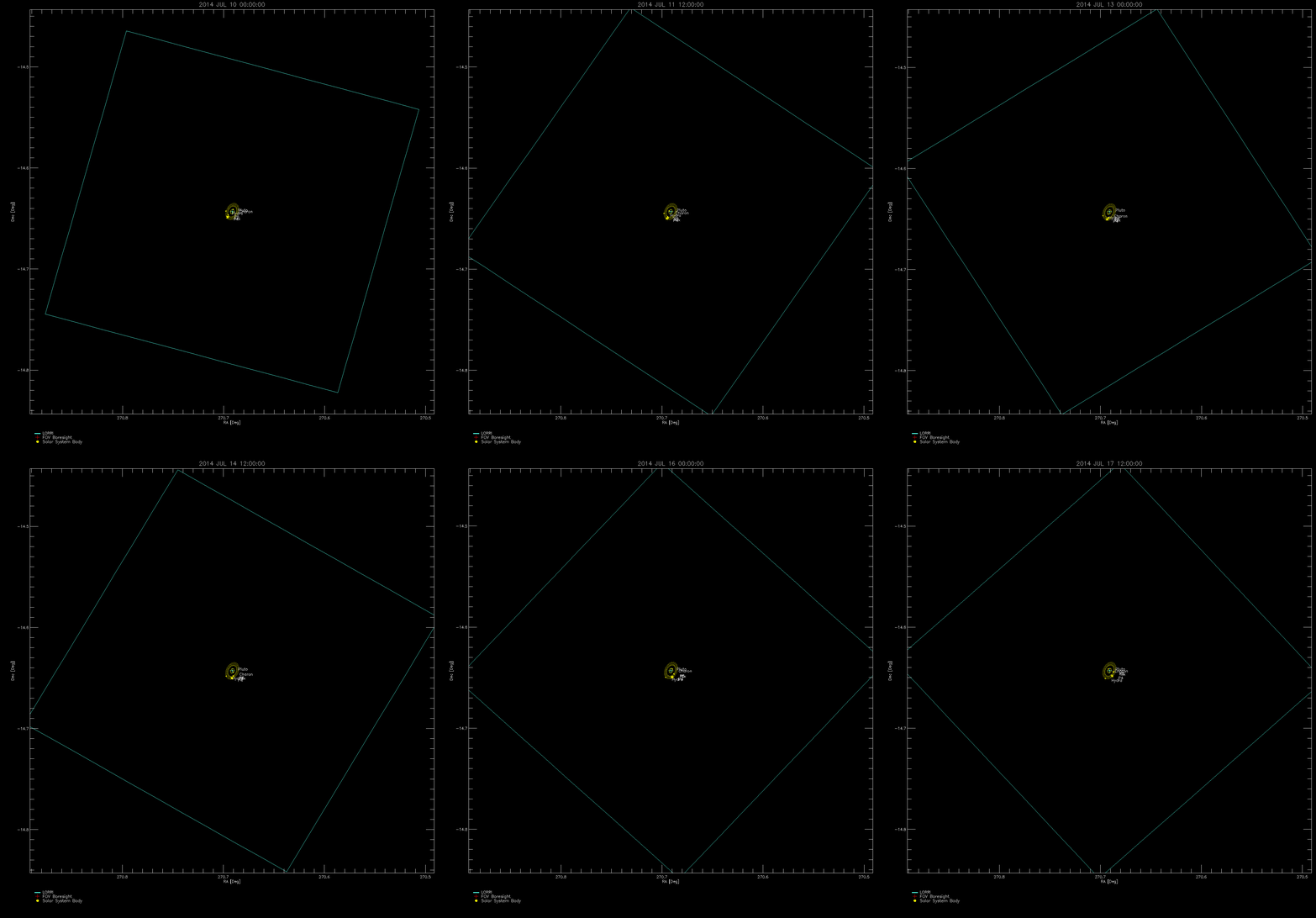
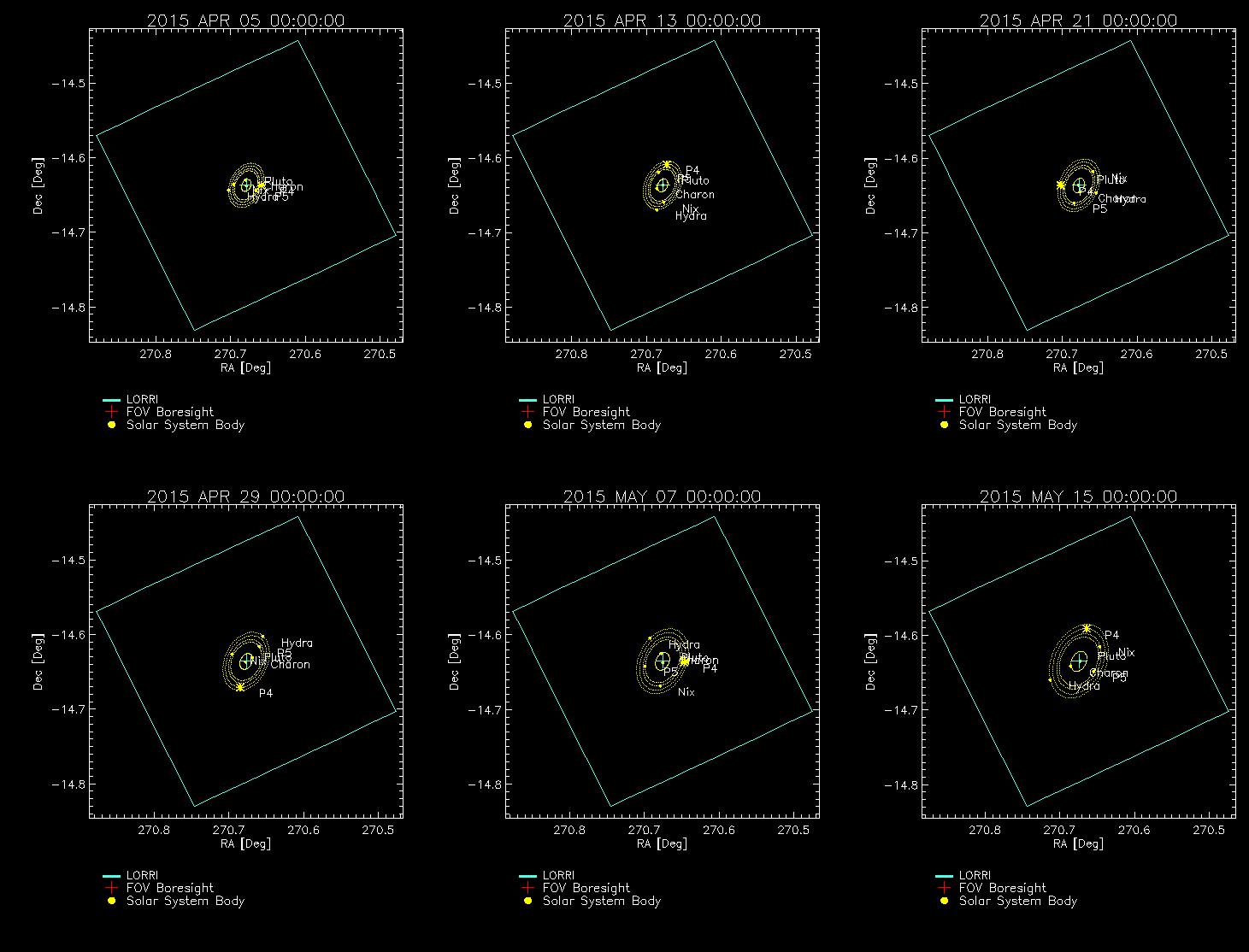
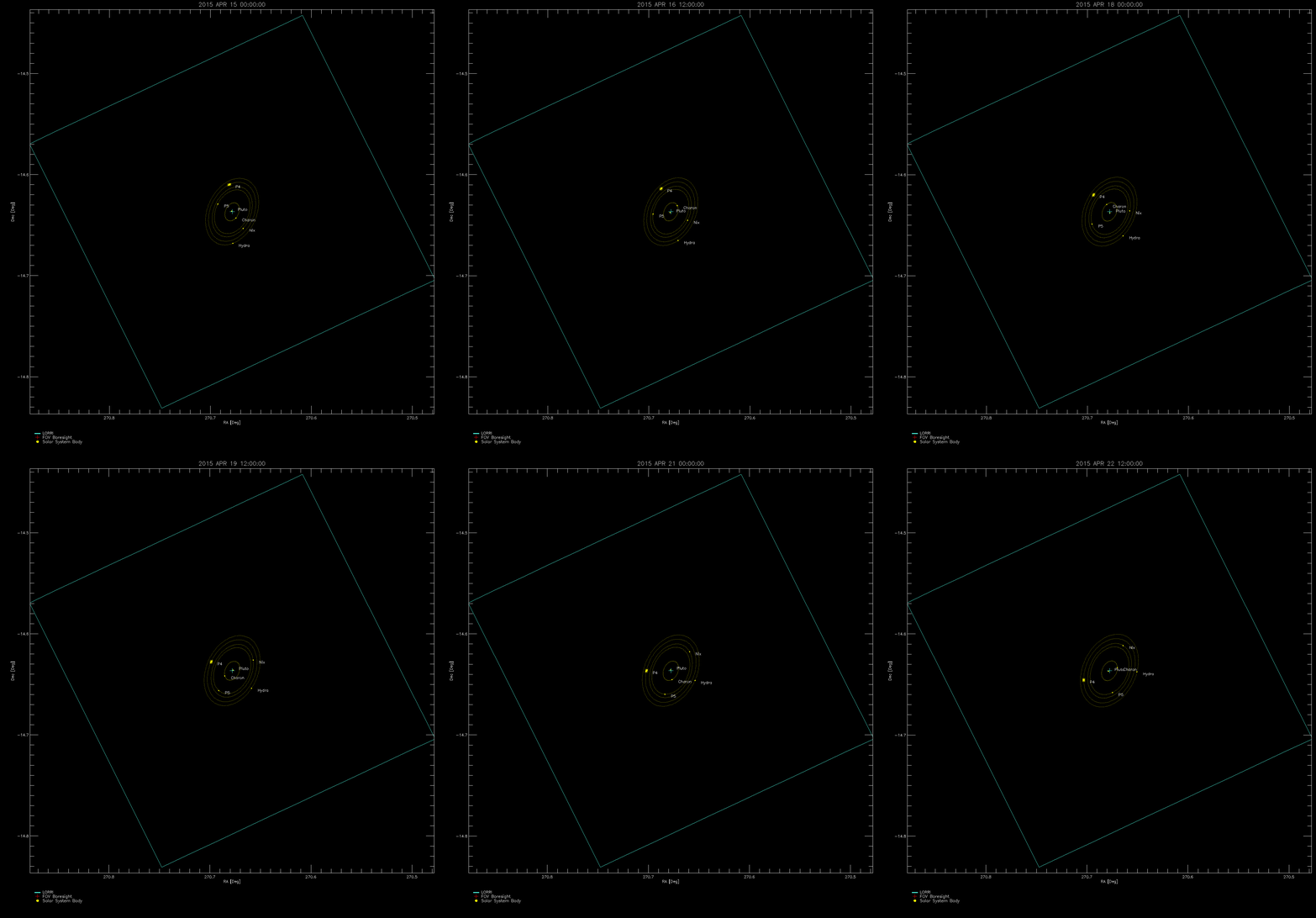
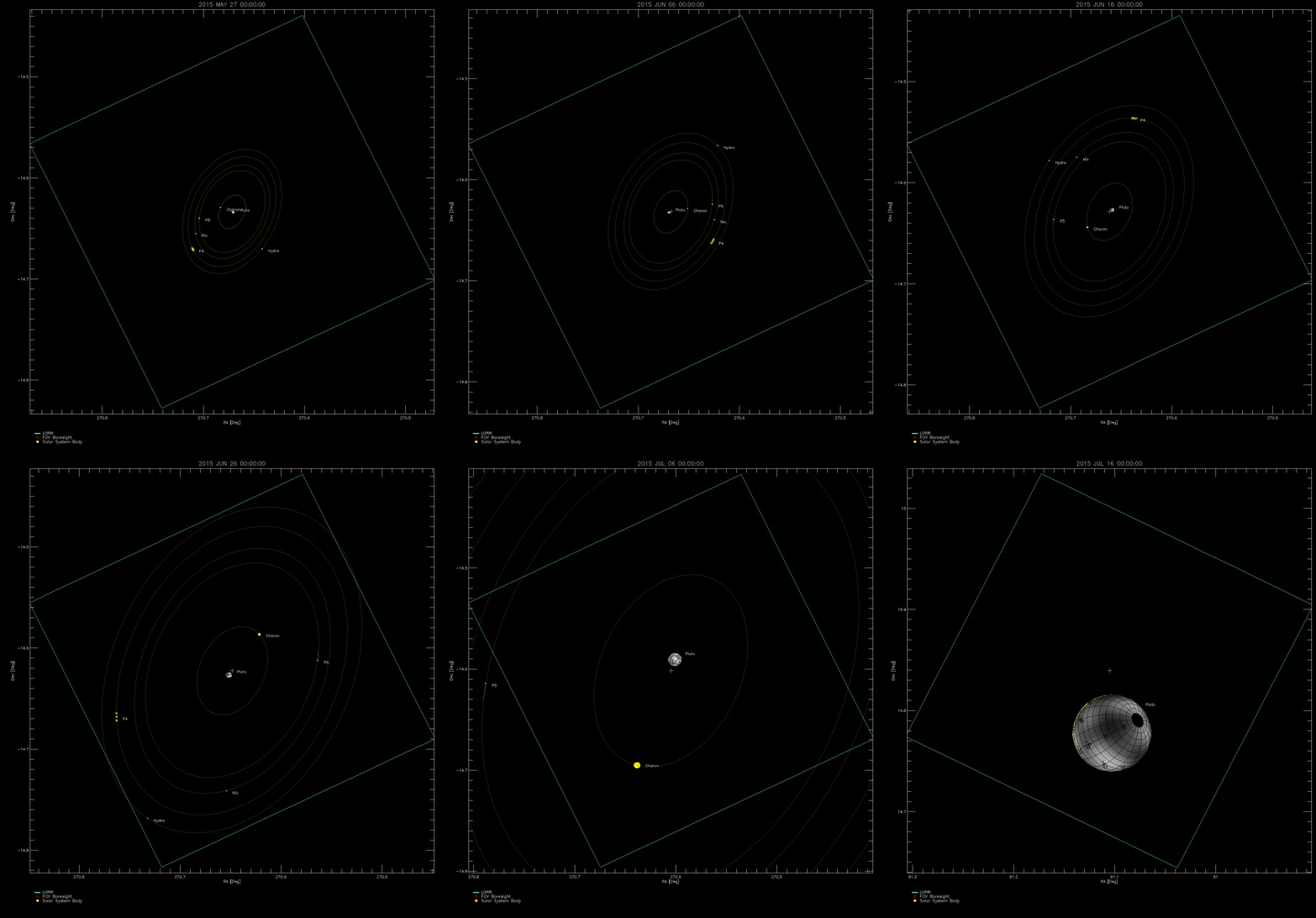
Counting down 350-some days will still take a while, so here's some simulated views from the LORRI camera as New Horizons approaches Pluto:

July 20 - 27, 2014
20140718_nh_opnav1.gif


January 25 - March 6, 2015
20140718_nh_opnav2_hydra.gif

20140718_nh_opnav2_charon.gif


April 5 - May 15, 2015
20140718_nh_opnav3_hydra.gif

20140718_nh_opnav3_charon.gif

After this sequence, New Horizons will turn to Earth and empty its flash memory in preparation for the flyby.

May 27 - July 16, 2015 (through flyby)
20140718_nh_opnav4.gif

Source: "New Horizons to take new photos of Pluto and Charon, beginning optical navigation campaign"
 
http://pluto.jhuapl.edu/news_center/news/20140822.php

August 22, 2014


On Aug. 25, NASA’s New Horizons spacecraft passes the orbit of Neptune, its last orbit crossing before beginning its historic exploration of Pluto in January 2015. By a celestial mechanics coincidence, the crossing occurs on the exact 25th anniversary of the Voyager 2 spacecraft’s encounter with Neptune in 1989. To commemorate Voyager’s achievements and the future discoveries of New Horizons, NASA will hold a two-part science event for the public to learn about the New Horizons mission and the spacecraft connection to Voyager’s historic visit to Neptune.
 
Looks like they're coming down on the planet from one of it's poles? (Given that the above images of the planet and its moons are showing near-circular orbits of the moons...)
 
Back
Top