
You are using an out of date browser. It may not display this or other websites correctly.
You should upgrade or use an alternative browser.
You should upgrade or use an alternative browser.
Updates NASA New Horizons Mission Updates
- Thread starter Notebook
- Start date

The less dense and smaller something is, the larger the mountains on it can be. Pluto is small and not very dense. Don't be surprised if it's not a nice sphere.

MaverickSawyer
Acolyte of the Probe
The less dense and smaller something is, the larger the mountains on it can be. Pluto is small and not very dense. Don't be surprised if it's not a nice sphere.
Solo... It's like Gilly or Minmus? Cool!

Unstung
Active member
Pluto is in hydrostatic equilibrium, it only looks lumpy due to the limitations of New Horizon's camera, or any digital camera for that matter.I just can't shake the notion while watching that; Pluto looks lumpy, I mean like not even remotely spherical...
A lot of people are commenting that Pluto does not look round in these photos. You're right, it doesn't look round, but that's just an artifact of the way the camera works and the way the images have been enlarged and processed. The processing tends to turn anything that is especially bright into something that looks like a mountain, and anything that is especially dark into something that looks like a hole. In fact, since Pluto is quite large enough for the force of its self-gravity to overcome the strength of its icy material, there is no question that it will be very much round, more round than Ceres. (Pluto has the same density as Ceres, so has similar ice/rock composition, but Pluto has more than 14 times Ceres' mass, so its gravity is significantly stronger.) Roundness is one of the very few things that we can confidently predict about Pluto before New Horizons' flyby, because basic physics does a remarkably good job of predicting bulk physical properties of space objects.
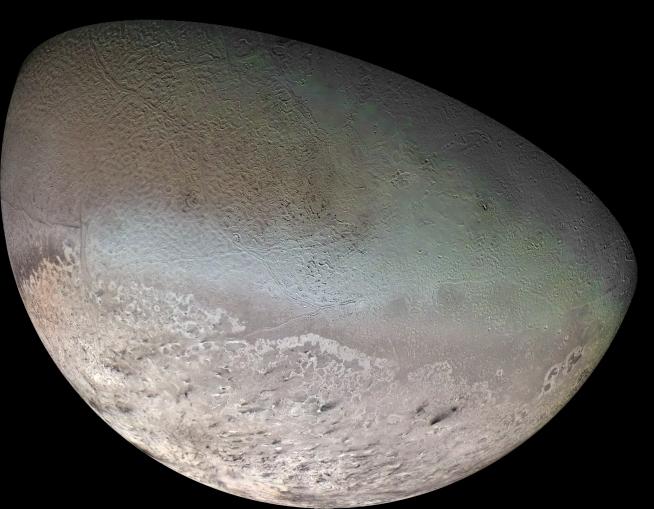
But Pluto is a pretty uniform sphere. The dwarf planet is icy, lacking an active silicate crust so mountains cannot be formed (a result of it being small and not dense). Ices relax and flatten any craters after an impact warms the surface. This can be seen on Ceres and icy moons. The kind of geologic activity that may occur on Pluto would likely be similar to Triton's cryovolcanoes. Speaking of Triton, it's probably the best analogue to Pluto and unmistakably round.The less dense and smaller something is, the larger the mountains on it can be. Pluto is small and not very dense. Don't be surprised if it's not a nice sphere.
The physics in KSP are impossible and I don't know where to start on the appearances of the game's worlds. Pluto won't look like a lumpy ball of cyan salt.Solo... It's like Gilly or Minmus? Cool!
Last edited:

The less dense and smaller something is, the larger the mountains on it can be. Pluto is small and not very dense. Don't be surprised if it's not a nice sphere.
It could be misshapen as the result of a giant impact in the not-too-distant past. That might also explain the many moons of Pluto.
Last edited:
I became addicted to new horizons webpage, looking for increasing size of Pluto every day... but I find Pluto fairly round on non processed images.
Yes, these "lumpy" pictures are very contrast-enhanced and that might be the cause of the apparent lumps.
The unprocessed images show pluto as very, very tiny and with not much detail at all!
The physics in KSP are impossible and I don't know where to start on the appearances of the game's worlds. Pluto won't look like a lumpy ball of cyan salt.
I'll start...
Eeloo, Minmus and the Mun have densities 50% greater than the densest of known elements, Osmium, Kerbin is a whooping 3 times Os' density...
The only way to have a solar system looking anything like Kerbol would be to have massive lumps of WIMPs accumulated at the center of the moons and planets.

Now back to our New Horizon programming

It could be misshapen as the result of a giant impact in the not-to-distant past. That might also explain the many moons of Pluto.
Possible. But I'd put my money down on them being captured.
That said, what Unstung said about Pluto is true, but don't get the impression that it's a smooth sphere. There'll still be mountains, but unlikely to be as high as the mountains on our Moon, for example.
That said, I guess we'll see when we get closer.
Unstung
Active member
Here are the raw images for reference. Pluto still looks a bit lumpy which I assume is due to the inability of digital cameras to capture high dynamic range scenes. So brighter features on Pluto would be blown out while darker ones turn black.Yes, these "lumpy" pictures are very contrast-enhanced and that might be the cause of the apparent lumps.
Processed:

Triton doesn't have any (known) prominent raised features and I suspect that will be the same with Pluto. On ice worlds, large impacts can still form significant central peaks, but an active one like Europa or Triton erases nearly all evidence of impacts. Their surfaces end up becoming pretty flat.There'll still be mountains, but unlikely to be as high as the mountains on our Moon, for example.
Last edited:

- Joined
- Nov 20, 2007
- Messages
- 11,965
- Reaction score
- 765
- Points
- 188
- Joined
- Nov 20, 2007
- Messages
- 11,965
- Reaction score
- 765
- Points
- 188
http://www.nasa.gov/feature/pluto-and-its-moon-charon-now-in-color
N
or Colour...Pluto and its Moon Charon, Now in Color
N

boogabooga
Bug Crusher
- Joined
- Apr 16, 2011
- Messages
- 3,010
- Reaction score
- 16
- Points
- 63

Being Canadian, I keep switching back and forth between UK/US spelling ... Drives people crazy


I'll just leave this here then :stirpot:

But back on subject:

Color or colour - anyway spelling in English too often hasn't significant influence to pronounciation. Especially suffer ancient greek and roman names. I was shocked to see IPA for (1) Ceres - looked like it is pronounced the same way as "series". It is strange.
Saturn's satellite Dione must be pronounced like it is spelled - /Dee -Oh - Nay/ , Titan also without "i" alphabetical sound but like in words "it", " is"!
So actually it is pronounciation which should be adjusted, not spelling.
BTW - not related to this, but I wanted to mention that Pluto is spelled Pluton in many languages, it sounds better.
Saturn's satellite Dione must be pronounced like it is spelled - /Dee -Oh - Nay/ , Titan also without "i" alphabetical sound but like in words "it", " is"!
So actually it is pronounciation which should be adjusted, not spelling.
BTW - not related to this, but I wanted to mention that Pluto is spelled Pluton in many languages, it sounds better.

If you want to spell all those mythological names "correctly", look at Latin or Ancient Greek. Though there are of course no recording of how people spoke back then, I'd say that the "ancient languages departement" of universities are the most credible...

- Joined
- Nov 23, 2008
- Messages
- 1,683
- Reaction score
- 4
- Points
- 38
Color or colour - anyway spelling in English too often hasn't significant influence to pronounciation. Especially suffer ancient greek and roman names. I was shocked to see IPA for (1) Ceres - looked like it is pronounced the same way as "series". It is strange.
Saturn's satellite Dione must be pronounced like it is spelled - /Dee -Oh - Nay/ , Titan also without "i" alphabetical sound but like in words "it", " is"!
So actually it is pronounciation which should be adjusted, not spelling.
BTW - not related to this, but I wanted to mention that Pluto is spelled Pluton in many languages, it sounds better.
How do you pronounce Ceres?
Similar threads

- Replies
- 7
- Views
- 5K

- Replies
- 14
- Views
- 5K


- Replies
- 11
- Views
- 6K


- Replies
- 10
- Views
- 9K

- Replies
- 0
- Views
- 2K