Updates NASA New Horizons Mission Updates

Last edited:
Surely the gods put Pluto so far away for a reason; there are things men are better off not knowing...;)

We should start a discussion on creepiest places in the Solar System. I would start with the sinkholes on Mars. But surely the mountains of Pluto, in the dim twilight of the distant sun, must be an unsettling place to a visitor walking through them for the first time. I'm not superstitious by any means, but I enjoy the thrill of letting my imagination run wild when I'm alone in a large building or camping alone in the woods.
 
Surely the gods put Pluto so far away for a reason; there are things men are better off not knowing...;)

We should start a discussion on creepiest places in the Solar System. I would start with the sinkholes on Mars. But surely the mountains of Pluto, in the dim twilight of the distant sun, must be an unsettling place to a visitor walking through them for the first time. I'm not superstitious by any means, but I enjoy the thrill of letting my imagination run wild when I'm alone in a large building or camping alone in the woods.

Creepy space fiction thread sounds perfect for this place.


The halo of pluto looks very dense...i wasnt expecting it to be like that. Is there data on how many tons of atmosphere are present on pluto? I expected there to be couple of atoms here and there.

In the first presentation, they said that some features were shaped by wind. I think they were even looking for cloud features during the flyby.
 
Yeah, Pluto appears to be a much more active place than I would've imagined. I figured it would be an inert rock with no atmo and no geology. Turns out it's got all that and more. Ice flows?! Awesome.
 
I figured it would be an inert rock with no atmo and no geology.

Pluto was known to have an atmosphere for decades, one that was predicted to freeze out as Pluto approaches aphelion. It was one of the motivations for sending a spacecraft there quickly. In fact, the atmosphere is less dense than thought.

Hubble was able to discern Pluto's reddish color and high contrast surface, indicating some kind of activity. Hubble's observations enabled New Horizons to target the face of Pluto with the greatest color variations.
 
Well, I would say "KthooLoo" emphasis on the "K"
 
newholizons_by_gomiyazaki-d91y77q.jpg


(by GoMiyazaki)
 
There is a place on Pluto called the "Cthulhu Region". How cool is that!

Not Region, but Regio. The Latin word for country (realm). Cthulhu Regio = Realm of Cthulhu. Now how cool is that ?

Also remember that Cuius regio, eius religio -- whose realm, his religion.

---------- Post added at 10:42 PM ---------- Previous post was at 10:33 PM ----------

New Horizons Finds Nitrogen Glaciers and Hazy Air on Pluto

Nitrogen glaciers. Yay!

---------- Post added at 10:44 PM ---------- Previous post was at 10:42 PM ----------

BtmbD7c.png
 
Last edited:
We should start a discussion on creepiest places in the Solar System. I would start with the sinkholes on Mars. But surely the mountains of Pluto, in the dim twilight of the distant sun, must be an unsettling place to a visitor walking through them for the first time. I'm not superstitious by any means, but I enjoy the thrill of letting my imagination run wild when I'm alone in a large building or camping alone in the woods.

How about the atmosphere of Uranus or Neptune?
 
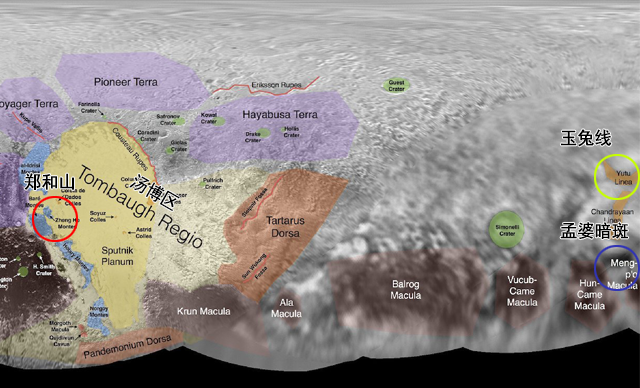
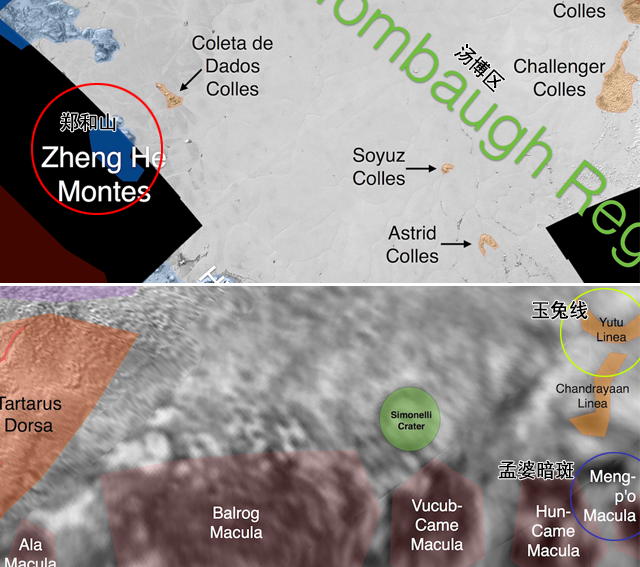
Pluto's new Chinese topographic names

2015-08-04

123171681.png

Full map of Pluto, July 28, 2015
View or download the explanations of the names


123171690.png


Zheng He Montes, Meng-p'o Macula and Yutu Linea made it to Pluto's topography along Chandrayaan-1, Tombaugh Regio and Balrog Macula.

In April of this year, the international astronomical union initiated a naming campaign for Pluto. Last week it announced the selected names presented for the final confirmation. The list includes Zheng He, Meng Po and Yutu.

Zheng He, 1371-1433, was a Chinese Ming Dynasty Muslim explorer and diplomat, led seven maritime expeditionary voyages to Asia, the Middle East and East Africa.

W020140604368148467468.jpg

1324213225044_1.jpg

t013317be573adedc30.jpg


Meng Po is the old lady who greets you in the Chinese Underworld and ensures that all memories of life are forgotten before the soul is reincarnated.

8758_084218_1.jpg


Yutu is China's first moon rover, named after an ancient mythological figure

20120104153917_XuzdZ.thumb.700_0.jpg


Informal Names for the Features on Pluto and Charon

http://tech.qq.com/a/20150804/006791.htm
 
Last edited:
http://pluto.jhuapl.edu/News-Center/News-Article.php?page=20150812

August 12, 2015
Scientists Study Nitrogen Provision for Pluto’s Atmosphere

Mission scientists are studying New Horizons data to discover what’s pumping up the nitrogen in Pluto’s atmosphere, even as it escapes into interplanetary space. This enhanced color image – created from four images from New Horizons’ Long Range Reconnaissance Imager (LORRI) combined with color data from the spacecraft’s Ralph instrument – helps scientists detect differences in the composition and texture of Pluto’s surface. The data hint that Pluto may still be geologically active, a theory that could explain how Pluto’s escaping atmosphere remains flush with nitrogen.

Image Credit: NASA/Johns Hopkins University Applied Physics Laboratory/Southwest Research Institute

The latest data from NASA’s New Horizons spacecraft reveal diverse features on Pluto’s surface and an atmosphere dominated by nitrogen gas. However, Pluto’s small mass allows hundreds of tons of atmospheric nitrogen to escape into space each hour.

So where does all this nitrogen come from? Kelsi Singer, a postdoctoral researcher at Southwest Research Institute, and her mentor Alan Stern, New Horizons principal investigator and SwRI associate vice president, outlined likely sources in a paper titled, “On the Provenance of Pluto’s Nitrogen.” The Astrophysical Journal Letters accepted the paper for publication on July 15, just a day after the spacecraft’s closest encounter with the icy dwarf planet.
 
Back
Top