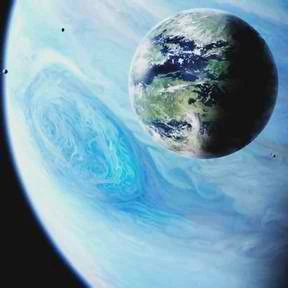
New exoplanet in habitable zone discovered - 4.5*Earth mass, 22 light years away.

Jarvitä

New member
Joined
Aug 5, 2008
Messages
2,030
Reaction score
2
Points
0
Location
Serface, Earth
An international team of scientists has discovered a potentially habitable super-Earth orbiting a nearby star. With an orbital period of about 28 days and a minimum mass 4.5 times that of the Earth, the planet orbits within the star’s “habitable zone,” where temperatures are neither too hot nor too cold for liquid water to exist on the planet’s surface. The researchers found evidence of at least one and possibly two or three additional planets orbiting the star, which is about 22 light-years from Earth.

1-newsupereart.jpg

http://www.physorg.com/news/2012-02-super-earth-habitable-zone-nearby-star.html


Another day, another exoplanet. This one wasn't even by Kepler.
 
Reaction of observational astrophysicist::bananadance::speakcool::woohoo: :jiggy::cheers::thumbup:

Reaction of theoretical astrophysicist: :rolleyes::zzz::coffee::facts::blahblah::dry:
 
Awesome! Breathtaking! Fascinating! Many other adjectives!
 
Reaction of observational astrophysicist::bananadance::speakcool::woohoo: :jiggy::cheers::thumbup:

Reaction of theoretical astrophysicist: :rolleyes::zzz::coffee::facts::blahblah::dry:

Reaction of space enthusiast/transhumanist: "Finally something we can reach in my lifetime."

Here's the rate of new exoplanet discoveries up to 2011 (colours represent different detection methods). Is there an up-to-date version of this graph?

fyzox.png
 
Only 22 LY? That's good... I am always surprised how rich is this part of galaxy. :cool: Is there some map of possibly habitable planets in our system's neighbourhood?
 
Last edited:
22 LY. It's our back yard.

We're gonna have to get used to the idea that Earth is only special in our eyes, but has no significance in the scope of our galaxy.
 
I say, 90% chance it is a flaming hothouse of high-pressure toxic death, like Venus. And I'm being generous with 90%... :dry:

We're gonna have to get used to the idea that Earth is only special in our eyes, but has no significance in the scope of our galaxy.

Just like how New Zealand is only special in the eyes of New Zealanders, but has no significance in the scope of islands worldwide (despite the fact that it's the only place where keas, moas, kiwis, tuataras, and kawapukas, or hakas, moko and hāngis exist)?

Also, how do you know this planet is anything remotely like Earth? ;)
 
Only 22 LY

What do you mean, you’ve never been to Alpha Centauri? For heaven’s sake, mankind, it’s only four light-years away, you know.
(Douglas Adams)

;)
 
What do you mean, you’ve never been to Alpha Centauri? For heaven’s sake, mankind, it’s only four light-years away, you know.

Why yes, home of the blue-skinned catpeople...

Pandora-in-front-of-polyphemus_288x288.jpg


:shifty:
 
What do you mean, you’ve never been to Alpha Centauri? For heaven’s sake, mankind, it’s only four light-years away, you know.
(Douglas Adams)

;)

Personally I like VY Canis Majoris better :)
 
Doesn't an orbital period of about 28 days suggest the planet is too close to its sun to really be within a “habitable zone”?
 
Doesn't an orbital period of about 28 days suggest the planet is too close to its sun to really be within a “habitable zone”?

That depends how hot the star is. Blueish white ones are the hottest, and their habitable zones are further than yellowish stars.
 
Doesn't an orbital period of about 28 days suggest the planet is too close to its sun to really be within a “habitable zone”?

No. It's about right for a star the size of the star in question (which is a third to half the mass of the sun and 20 to 50 times dimmer).

That said, the chances that this planet has any life are slim: Gl 667C is a flare star, which means that, even assuming ideal temperature conditions for life on this planet, it's going to get a stiff radiation bath fairly frequently.
 
Furthermore, can a planet that has such a short year have been in a stable state long enough for any sort of life to evolve?
 
Furthermore, can a planet that has such a short year have been in a stable state long enough for any sort of life to evolve?

No, why should it? Unless there are for some reason bad fluctuations in eccentricity or the orientation of the planet relative to the star, there's no reason to believe that the short orbital period would lead to any stability issues.

That said, the chances that this planet has any life are slim: Gl 667C is a flare star, which means that, even assuming ideal temperature conditions for life on this planet, it's going to get a stiff radiation bath fairly frequently.

Depends heavily on the intensity and frequency of the flares, in what environments on the planet in which any hypothetical life would exist, and what chemical or behavioural adaptations they might have to surviving flares.
 
Furthermore, can a planet that has such a short year have been in a stable state long enough for any sort of life to evolve?

You'd need to know other things like planet rotation rate, inclination, and orbital eccentricity, to say.
 
That said, the chances that this planet has any life are slim: Gl 667C is a flare star, which means that, even assuming ideal temperature conditions for life on this planet, it's going to get a stiff radiation bath fairly frequently.

Nothing like an occasional blast of ionizing radiation to drive up the mutation rates and speed up evolution.
 
Nothing like an occasional blast of ionizing radiation to drive up the mutation rates and speed up evolution.

Nothing like an occasional blast of ionizing radiation to kill everything...

There is much more to evolution than mutation rates alone.
 
Last edited:
Nothing like an occasional blast of ionizing radiation to kill everything...

There is much more to evolution than mutation rates alone.

Agreed, but there is a peak mutation rate at which there is maximal diversity. Pass that and you're decreasing it by killing off the population excessively. If the flares were within limits, they could actually be beneficial to life on the planet - life in general, of course, not the specimens that get irradiated (in the majority of cases).
 
Back
Top