OFMM Science Goals - Surface: Discussion

how close to the LZ? If its too close, you run the risk of the guidance going kaput and you smashing the LZ to shreds. About 15-20 KM seems about far enough. Or am I missing something?

If we have humans on the transit, we should be able to separate it a day before capture burn and still get its guidance within 800 meters accurate. We just need to track it from the main spacecraft to keep the navigation fixes correct.

Still, we don't want it to impact near the LZ, we want it at the right distance to get seismic data... 135° great circle distance to the seismometer array should do it.

Accuracy during landing is needed for another reason: It reduces the errors in the seismic data. We can reconstruct the impact zone from the seismic data, but we get more inaccuracy, the worse the impact accuracy is to start with.if we can monitor the impact visually from space with a telescope, we should be able to get much better impact data, but I can't tell the visibility during this work-load heavy phase.

Maybe we should coordinate the impact with a previously deployed Mars satellite.
 
Last edited:
If we have humans on the transit, we should be able to separate it a day before capture burn and still get its guidance within 800 meters accurate. We just need to track it from the main spacecraft to keep the navigation fixes correct.

Still, we don't want it to impact near the LZ, we want it at the right distance to get seismic data... 135° great circle distance to the seismometer array should do it.

Well, i'm more concerned with the guidance system failing and it not impacting on target or somewhere like the LZ... 135* circle sounds about right...
 
... and the impact zone:
crater003.jpg
 
... and the impact zone:

Did you use the proper crater size? :lol: It looks so big.

(BTW: In reality it is more deep than high, the crater rims are too steep and too high compared to the depth of the crater)
 
It's around 60 meter wide
Too big?
 
It's around 60 meter wide
Too big?

yes, 60 meters is a lot too much. 10-20 meters would be my estimate for a 250 kg TNT impact, but that depends a lot on the terminal velocity. Do you have a measurement from Orbiter already?

(On Earth, this projectile would make a 7m diameter simple crater, 1.34 meter deep, Mars should be close despite the lower gravity, since rock density is more important)
 
Last edited:
I think about 2.5 km/s is the average impact velocity
 
Are you using similar equation to estimate TNT equivalent of kinetic impact:

Code:
TNT Equivalent [kg] = m[kg] (0.5 * V^2) / 4.5e6

???

I got

173 kg of TNT for 2.5 km/s

and

250 kg of TNT at 3 km/s

From 600 km high orbit impact is around 3 km/s
 
I don't know how well this could work, but could we use mars to help with parallax measurements to help refine the distances of stars? If it's enough of a change in distance, it could help us refine figures...

Side note: I have a sketchup model of a possible seismometer for us. It's simple, and solar powered. It would be a UCGO cargo, but I need the .skp turned into a .msh, and I can't do that and keep the textures. Any help would be welcome.
 

Attachments

I know cubes are easy but come'on - it was done in like 40 minutes

s-meter.jpg
 
Last edited:
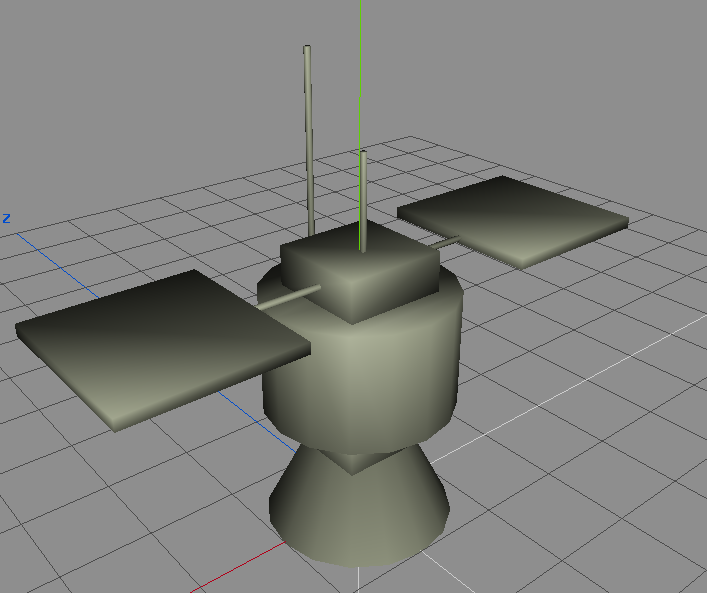
Decided to give a go myself:
picture.php


Around 2500 polys.

Done in around half an hour.
 
Tried as well:

ofmmseismometer.png


But seeing as we don't want to go down the "old OFMM path" (and I have yet to learn coding), I suggest someone else's seismometer.
 
Who says there needs to be output? We just need the meshes, so we can use UCGO to pack them along, then place them. Something for the EVA people to do while out on the surface.
 
surface science kit:
(from left to right: - mobile sat uplink dish, weather station, RTG, Scientist

mso-test3.jpg


underway: seismometer & drill.
 
drilling some holes (on the right)

mso-test06.jpg
 
Hmm... a drill core sample container might be a wise addition.
 
I think we can use UCGO crate for that
 
Back
Top