Updates Orion (MPCV) Updates and Discussion

Successful Orion droptest

CPAS just completed the EDU-A-CDT-3-5 (PTV-2) airdrop test. All visuals indicate a nominal parachute test. Recovery operations at the DZ will begin shortly to return the test hardware to the hanger in Yuma which will complete the day’s activities.

534505_354133647989707_120238269_n.jpg


The Orion team is securing the PTV and the chutes after a successful test

539705_354148407988231_1021136013_n.jpg
 
Video from the drop test

 
Part of a Larger Plan hopefully

I can see Orion being more robust and safer for a manned mission to
an nearby asteroid, or a long period stay in lunar orbit than a Spacex Dragon Upgrade.
But it's mission endurance cant be more than a few weeks with a crew of 4.
Does Nasa have a Space Hab Module designed to go along with it?

PS.
A fast mars mission would be possible if we had the guts to put
a return booster already in orbit on mars when we launch the mission from
Earth Orbit. Using Aerobraking in both Mars and Earth. Now that's risk.
 
Last edited:
NASA: Mockup Orion Stack Shows Path to Launch:
The Vehicle Assembly Building's transfer aisle offered a glimpse of the future recently as a full-size Orion spacecraft mock-up was placed atop a model of the service module so engineers and technicians could determine the exact dimensions for connectors that will run from the launch pad structure to the spacecraft before liftoff.

[table="head;width=450"]{colsp=2}
Click on images to enlarge​

|

mage above: The mockup components of an Orion spacecraft are laid out in the transfer aisle of the Vehicle Assembly Building at NASA's Kennedy Space Center in Florida. In the foreground is the Launch Abort System, then the aerodynamic shell that will cover the capsule. To the right is the Orion capsule model on top of a service module simulator. All are the exact dimensions the flight-ready Orions will be.
Photo credit: NASA/Dmitri Gerondidakis​
|Image above: The Orion mockup and its service module simulator.
Photo credit: NASA/Dmitri Gerondidakis​
[/table]​

{...}
 
NASA:
NASA Completes Maximum Parachute Test for Orion Spacecraft

August 29, 2012

NASA successfully completed another parachute test of its Orion spacecraft on Aug. 28 high above the skies of the U.S. Yuma Army Proving Ground in southwestern Arizona. The test examined the maximum pressure Orion's parachutes might face when returning from exploration missions.

Orion will be the most advanced spacecraft ever designed and carry astronauts farther into space than ever before. It will provide emergency abort capability, sustain astronauts during space travel and provide safe re-entry from deep space.

[table="head;width=450"]{colsp=2}
Click on images to enlarge​

|

Image above: (28 Aug. 2012) -- A dart-shaped test vehicle that is used to simulate Orion’s parachute compartment descends above the skies of the U.S. Yuma Army Proving Ground in Arizona. Engineers were testing the maximum pressure Orion’s chutes might face when returning from exploration missions.
Photo credit: NASA​
|Image above: (28 Aug. 2012) -- A dart-shaped test vehicle that is used to simulate Orion’s parachute compartment descends above the skies of the U.S. Yuma Army Proving Ground in Arizona. Engineers were testing the maximum pressure Orion’s chutes might face when returning from exploration missions.
Photo credit: NASA​

{colsp=2}[/table]​


During the test, a C-130 airplane dropped a dart-shaped test vehicle with a simulated Orion parachute compartment from an altitude of 25,000 feet. Orion's drogue chutes were deployed at approximately 20,000 feet, followed by small pilot chutes, which then deployed the three main parachutes. Each of the main parachutes is 116 feet wide and weighs more than 300 pounds.

"Each one of these tests helps us verify the parachute system for Orion is safe, efficient and robust," said Chris Johnson, a NASA project manager for Orion's parachute assembly system. "Today's test demonstrated the parachutes can deploy at the maximum velocity expected when returning from deep space."

This is the latest in a series of parachute drop tests, with each one designed to test a different condition or behavior of the parachutes. Besides the dart-shaped test vehicle used to simulate the speeds at which Orion will descend, NASA also uses a test vehicle that more closely resembles the actual Orion spacecraft.

{...}


Parabolic Arc: NASA Completes Maximum Parachute Test For Orion Spacecraft

 
Aviation Week: NASA Weighs Early Deep-Space Tests With Orion:
Planners in NASA’s human exploration and operations (HEO) missions directorate are studying whether it would be possible and worthwhile to expand the first three planned tests of the Orion multipurpose crew vehicle, including the first flight with a crew, to evaluate the capsule’s performance beyond low Earth orbit.

{...}
 
NASA / NASA News Release:
RELEASE : 12-340
NASA Orion Splashdown Tests Ensure Safe Landings For Astronauts


Sept. 27, 2012

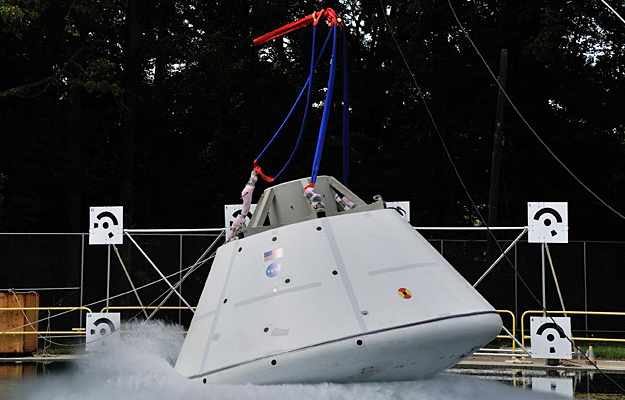
HAMPTON, Va. -- The 18,000-pound test article that mimics the size and weight of NASA's Orion spacecraft crew module recently completed a final series of water impact tests in the Hydro Impact Basin at the agency's Langley Research Center in Hampton, Va.

The campaign of swing and vertical drops simulated various water landing scenarios to account for different velocities, parachute deployments, entry angles, wave heights and wind conditions the spacecraft may encounter when landing in the Pacific Ocean. The next round of water impact testing is scheduled to begin in late 2013 using a full-sized model that was built to validate the flight vehicle's production processes and tools.

{...}
 
Id have to say Orion is what I dream about. Just imagining being able to travel outside of Earths SOI for the first time is incredible.
 
NASASpaceflight: NASA evaluate rescue plans for Orion crew after off-nominal landing:
NASA teams are continuing to set up the mission rules for their Orion spacecraft, with the latest set of expansive “Concept of Operations (CONOPS)” outlines including scenarios for keeping a crew alive after they have splashed down at the end of a mission. The scenarios include off-nominal landings, where a crew may require rescue from remote areas of the ocean by Department of Defence (DoD) assets.

{...}
 
NASASpaceflight: EM-2: Orion crew to spend up to four days in Lunar Orbit:
The first crewed mission of NASA’s Beyond Earth Orbit (BEO) exploration era will send a crew of four on a short vacation into Lunar orbit in 2021. Exploration Mission -2 (EM-2) will be a key test of Orion’s life support systems, following a baseline path laid out by EM-1, the uncrewed debut of the Space Launch System (SLS) and Orion duo.

{...}
 
Back
Top