Updates Orion (MPCV) Updates and Discussion

Both Soyuz modules combined offer more space, but individually they don't. The orbital module is quite crowded I think.

The Apollo CSM could be heavy without trouble due to the massive SPS.

Can the service module of Soyuz be used, as it is, to decelerate the entire spacecraft into lunar orbit, with a lunar lander attached of course, and accelerate it back to earth (without a lunar lander, yes)? And could the entry module carry the same amount of rocks and equipment back to earth with three astronauts aboard? 3.5 m³ sounds a little less.
 
Last edited:
Both Soyuz modules combined offer more space, but individually they don't. The orbital module is quite crowded I think.

That is not the question - for every hour except the last and the first, the Soyuz has both modules available.

The Apollo CM could be heavy without trouble due to its massive SPS.

The CM has no SPS. The SM has it.

Soyuz could also be equipped with much heavier service modules, including one that does the role of the Apollo SM.

Can the service module of Soyuz be used, as it is, to decelerate the entire spacecraft into lunar orbit, with a lunar lander attached of course, and accelerate it back to earth (without a lunar lander, yes)? And could the entry module carry the same amount of rocks and equipment back to earth with three astronauts aboard? 3.5 m³ sounds a little less.

Lets see: Soyuz just lands maximal 150 kg payload additionally to the three astronauts. The maximum that Apollo returned was 110 kg lunar samples on Apollo 17.
 
The historic Soyuz architecture also differed for lunar operations. The LOK Soyuz was to have used it's heavier service module only for TEI, having performed LOI with a Block D.
 
The CM has no SPS. The SM has it.

Or the C"S"M has it ;) (my correction already took place several minutes before your reply)

So, the Soyuz-TMA, as it is, can't be used to insert into a lunar orbit (including a lunar lander attached), and return back to earth. And that was my point.

If you add all the stuff, maybe it's still lighter than the Apollo spacecraft, but not really much more advantageous for long duration missions only because two modules combined offer just a little more volume than the Apollo CM did. The MPCV and even Dragon offer more space than Soyuz. Yes, it's also heavier. So what? Of course it might be possible to build a new Soyuz which has even more space and still weighs less. Then I would be excited, if it would be BEO capable additionaly. But Soyuz-TMA doesn't really impress me in compariosn to the Apollo CSM or the MPCV at all. But it doesn't really matter. Soyuz mainly is a LEO system whilst the Apollo CSM had a very powerful BEO capability in comparison. And if you look into the CM's equipment bay it actually was quite comfortable in a zero-g environment. If I watch ISS astronauts presenting Soyuz docked to the station, it actually looks quite scary if one talks about available space (it almost looks like a messy basement). And Michael Fincke even said that it's a little cramped but nevertheless nice to ride.
 
The point isn't that Soyuz is better for that mission, but that the soyuz overall design is better. Soyuz is indeed a tight squeeze but crams a tremendous amount of capability into the relatively low payload limit of the R-7.

The point Neo and Urwumpe are making is that from an engineering perspective, if we pretend we have a fixed service module that fits our mission and are left with a choice between apollo-style and soyuz-style one could obtain a lighter and more spacious overall capsule by using the soyuz-style. This is largely because of the seperable hab module but also because of the base shape being a sphere, and not a cone.
 
This thread has become too hard to follow, can some one draw me a picture with labels and callouts for what is being expressed? Use graphics, not words please. Thank you.
 
Am afraid the picture will be :censored: and not very family-friendly...
 
I guess I have to study up on the Russian made stuff, it's where most of the confusion comes from.

I know what a Soyuz TMA is, I'll start from there, and work my way back in time.
 
I guess I have to study up on the Russian made stuff, it's where most of the confusion comes from.

I know what a Soyuz TMA is, I'll start from there, and work my way back in time.

It isn't that hard, if you go through the families of the spacecraft on Astronautix.

http://www.astronautix.com/project/soyuz.htm

As already explained well: The Apollo CSM was never a good space station taxi, the Soyuz as it is no lunar orbiter. If you compare both, you should never forget their mission profile. of course Soyuz could be a lunar orbiter, it wouldn't even need strong changes there. Apollo instead was even with strong changes for the orbital missions (launched by Saturn IB) a pretty overweight vehicle.

The law that applies to Dragon & MPCV as well though, is: The more modular a spacecraft is, the easier it is to adapt for different missions. The MPCV and the Dragon are very similar spacecraft, but the Dragon has a tiny advantage there: It has less dependencies on the service module, that FADEC is so eager to consider mandatory. By the design, it could even fly without Service Module. This means that its service modular could actually be anything that has the right interfaces - contrary to the MPCV, which has much more dependencies there.
 
Last edited:
By the design, it could even fly without Service Module. This means that its service modular could actually be anything that has the right interfaces - contrary to the MPCV, which has much more dependencies there.

In point of fact, so far it's only flown without a service module. Granted it was an unmanned and very preliminary test flight, so it might be more complicated with a fully functional vehicle carrying people, but AFAIK it's been designed to function that way, like you said. Easy integration with different service modules has all sorts of interesting possibilities, starting with a larger, Apollo-style propulsion system, if you insist on doing that type of lunar mission profile.
 
In point of fact, so far it's only flown without a service module. Granted it was an unmanned and very preliminary test flight, so it might be more complicated with a fully functional vehicle carrying people, but AFAIK it's been designed to function that way, like you said. Easy integration with different service modules has all sorts of interesting possibilities, starting with a larger, Apollo-style propulsion system, if you insist on doing that type of lunar mission profile.

Exactly - the less assumptions your capsule has on your service module, the more different service modules you can use. From the Apollo style to just a small stub with a special docking system for a larger stage.
 
Exactly - the less assumptions your capsule has on your service module, the more different service modules you can use. From the Apollo style to just a small stub with a special docking system for a larger stage.

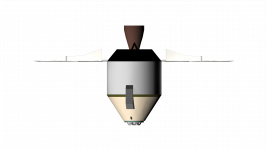
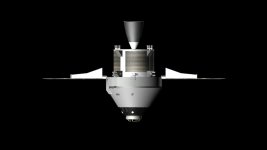
If I read this right then it's correct to assume the CEV's you find in OHM that have the same SM characteristics, as you describe here, could be/have potential modularity. But wern't they evolutionary rather than modular?
 

Attachments

  • CEV Type 1_Top.png
    CEV Type 1_Top.png
    430.3 KB · Views: 22
  • CEV Type 2_Top.jpg
    CEV Type 2_Top.jpg
    38.5 KB · Views: 28
The SM diameter was downsized at one point, but that was due to the fact that a larger SM wasn't needed and Ares I needed a lighter payload...
 
The SM diameter was downsized at one point, but that was due to the fact that a larger SM wasn't needed and Ares I needed a lighter payload...

So evolutionary then. As I thought, launch constraints, and probably mission(LEO), got to the CEV as well.
 
So evolutionary then. As I thought, launch constraints, and probably mission(LEO), got to the CEV as well.

Yes, but no modular trait. The SM is still a major structural component influencing the rest of the vessel. Modularity requires well-defined interfaces that can be frozen at one point in development and permit still flexibility for the combination of both SM or capsule. The MPCV is still far away from such a situation.
 
NASASpaceflight: OFT-1: NASA gearing up for Orion’s 2013 debut via Delta IV Heavy:
The efforts relating to the debut launch of Orion – otherwise known as the Multi-Purpose Crew Vehicle (MPCV) – on a “multi-hour” test flight are ramping up, as managers discuss the preliminary objectives, which may include a “human capable” version of the spacecraft being tested. A launch date of July, 2013 has been set, with the Delta IV Heavy assigned to the role of launch vehicle.

{...}
 
A launch date of July, 2013 has been set, with the Delta IV Heavy assigned to the role of launch vehicle.
Awesome, if it goes up I'll get so see the beginning of the new manned space program before I go to college.
 
Seems a bit expensive, but I like the Orion/Delta4H config very much. No SRM = even more safety. :cool:
 
At least the launcher isn't overkill for the job of lifting stuff into LEO.

Why do people hate SRMs? What's wrong with SRMs? When last did a total failure occur on a Delta IV or Atlas rocket because of SRMs?
 
If NASA only would have chosen an existing LV already from the beginning instead of the Ares launchers :facepalm:

I like the idea.

PS: I don't care about costs. I only care about time.
 
Back
Top