

Will
New member
Hello,
I am reading a book called "Quantum Mechanics and Path Integrals" by the one and only Richard Feynman. When it comes to define the sum over paths it uses an analogy with the Riemann Integral (that's fine) to come up with the equation
∫…∫ ∫∅[x(t)]dx1dx2…dxN-1
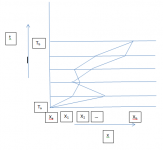
I think I can see physically what this equation is getting at: if you have a particle starting at a and finishing at b and divide the time into equal segments of width E, you say the particle could go from x0 at time t0 to x1 at t1 then to x4 at t2 then x2, t3... or x0 at t0 to x5 at t1 then to x4 at t2 then x7, t3 etc and you sum the amplitudes of all these possible mini paths and somehow end up with the equation above, can anyone explain how this equation is formed?
Thanks
Will Wilson
I am reading a book called "Quantum Mechanics and Path Integrals" by the one and only Richard Feynman. When it comes to define the sum over paths it uses an analogy with the Riemann Integral (that's fine) to come up with the equation
∫…∫ ∫∅[x(t)]dx1dx2…dxN-1
I think I can see physically what this equation is getting at: if you have a particle starting at a and finishing at b and divide the time into equal segments of width E, you say the particle could go from x0 at time t0 to x1 at t1 then to x4 at t2 then x2, t3... or x0 at t0 to x5 at t1 then to x4 at t2 then x7, t3 etc and you sum the amplitudes of all these possible mini paths and somehow end up with the equation above, can anyone explain how this equation is formed?
Thanks
Will Wilson


