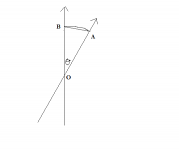
See attached diagram. (Viewed from above and projected into 2 dimensions).
OA is current velocity, OB is your targetted velocity, with θ being the angle between the two (RInc).
You want your final speed to be the same as your current speed (only a plane change, not affecting eccentricity of orbit), so OA = OB. Thus the triangle OAB is a isosceles. From trigonometry, you can thus calculate the length OB (the speed change required) to be
ΔV = 2v * sin(θ/2)),
where v = your speed at the point of intersection.
However, that's for a direct-line burn, which we very rarely do in orbiter. As we normally perform plane changes by burning normal/antinormal, we need to take the 'curved' route around the top of the triangle - an arc centred about O. Thus, the arc-length is much simpler in this case, being merely ΔV = vθ, where θ (your RInc) is expressed in radians.
As plane changes are normally very small (ie θ is very small), sin (θ/2) approximates down to θ/2, giving you the same result for both cases.