
You are using an out of date browser. It may not display this or other websites correctly.
You should upgrade or use an alternative browser.
You should upgrade or use an alternative browser.
Updates Rosetta Mission News
- Thread starter Notebook
- Start date

- Joined
- Feb 4, 2008
- Messages
- 9,761
- Reaction score
- 1,030
- Points
- 203
No thrusters and a very gentle landing.I'm a bit surprised by the lack of dust thrown up. I expected Philae to generate quite a cloud of dust that would have taken hours to disperse.

Astro SG Wise
Future Orion MPCV Pilot
Sorry I may be butting in, but I can't believe that Philae bounced off! Insanity! If they wasted 10 years of work, it would be an understatement to say that I was sorry for them.

- Joined
- Feb 6, 2008
- Messages
- 38,938
- Reaction score
- 3,937
- Points
- 203
- Location
- Wolfsburg
- Preferred Pronouns
- Sire
Sorry I may be butting in, but I can't believe that Philae bounced off! Insanity! If they wasted 10 years of work, it would be an understatement to say that I was sorry for them.
It bounced off two times, landing on 15:33, 17:26 and 17:33 UTC (about 1 km high on the first one, only centimeters high on the second bounce of 7 minutes duration)... and has now landed somewhere behind a cliff it seems

- Joined
- Nov 23, 2008
- Messages
- 1,681
- Reaction score
- 4
- Points
- 38
Of course - and there is no reason (gradient, edges, other surface features) to assume, that the lander is not upright and the large back area is no shadow. <snip>
I would hesitate to make those assumptions. It would be rather amazing if the shadow were being cast in such a way as to leave the landing leg perfectly lit, while being so shallow in angle that no pebbles or protrusions escaped shadow.
- Joined
- Feb 6, 2008
- Messages
- 38,938
- Reaction score
- 3,937
- Points
- 203
- Location
- Wolfsburg
- Preferred Pronouns
- Sire
I would hesitate to make those assumptions. It would be rather amazing if the shadow were being cast in such a way as to leave the landing leg perfectly lit, while being so shallow in angle that no pebbles or protrusions escaped shadow.
Sure - but it is also no reason to assume the opposite. We in the forum have not more data than the scientists and even the scientists have no precise idea right now.

- Joined
- Feb 11, 2008
- Messages
- 2,601
- Reaction score
- 31
- Points
- 63
I liked the comment (plea) to not emphasize the parts that "failed" but concentrate on successes. But then I thought about it for a minute. The general public likes "victories snatched from the jaws of defeat". Apart from space-buffs (like us) nobody has any idea of the existence of any space telescopes except Hubble.
Will a partial failure make a space mission be more popular? I suspect the people that only pay attention to failures aren't going to be supporters of space exploration any time soon. The time lines in space exploration are simply too long to hold the attention of anyone but the most hardline supporters. I'm afraid that it will take something like the total failure if GPS or something similar to make people take notice.
Will a partial failure make a space mission be more popular? I suspect the people that only pay attention to failures aren't going to be supporters of space exploration any time soon. The time lines in space exploration are simply too long to hold the attention of anyone but the most hardline supporters. I'm afraid that it will take something like the total failure if GPS or something similar to make people take notice.
- Joined
- Nov 23, 2008
- Messages
- 1,681
- Reaction score
- 4
- Points
- 38
Sure - but it is also no reason to assume the opposite. We in the forum have not more data than the scientists and even the scientists have no precise idea right now.
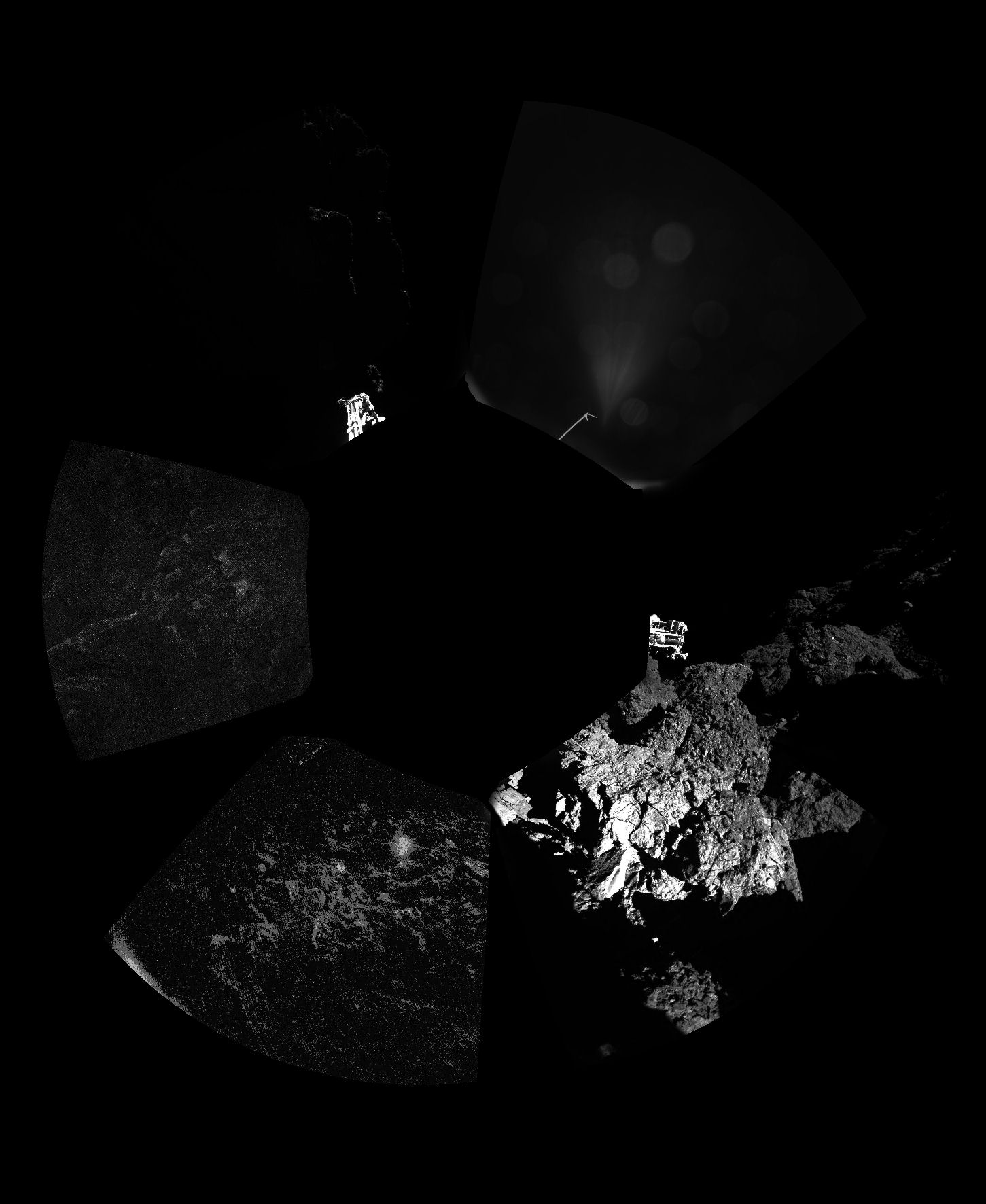
I would argue that the bright lighting on the landing foot contrasting with the black shadow or space behind it is VERY strong evidence that foot is not in contact with the surface.
didn't someone say that some of the screws deployed? If that is not the black of space behind the foot, one scenario I could imagine would be that the screw raised the foot above the surface into full light having no harpoon stability to work against

Unstung
Active member
The Planetary Society: "Philae status, a day later"

- They do not yet know exactly where Philae landed (more on that below).
- After the initial impact, they rebounded at about 38 centimeters per second -- about a third of their 1-meter-per-second impact velocity.
- They saw rotation for about 2 hours after impact, and then rotation stopped (this was while the spacecraft was on its long first bounce).
- They lost the link about 30 minutes after its final touchdown.
- The solar panels are only getting illuminated for 1.5 hours of each 12-hour comet day, which is much, much less than they need in order to keep the lander going after its batteries run out.
- Contrary to earlier reports, the solar panels are not damaged.
- Rosetta is operating nominally; the network systems and overall ground segment to control the mission are nominal
- Last night, Rosetta lost contact with Philae as expected when it orbited below the horizon just after 20:00 CET.
- Contact was re-established this morning at 06:01 UTC / 07:01 CET, and the Philae-Rosetta radio link was initially unstable.
- As Rosetta rose higher above the Philae landing site, the link became very stable and the lander could transmit telemetry (status and housekeeping information) and science data from the surface.
- This morning's surface link was again lost due to Rosetta's orbit at about 09:58 UTC / 10:58 CET. Ignacio explains that with the current orbit, Rosetta will have, typically, two Philae communication windows per day.
- The next window opens at 19:27 UTC on the spacecraft and runs through to 23:47 UTC spacecraft time.
Where did Philae land? Its initial impact point is precisely located within the red square. Its final landing location is not yet known, but CONSERT radar sounder data suggests it is somewhere within the blue diamond.

Gosh, it's really dark. Make sure to bring a camera with flash when visiting a comet.

- Joined
- Feb 11, 2008
- Messages
- 2,601
- Reaction score
- 31
- Points
- 63
Is that a gas jet the upper portion of the image?
IIRC that was lens flare from the sun plus a few stars.
Well, at least the limited battery life will force the team to make some moves rather quickly instead of dwaddling for months on end.
Good links here:
http://www.unmannedspaceflight.com/index.php?showforum=76
Good links here:
http://www.unmannedspaceflight.com/index.php?showforum=76
Last edited:

When the battery gets near dying, I hope they try a few more times to start the thruster and maybe, without harpoons or screws, that could spring the lander back up to land in a new location? Maybe? 
Last edited:
The gravity is so low, if they have anything that can produce some vertical kickback, like a hammer or something like that, they'd be off the surface... We're talking about surface gravity in the single digit cm/s range...
Unstung
Active member
Curiosity has its own LEDs for nighttime observations. That's not as practical for a solar powered spacecraft and one that was supposed to land on flat terrain.Gosh, it's really dark. Make sure to bring a camera with flash when visiting a comet.
When the battery gets near dying, I hope they try a few more times to start the thruster and maybe, without harpoons or screws, that could spring the lander back up to land in a new location? Maybe?
Philae will try to deploy MUPUS to expose its solar panels better. The drill, SD2, will likely be used at the end of the lander's battery life because there's nothing to lose. I recall that the thruster problem had no chance of being resolved so the team went ahead with the landing in the first place.The gravity is so low, if they have anything that can produce some vertical kickback, like a hammer or something like that, they'd be off the surface... We're talking about surface gravity in the single digit cm/s range...

- Joined
- Feb 6, 2008
- Messages
- 38,938
- Reaction score
- 3,937
- Points
- 203
- Location
- Wolfsburg
- Preferred Pronouns
- Sire
Could they roll across the surface KSP style with the reaction wheels?
I wanted to say no... but I am not sure if this might actually work. :lol:
The problem is, switching on the single flywheel might consume a lot of battery and I am not sure how much you could control the motion by a single flywheel.
Similar threads

- Replies
- 3
- Views
- 1K


- Replies
- 0
- Views
- 1K