
Yes, it's 1/4. It's from the surface formula for a sphere. A=4 x pi x r^2. If you have 2x distance you get 1/4 light per area.
I think you're trying to write this:
1 / r^2, not 1 / r^4


Yes, it's 1/4. It's from the surface formula for a sphere. A=4 x pi x r^2. If you have 2x distance you get 1/4 light per area.

At mission end (Rosetta orbiter) there is talk about landing it, too, on the surface. All they'd need to do is get close, and let it settle in place.
While that's happening, imagine the closeup pictures. Thousands of pixels per meter!

Could the orbiter use the remaining fuel to land and then hop from surface to surface?


So it seems that the "Philae mission" was a full success, even if the batteries went out of power just after transmitting all the data!
But I will be carefull: Maybe it's a bit early to say this...
Can somebody confirm (maybe from an official source)?

From a quick calculation, the light will be about five times as intense when Philae reaches perihelion than when it landed. If the logic is correct, Philae will receive the equivalent of 7.5 hours of sunlight per 12-hour day at 67P's current distance. This is more than enough to charge Philae's batteries based on the plans that the lander would wake up with only 6 hours of light per day at its current distance from the sun. These assumptions, of course, neglect how much dust will settle on Philae, how much of its solar panels are exposed to sunlight, and how the lighting conditions will change.So far, even the official sources seem to agree there.
Also, the scientists are optimistic that the mishap with the landing site could turn out to be an advantage later. The lander could maybe survive the perihelion passage and collect data even after the planned EOL.

As far as I know from all the information I've got, it theems that the drill was a sucsess and all 10 experiments has been completed.
I read different sources, one is here:
http://eandt.theiet.org/news/2014/nov/philae-power-drilling.cfm
So it seems that the "Philae mission" was a full success, even if the batteries went out of power just after transmitting all the data!
But I will be carefull: Maybe it's a bit early to say this...
Can somebody confirm (maybe from an official source)?

MUPUS scientists tried each of the hammer's three power settings - and after failing to penetrate the surface using those, proceeded to a "secret" fourth setting. This setting, nicknamed "desperate mode", broke the hammer.
Nevertheless, the exercise suggests the surface of the comet may have a tensile strength approaching that of sandstone.
Could the surface at the slope where Philae landed be tougher than its flat landing site? BBC assumes that the surface at the landing site had a similar consistency: "That hard surface might also explain why Philae bounced so high - maybe a kilometre up - after its initial landing".

OSIRIS pictures of Philae taking a walk on the wild side:
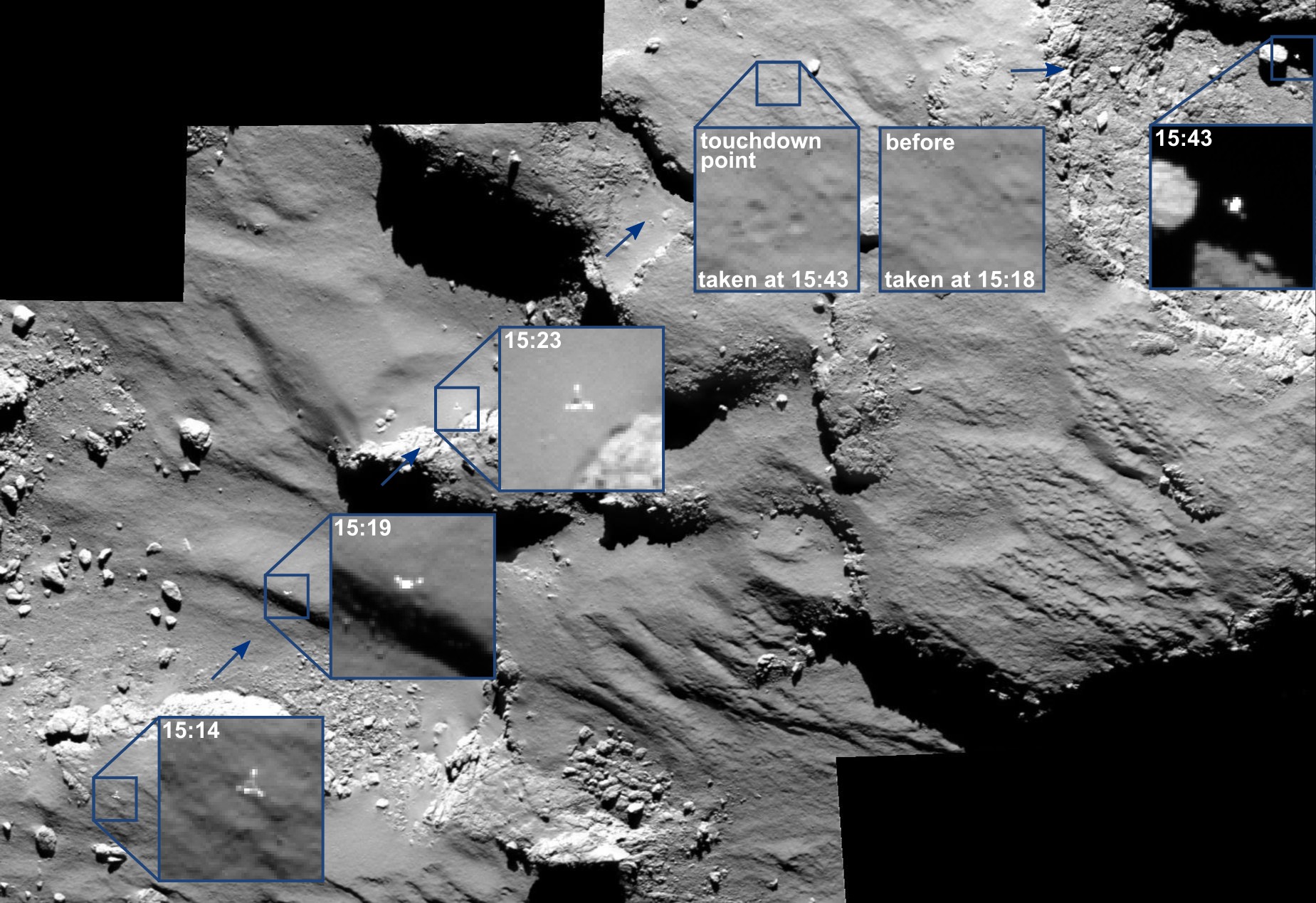
thats so weird!
Does anyone have the reasoning about the path... I don't understand the "touchdown point"... was that location of the second bounce? or are those images just at an odd angle showing the height as an illusion of transverse movement? whats going on there??

Could the surface at the slope where Philae landed be tougher than its flat landing site? BBC assumes that the surface at the landing site had a similar consistency: "That hard surface might also explain why Philae bounced so high - maybe a kilometre up - after its initial landing".
 iron plate!

From a quick calculation, the light will be about five times as intense when Philae reaches perihelion than when it landed. If the logic is correct, Philae will receive the equivalent of 7.5 hours of sunlight per 12-hour day at 67P's current distance. This is more than enough to charge Philae's batteries based on the plans that the lander would wake up with only 6 hours of light per day at its current distance from the sun. These assumptions, of course, neglect how much dust will settle on Philae, how much of its solar panels are exposed to sunlight, and how the lighting conditions will change.

the reference
my head


