Updates Rosetta Mission News

The comet being followed by Europe's Rosetta spacecraft has a mass of roughly 10 billion tonnes.

The number has been calculated by monitoring the gravitational tug the 4km-wide "ice mountain" exerts on the probe.

Ten billion tonnes sounds a lot, but it means Comet 67P/Churyumov-Gerasimenko has quite a low bulk density, something in the region of 300kg per cubic metre.

If you could put the object in an ocean, it would float.

http://www.bbc.co.uk/news/science-environment-28881015

Edit:
some interesting comments at the end of the article...
see:
48.David Wallis
46 Minutes ago

N.
 
Last edited:
:lol: What a perfectly coined phrase. Deserves a place in the technical jargon.

That what really disturbed me... now it makes sense to me as well, but such a great term never made it into the dictionary.
 
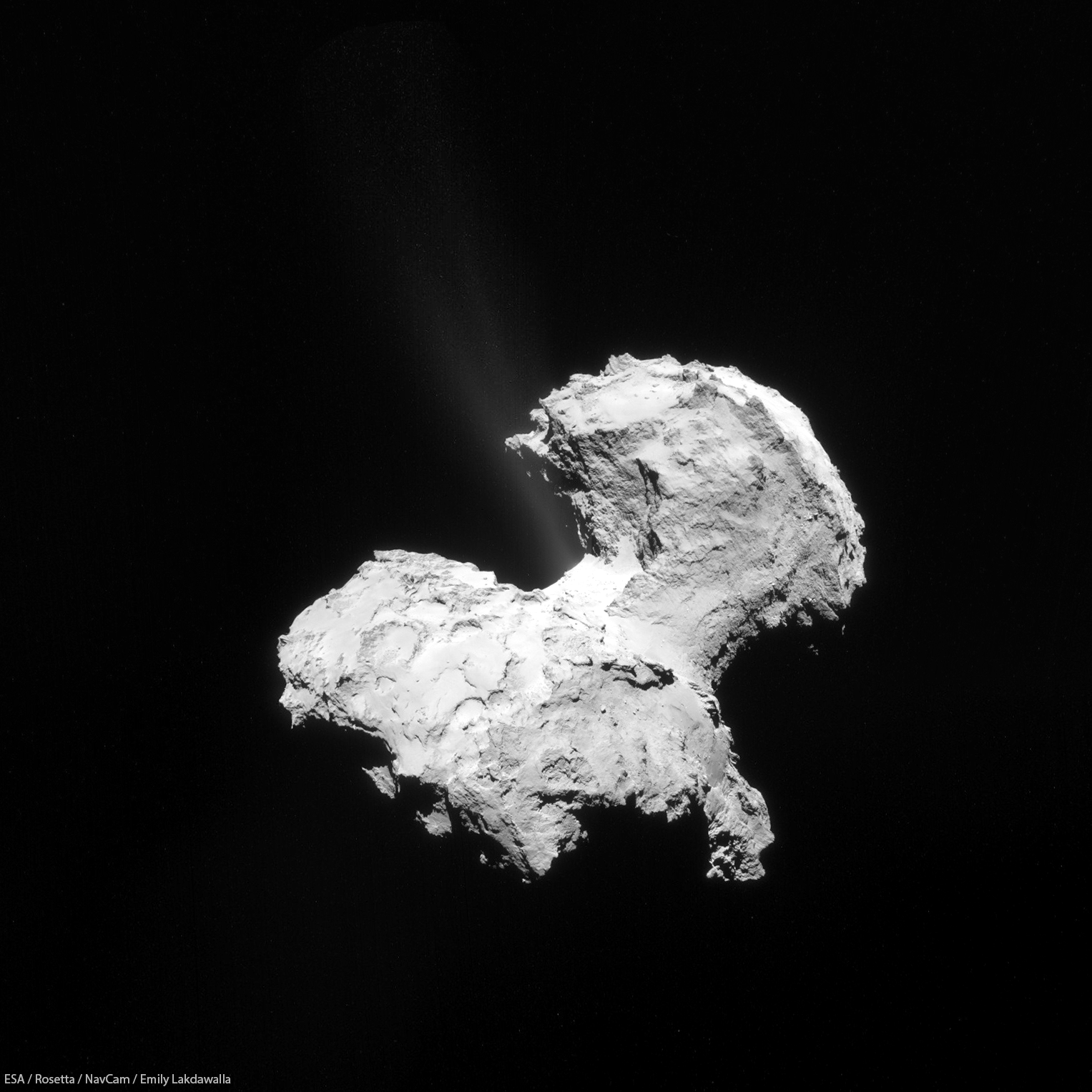
The NavCam images now have pretty high resolution, and it's possible to process the images to make 67P's jets readily visible.

20140904_ESA_ROSETTA_NAVCAM_20140902A_16bit_destriped_stitch.png

The Planetary Society: "Latest Rosetta NavCam images reveal jets on Churyumov-Gerasimenko"
 
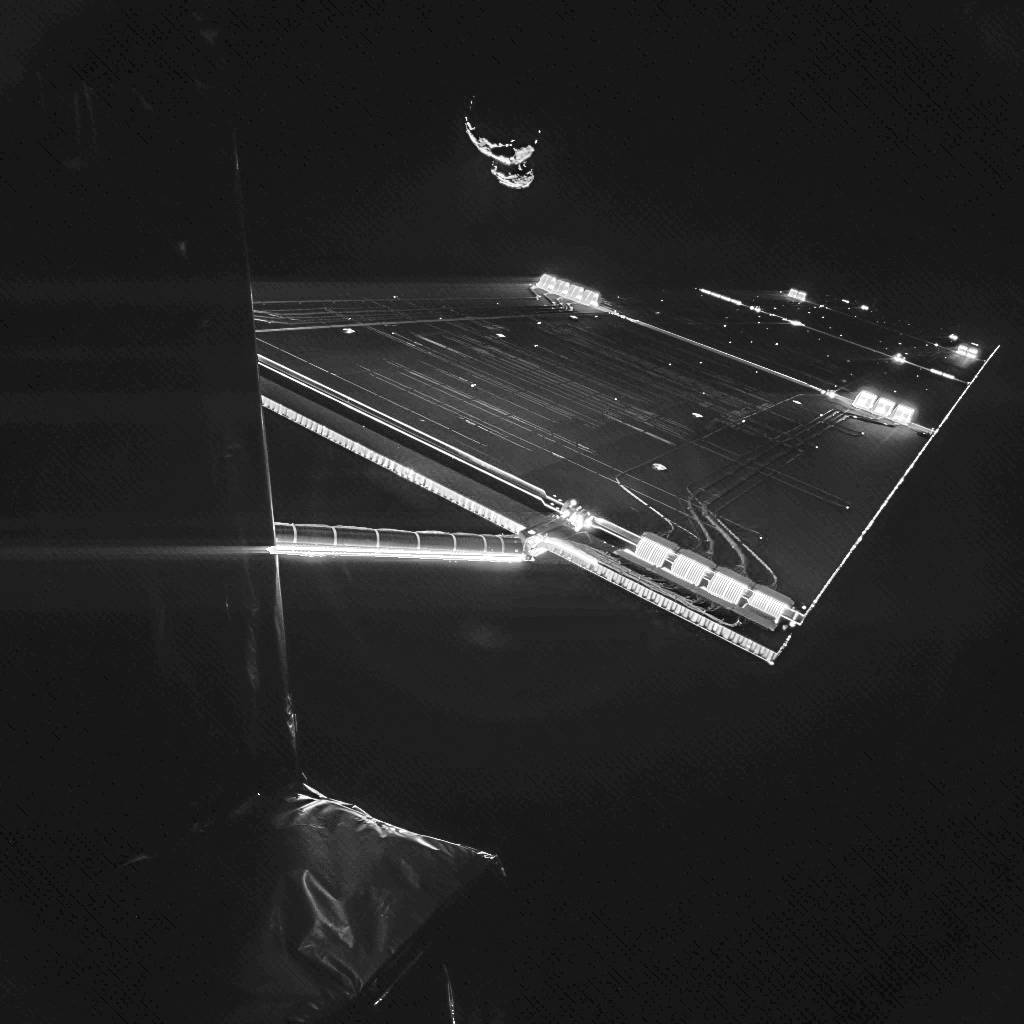
The ultimate selfie?

rosetta_selfie.jpg
 
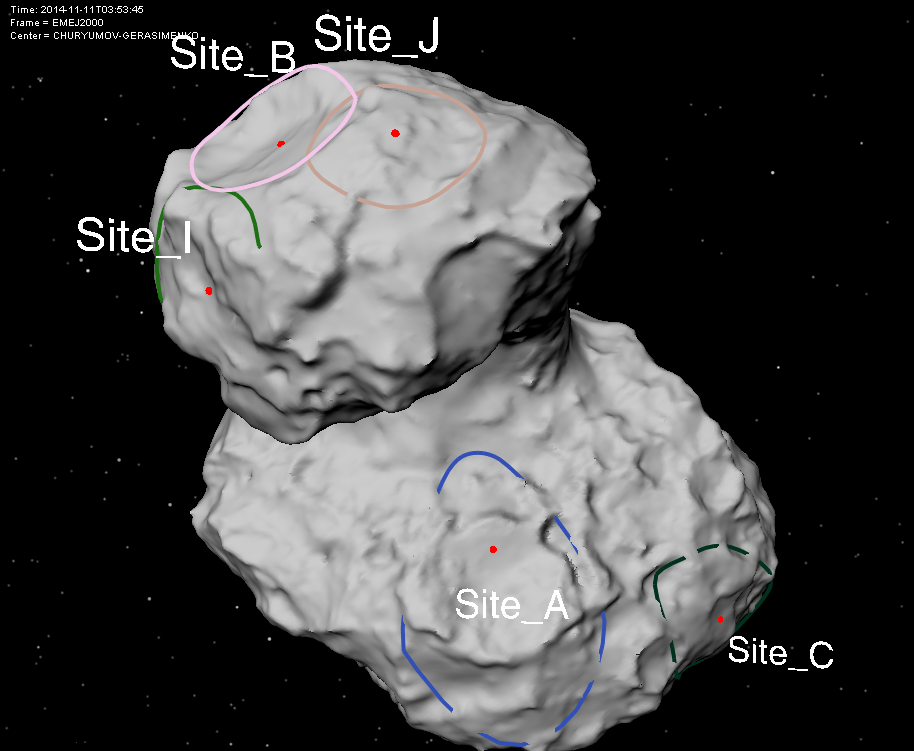
The landing site for Philae has just been selected, called site J which is located on the smaller lobe. Site C is the backup and on 67P's larger lobe. The landing is scheduled for 11 November.

BBC: "Rosetta: Audacious comet landing site chosen"
_77591896_jsite.jpg


The Planetary Society provides some more detailed information on the candidate sites via ESA and DLR.
Site C lies on the larger lobe of the comet. Here, scientists have found a range of different landforms such as depressions, cliffs, hills and flat areas – and also material that appears brighter than usual on the acquired images and is thus particularly interesting. But it is precisely these surface structures that must now be looked at in more detail to assess the risks they could pose for a safe landing. The illumination conditions are good, which will be of benefit to the later phases of scientific investigation.

Site J is similar to site I – the landing site also sits on the smaller comet lobe, has interesting surface features and good lighting. This landing site is the most favourable for the CONSERT experiment, which will probe the comet's interior by studying radio waves that are reflected and scattered by the nucleus. This landing site is more favourable than landing site I. However, since there are some boulders and terracing features, higher-resolution camera images will be necessary to study the terrain in detail.

20140825_sites_atterrissage.png


EDIT: :ninja:
 
I absolutely can't wait to see the surface photos!!!
:woohoo:
 
Don't get too hopeful for Philae's landing; ESA is downplaying its chances of success. There are many criteria to be met for a landing site and balancing all of them perfectly for such an odd object are impossible.
 
Yeah i watched an animation and it didn't even seem to have guidance... But maybe it has mechanical attitude control. Never looked into it. Seems to have an extremely robust science payload...

But I have faith in the probe! :hailprobe:
 
Last edited:
Yeah i watched an animation and it didn't even seem to have guidance... But maybe it has mechanical attitude control. Never looked into it. Seems to have an extremely robust science payload...

But I have faith in the probe! :hailprobe:


AFAIR, it has cold gas thrusters (Yes, it has:... Active Descent System ADS). The gravitational acceleration of the comet is just a few mm/s² ... extremely small.

http://www.dlr.de/rd/Portaldata/28/Resources/dokumente/rx/Philae_Lander_FactSheets.pdf
 
Last edited:
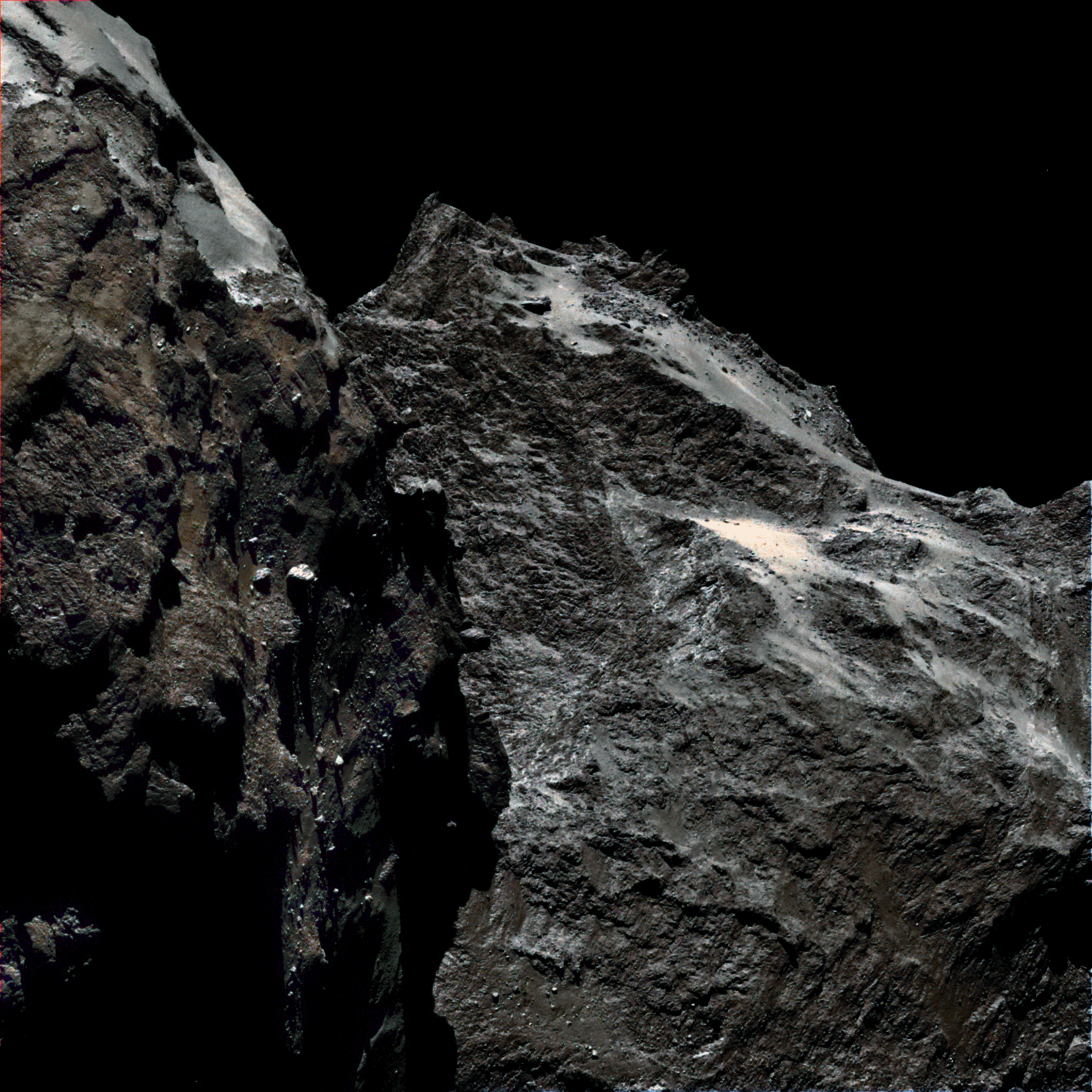
Would seem as they took a whole bunch of readings from a black and white camera... And artificially colored them to make that image. Can someone confirm this?
 
Certainly seems to give a picturesque meaning to "flying mountain".
 
Anyone else seeing lots of strata in the "reconstructed colour image" above? Especially the bottom-right corner of the image. Looks like sedimentary rock! (although I don't see how it could be). Impact fractures? Erosion? Optical illusion?
 
Back
Top