Updates Rosetta Mission News

Anyone else seeing lots of strata in the "reconstructed colour image" above? Especially the bottom-right corner of the image. Looks like sedimentary rock! (although I don't see how it could be). Impact fractures? Erosion? Optical illusion?

From meteorite studies of carbonaceous chondrites it has been speculated that comets might contain clays and/or carbonates. If so then they would contain sedimentary rock.

Bob Clark
 
From meteorite studies of carbonaceous chondrites it has been speculated that comets might contain clays and/or carbonates. If so then they would contain sedimentary rock.

Bob Clark
Very interesting. Part of me is still thinking "don't you need a lot of water + pressure to make layers like that?" - but I'm no geologist! Must find some up-to-date reading on comet formation. They sure picked a great rock to visit for this mission :)
 
Maybe remnants, from an early planetoid collision ?
 
Maybe remnants, from an early planetoid collision ?

Some speculation on how carbonates could have formed on comets is discussed in this article:

Comet's minerals hint at liquid water.
18:47 08 September 2005 by Maggie McKee, Cambridge, UK
http://www.newscientist.com/article/dn7971-comets-minerals-hint-at-liquid-water.html

If Rosetta can prove definitively that carbonates exist on comets it will be a profoundly important mission discovery. Recall that for Mars for a long time carbonates could not be detected on Mars to the extent some scientists even began to doubt the ancient large channels seen on Mars were carved by liquid water.
Finally, in a key discovery Mars Reconnaissance Orbiter was able to confirm large deposits of both carbonates and clays.

Bob Clark
 
"Reconstructed Color" means that images taken with different filters were combined. However, these filters do not exactly reproduce what a human eye would see. It's just an approximation. More information on Rosetta's cameras can be found here.
 
http://www.bbc.co.uk/news/science-environment-29633734

The decision to try to land a robot on Comet 67P/Churyumov-Gerasimenko on 12 November has been confirmed.

Last month, planners on Europe's Rosetta mission announced a preference for a touch-down location on the head of the icy, rubber-duck-shaped object.

A detailed follow-up analysis, informed by new high-resolution pictures, has found no reason to rescind the choice.

The Rosetta probe will eject the Philae robot shortly after 08:30 GMT on the day of landing.

N.
 
COMETWATCH – 18 OCTOBER

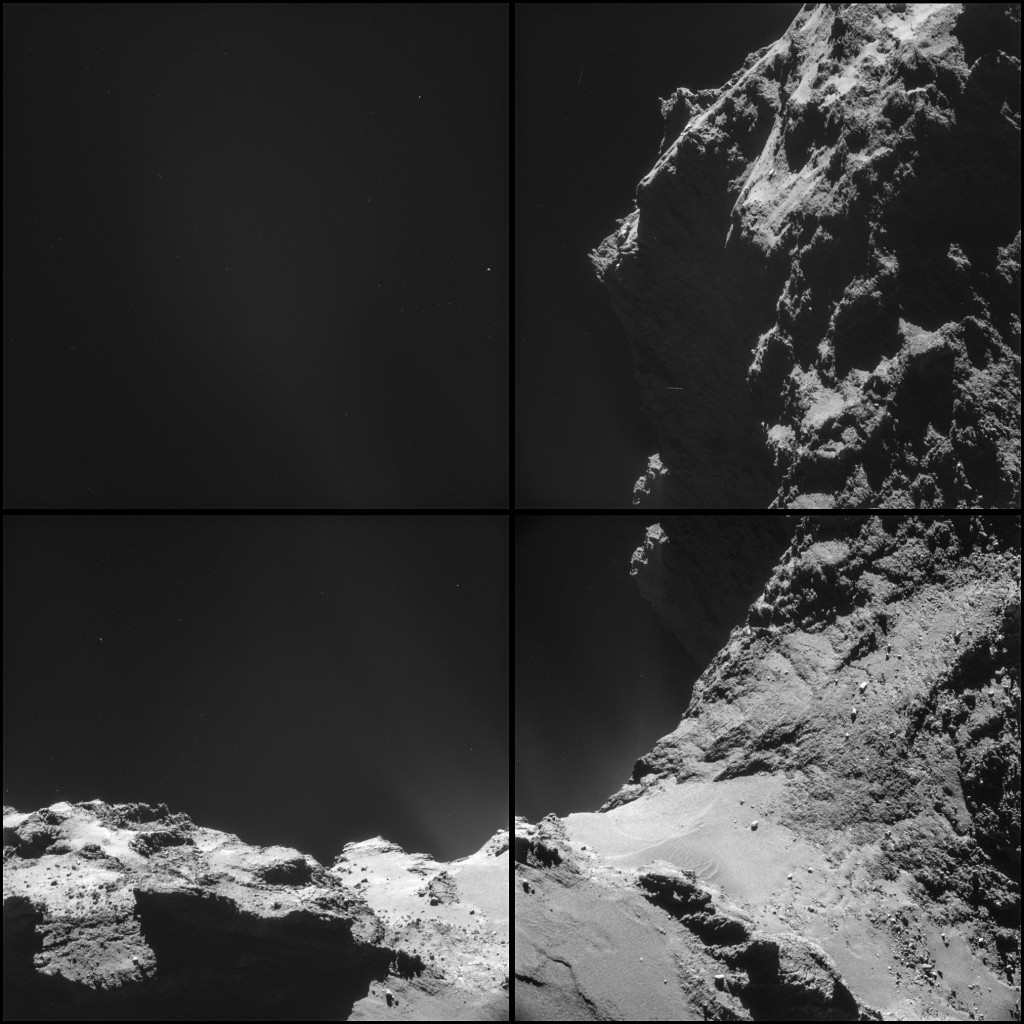
This four-image NAVCAM montage comprises images taken on 18 October from a distance of 9.8 km from the centre of comet 67P/C-G – about 7.8 km from the surface. The four 1024 x 1024 pixel images making up the montage are provided at the end of this post.

ESA_Rosetta_NAVCAM_141018_montage-1024x1024.jpg


:jawdrops:
 
It would be interesting to add a man's shape to this photos, for comparison and sense of scale. Might be a dot at this distance.
 
The NAVCAM photos are stunning enough, but come on ESA, where are the OSIRIS images? I recall that there is a time frame for when all Rosetta data will finally be released.
 
The NAVCAM photos are stunning enough, but come on ESA, where are the OSIRIS images? I recall that there is a time frame for when all Rosetta data will finally be released.

like usual for ESA ... first the science then the public. They will release processed and interpreted images after their scientists had a good look on it... worked great for Mars and Venus Express so far, so why change it?
 
Rosetta will release Philae in just over a week and has maneuvered into the pre-delivery orbit.

 
One day from now, Philae will say goodbye to its 10+ year companion and free-falls on a 7 hour journey to 67P! Release is scheduled at 09:03 UTC tomorrow with touchdown planned at 16:02 UTC.

And yes, Rosetta will need to be very precise in dropping Philae away, for a little mistake can send the lander into deep space forever! :shifty:
 
Awesome! Does Philae have it's own RCS, or must Rosetta drop Philae the right way? How much delta-v does Philae have (could it be used for course corrections in event of a mishap)?
 
Awesome! Does Philae have it's own RCS, or must Rosetta drop Philae the right way? How much delta-v does Philae have (could it be used for course corrections in event of a mishap)?

No RCS, it is controlled by reaction wheels. It has no delta-V for corrections.

It has cold gas thrusters for compensating the firing of the harpoons, but those can not be used for manoeuvring.
 
No RCS, it is controlled by reaction wheels. It has no delta-V for corrections.

It has cold gas thrusters for compensating the firing of the harpoons, but those can not be used for manoeuvring.

I hope Rosetta hits the bullseye then :blink:
 
I hope Rosetta hits the bullseye then :blink:

The separation maneuver is pretty much like slow-motion curling.

Something really strange would need to happen for missing the comet, I would be more concerned about it rolling over the comet surface or failing to arrest before bouncing away.
 
Back
Top