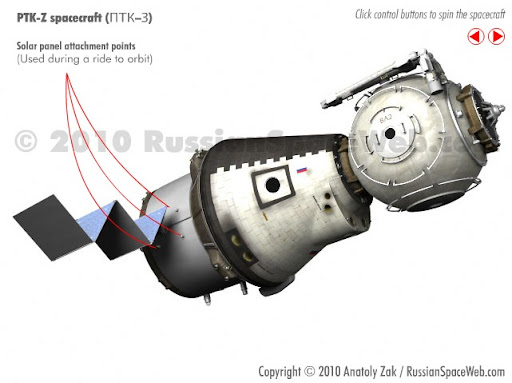
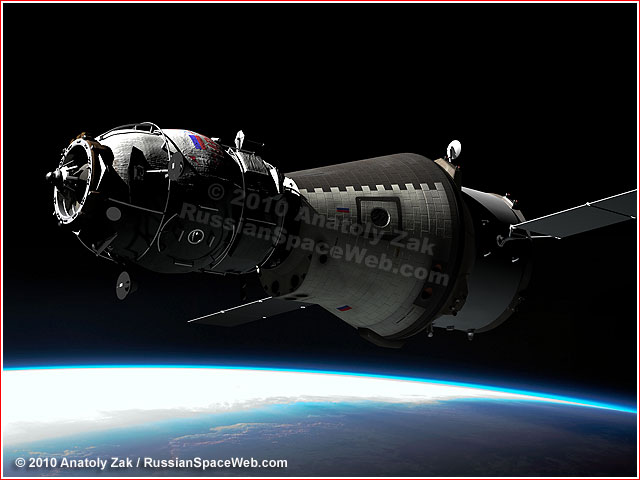
And here are the latest speculative image of the ACTS (PTK-NP) drawn by Analtoly Zak based on his analysis of the published technical project requirements. The new spaceship morphs to a Soyuz-like beast!
(watch through the full flash animation sequence with Anatoly's comments at
http://www.russianspaceweb.com/ptk_z.html)
quoting on from russianspaceweb:
In October 2010, Russian space agency, Roskosmos, published its requirements to the industry for the development of the Technical Project of the next-generation spacecraft, PTK NP. The document identified two versions of the spacecraft, which would be a priority for the Technical Project in the next two years. First of these two variants was a three-module PTK-Z spacecraft. It was designed for long-duration autonomous missions in the Earth orbit, while a two-module PTK-S variant was intended to service the Earth-orbiting station, such as ISS.
PTK-Z spacecraft
According to Roskosmos, the PTK-Z spacecraft (where "Z" probably stands for "Zemnaya orbita" or Earth orbit) would fly scientific, application and experimental missions in the Earth orbit. As usual, the capabilities of the spacecraft were likely defined in coordination with RKK Energia, Russia's prime developer of manned spacecraft which would ultimately be responsible for the new generation of vehicles.
PTK-Z would have to be able to carry four people on a two-week mission, or provide for a reduced crew of two during an extended month-long flight. It would differ from a base version of the PTK NP spacecraft by the so-called Additional Pressurized Module, or "Dopolnitelny Germetichny Otsek, DGO," in Russian, which would be attached to the front of a cone-shaped crew capsule. Such configuration would make the general arrangement of the spacecraft components very similar to the classic Soyuz spacecraft, with the returnable crew capsule in the center, the habitation module in front and the propulsion module in the back. However, unlike the Habitation Module of the Soyuz spacecraft, the DGO module would ride into orbit below the rest of the spacecraft. After reaching orbit and separating from the second stage of the launch vehicle, PTK-Z would turn around and dock to the DGO module mounted on the rocket stage. Only then, the completed three-module spacecraft would separate from the empty rocket stage. Such flight scenario was well familiar to Apollo astronauts. In each lunar expedition, the Apollo spacecraft, including command and service module, would have to turn around after the separation from the upper stage of the Saturn rocket, in order to dock to the lunar module, which during the launch was mounted on the rocket stage behind the manned portion of the spacecraft. Such architecture was dictated primarily by the goal of having the crew capsule at the very top of the rocket during the ride to orbit, in order to simplify the escape system.
DGO module requirements
In the PTK-Z design, the DGO module would have to be capable of carrying no less than a ton of customized payloads and provide up to six cubic meters of volume for their accommodation. No less than 800 kilograms of instruments and equipment should be removable and returnable to Earth, the agency required.
The agency specifically requested to evaluate the possibility of mounting external payloads on the DGO module with the help of "robotic means," a clear reference to the use of remotely controlled manipulator arms on the exterior of the spacecraft. The DGO module was also required to have at least two windows, which would perpendicular to the axis of the spacecraft, probably intended for remote-sensing of the Earth surface, and astronomical observations of the sky. At least one window would have to be able to accommodate UV sensors.
Peculiarly, the agency documents envisioned the dockings of the PTK-Z spacecraft to the orbital station, while carrying the DGO module and/or without it.
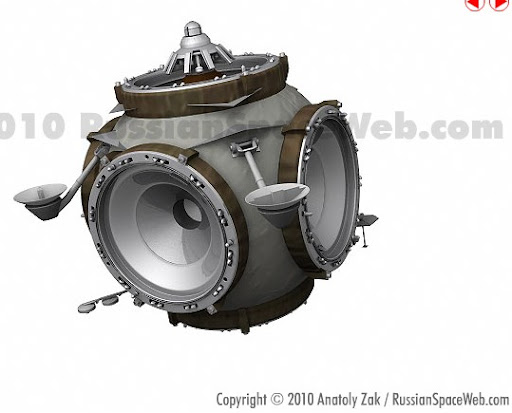
Roskosmos provided no specifications on the design of the DGO module and no visual references on this component had been officially released. However as of 2010, it was widely believed that RKK Energia hoped to rely on the design of the ball-shaped
Node Module proposed for the Russian segment of the International Space Station as a basis for the DGO structure.
Unlike the station's Node Module, which was expected to carry six docking ports on its surface, the DGO module would only be equipped with two ports. One "passive" docking unit would be used for the docking with the crew module of the PTK-Z spacecraft and one forward mechanism would be used to dock with the space station as necessary.
The design of the Russian Docking Compartment on the International Space Station was also rumored as a possible basis for the DGO module design. However due to a larger size and the mass of the structure, it was considered a less likely candidate for the DGO design than the Node Module.
A possible configuration of the PTK NP spacecraft with an additional pressurized module, DGO, which could be based on the Docking Compartment or a node module of the International Space Station. The head of the Russian space agency Anatoly Perminov first mentioned such option in April
Other requirements
The PTK-Z spacecraft was expected to fly in regular orbits, which would be accessible from Vostochny launch site with an altitude of 200-500 kilometers and an inclination 51.7 degrees toward the Equator. Roskosmos asked the industry to additionally evaluate the possibility of bringing the ship into a radiation-prone altitude of 1,000 kilometers for as long as three days. Optional missions in higher inclination orbits would also be studied. As expected, the Rus-M rocket would be responsible for delivering the spacecraft into orbit.
In another peculiar development, the agency cited the accuracy of landing radius for the PTK-Z spacecraft as five kilometers, which was considerably "relaxed" target than a two-kilometer accuracy, which Russian space officials and documents quoted previously. This change likely reflected a recent decision to use parachutes during the nominal landing, instead of relying exclusively on rocket power.
Known PTK-Z specifications:
DGO module payload capacity|no less than 1,000 kilograms
DGO module available payload volume|no more than 6 cubic meters
Return to Earth payload capability|no less than 800 kilograms
Power supply for payload in the DGO module|no less than 2 kWatts
Standard operational orbit|200-500 kilometers; 51.7 degrees
Optional orbital inclination|63, 72, 83 and 98 degrees
Launch vehicle|Rus-M