Project Saturn V MK2

Sky Captain

New member
Joined
Jan 29, 2009
Messages
945
Reaction score
0
Points
0
With all that talk about possible Ares rocket replacements going on I decided to make a modern version of Saturn V rocket for heavy cargo launches. It uses five slightly uprated kerosene/LOX fueled RD 171 engines on a first stage producing 42600 kN of thrust and seven H2/LOX fueled J2X engines on second stage. Stage diameter is 12.8 meters allowing for shorter stage length (and more space for additional strap on boosters) than original Saturn V.


So far basic version with two stages are finished, payload capability to LEO is ~ 200 tons. Launch mass is 3295 tons.
http://img7.imageshack.us/i/svmk2.jpg/
 
So far basic version with two stages are finished, payload capability to LEO is ~ 200 tons. Launch mass is 3295 tons.

You didn't optimize much, did you? 200/3295 makes just 6% payload mass fraction for the whole launcher...(the shuttle has effectively 7%, if you consider the Orbiter the payload, a side-mount would reach similar or better values).
 
You didn't optimize much, did you? 200/3295 makes just 6% payload mass fraction for the whole launcher...(the shuttle has effectively 7%, if you consider the Orbiter the payload, a side-mount would reach similar or better values).

Here are exact mass values for first and second stage

Stage 1
Fuel 2150 t
Structure 120 t

Stage 2
Fuel 755 t
Structure 51,3 t

Fairing 14 t

Total mass (rocket + cargo + fairing) on pad is 3310 tons. 220 tons of cargo is possible to lift to very low ~140X230 km orbit (second stage burns totally dry).
What more could be optimized? Stage mass fractions already are better than real SaturnV to account for better materials.
 
The ratio between the stages for example.
 
That is 0.46 (second stage + cargo vs first stage)

---------- Post added at 01:39 PM ---------- Previous post was at 01:11 PM ----------

I tested with lower mass ratio between stages 0.36 and it performed slightly worse I run out of fuel before achieving orbit at 7320 m/s.
 
That is 0.46 (second stage + cargo vs first stage)

Right number, wrong information. :lol:

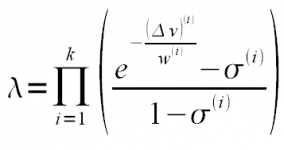
You want to reach a total velocity change of about 9200 m/s usually (real value depends on trajectory but is just slightly less usually), the optimization problem is just, how much of the 9200 m/s you need to produce with each stage for getting the optimal payload mass ratio (PMR for today, usual symbol is lambda). The total PMR is the product of the PMR of each stage.
 

Attachments

  • Formula_PayloadMassRatio.png
    Formula_PayloadMassRatio.png
    4.7 KB · Views: 31
Last edited:
Here
http://home.arcor.de/francisdrakex/download/
I found useful MS excel spreadsheet for calculating delta v of a 2 stage rocket. It turns out the stage mass ratio I already had is nearly the optimal. If I subtract the propellant mass from second stage and add it to first stage while also changing the dry mass of each stage so mass ratios of each stage and total mass of the rocket remains the same the total available delta v drops.
If I subtract propellant mass from first stage and add it to second stage I get a slight gain in total available delta v, but increased mass (and lower speed at first stage burnout) reduces thrust to mass ratio of second stage which makes gravity loses excessive killing any potential gain in payload.
 
Sorry, but this does not make sense to me here. When your total dV increases in the forward calculation of the rocket equation, you gained performance and can increase payload mass.
 
Problem is thrust to mass ratio of second stage which becomes lower if I add more fuel to it. Second stage has 7 J2X engines producing 9156 kN of thrust. For example when I subtracted 200 tons of fuel from first stage (2150 - 200) and added it to second stage (755 + 200) changing also the stage dry mass accordingly I get an increase of total available delta v by 160 m/s however now the second stage has lower thrust to mass ratio and combating gravity looses killed that delta increase.

If I add more engines to second stage the thrust to mass ratio becames better but now stage is also heavier which again removes the delta v gain.
 
does thrust to mass ratio really matter?
 
It matters because at the configuration that provides the biggest total delta v first stage burns out at ~1,9 km/s and second stage for few minutes has to fly at ~ 20 - 30 pitch to maintain positive VS which wastes lots of fuel.
 
1.9 km/s sounds a bit extreme low for first stage separation, you can put more mass on the first stage. also you don't move just fuel mass, the rocket structure itself gets lighter when you have less fuel to carry.

That factor between stage total mass and stage dry mass is sigma in the formula i posted.
 
I have tried various stage mass ratios and the one that theoretically has highest total delta v makes stage separation to occour at ~1.9 km/s which is inefficient because the second stage still has to fight lots gravity drag. I also changed structural mass of the stages accordingly to amount of propellant I moved between them so that`s not a problem.

Can you post what each variable in your formula stands for
 
λ is payload mass ratio - the mass of the payload relative to the launch mass.
Δv is the velocity change, with superscript (1) it is the velocity change by stage 1.
w is the average exhaust velocity or specific impulse in m/s. Superscripts like for the Δv
σ is the construction mass ratio, the ratio of the dry mass of a stage (tankage, engines, residuals) to the total stage mass. It does not include payload.
 
With help from Atomic Rockets site
http://www.projectrho.com/rocket/rocket3ai.html#setsize
I managed to create an Excel spreadsheet to allocate delta v fractions to each stage and minimize the initial launch mass and it turns out for 220 ton payload the lightest launch mass possible is 3122 tons with first stage delta v fraction of 0.24 however when testing this setup in Orbiter I quickly find out the second stage has too low thrust to weight and loads of fuel were wasted to compensate for gravity looses.

In Orbiter the best performance was with first stage delta v fraction of ~0.37

It also turns out such big discrepancy is because the first stage has lower ISP than second stage so it`s more efficient when second stage does most of the final acceleration.

When I set similar ISP to both stages the lowest launch mass is when the first stage provides half of the total mission delta v
 
Did you try a better launch trajectory maybe? If you have to fight with gravity losses in the second stage flight, maybe you failed leaving the gravity losses at the (rather ineffective) first stage.
 
I have tried various launch trajectories and the speed at stage separation is just too low ~1.3 km/s for second stage with it`s initial 0.7 G of acceleration to efficiently compensate for gravity looses. Even if I build up vertical speed with first stage to 800 m/s before separation second stage still fails to reach orbit.

When I ramp up second stage thrust twice it works almost perfectly and my calculated delta v and stage mass fractions really works like they should in Orbiter.
 
Well, if it works, it works.
 
An upgraded version with 7 RD 171 engines and stretched first stage increasing the fuel tank capacity by ~1000 t. Payload has increased from 220 t to 280 t.

 
Back
Top