

- Joined
- Feb 13, 2008
- Messages
- 5,398
- Reaction score
- 8
- Points
- 0
- Location
- Khimki
- Website
- tigerofsiberia.livejournal.com


Launch site: Baikonur
Launch date: June 30/July 1, 2009
The launch time is:
01:10:00 Baikonur 01.07.2009
23:10:00 Moscow Local 30.06.2009
19:10:00 UTC June 30, 2009
3:10:00 p.m. EDT June 30, 2009
Payload: Sirius FM-5
Spacecraft: Sirius FM-5
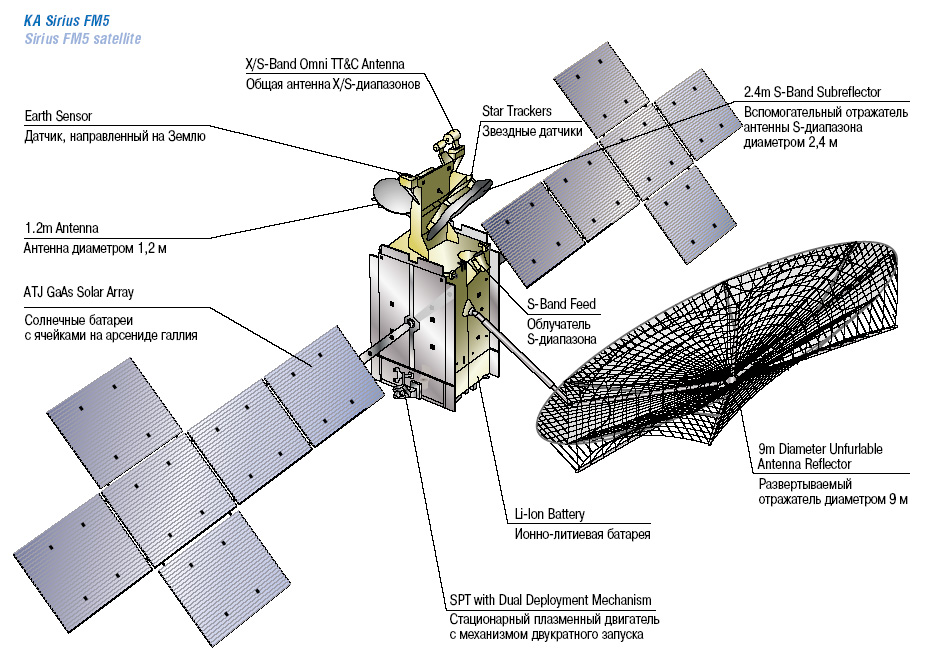
Manufacturer: Space Systems/Loral

Sirius FM5 is a new high-EIRP geostationary satellite to be launched for Sirius Satellite Radio Inc. It will join the company’s three satellites that broadcast 100% commercial-free music, plus sports, news, talk, entertainment, traffic, weather and data over the United States.
Sirius FM5 Specifications
Application|Broadcasting
Orbit|GEO-Sync
Orbit Position|96.0° W
Operator|Sirius Satellite Radio Inc.
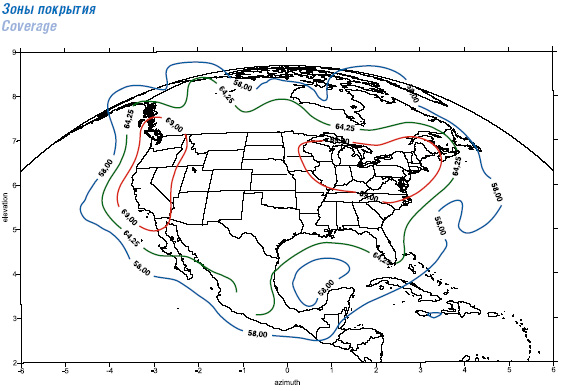
Coverage|CONUS, Canada, Mexico & Caribbean
Prime Contractor|Space Systems/Loral
Platform|1300 Spacecraft Bus
Propulsion|Dual Bi-Propellant (MMH/N2O4) and Stationary Plasma Thrusters (SPTs)
Design Lifetime|15 years
Launch Mass|Approximately 5,840 kg
Dry Mass|2,734 kg
Dimensions (stowed)|3.2m x 3.0m x 8.2m
Dimensions (in orbit)|32.4m x 17.4m x 8.2m
Similar to Sirius FM1/2/3, the satellite payload of Sirius FM5 consists of a single high-power “bent pipe” repeater. Dedicated antennas are used for the reception of the 7.1-GHz uplink and transmission of the 2.3-GHz downlink.
The satellite receiving antenna is a 1.2-m single-offset, prime-focus reflector antenna, which is deployed via dual-axis positioning mechanisms (DAMPs).
The satellite transmit antenna is a Gregorian configuration and consists of a 9-m-diameter, deployable, mesh parabolic reflector, a 2.4-m solid shaped reflector, and a feed assembly. The main reflector is stowed for launch on the east side of the spacecraft, while the subreflector is stowed for launch on the east side of the spacecraft tower and deployed via DAMPs.
The input section of the repeater provides low-noise signal reception and channel selectivity. Downconversion of the X-band uplink to the S-band downlink occurs in the receivers. Similar to the existing Sirius satellite constellation, three-forone redundant receivers are provided to ensure high reliability of the payload.
The rest of information about Sirius-FM5 payload and the new technology implemented you can find at http://coopi.khrunichev.ru/main.php?id=22
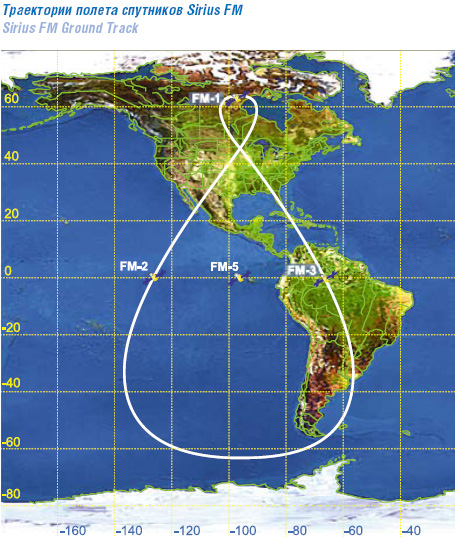
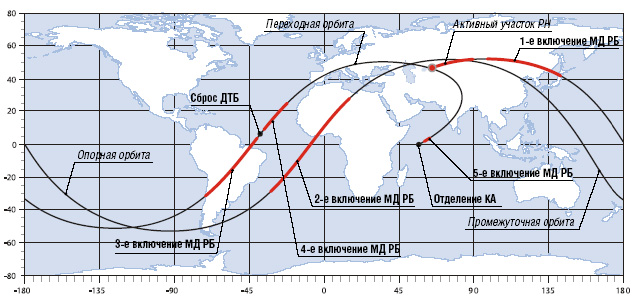
Ground Track and Coverage
The spacecraft is going to operate at so called Tundra Orbit, a variation of a Geo-Synchronous orbit:
Launcher: Proton-M with Briz-M upper stage

Rocket Family|Proton
Designation|8K82M
Class|Heavy
Type|Expendable
Designer|Salut Design Bureau
Manufacturer|Khrunichev State Research and Production Space Center
Stages|4
Height, mm|42340
Diameter, mm|7400
Launch Mass, kg|700000
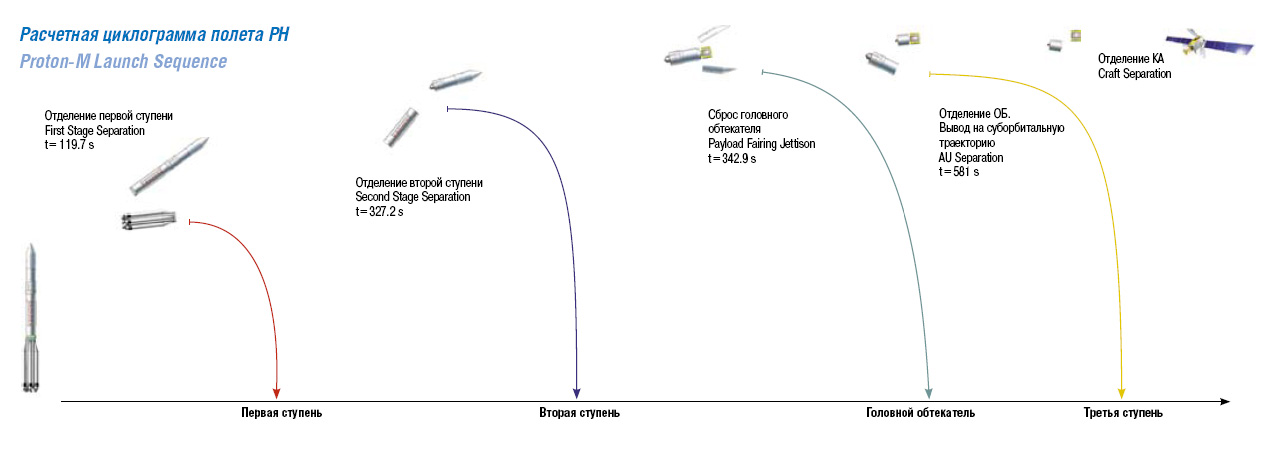
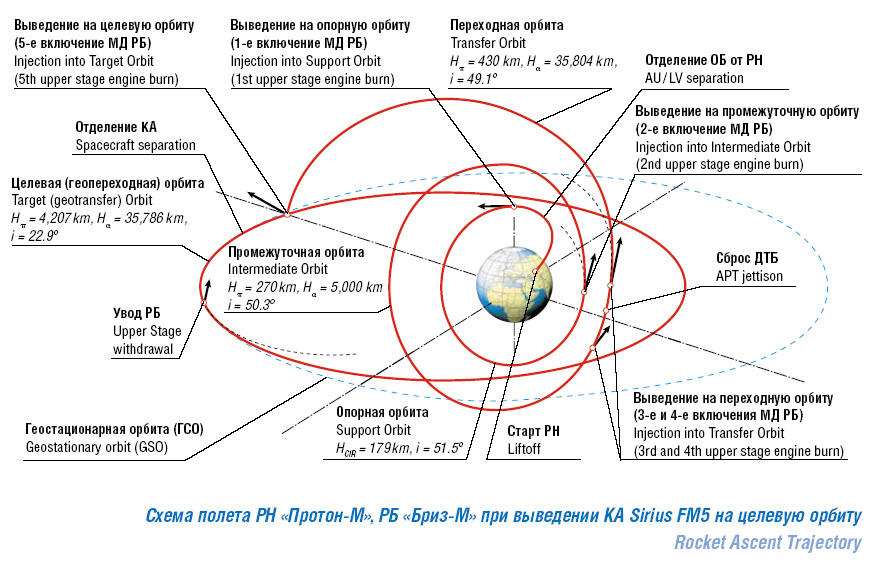
The Proton-M first three stages place the ascent unit (AU), which consists of a Breeze- M upper stage, adapter system and Sirius FM5, into 51.5° inclination suborbital trajectory.
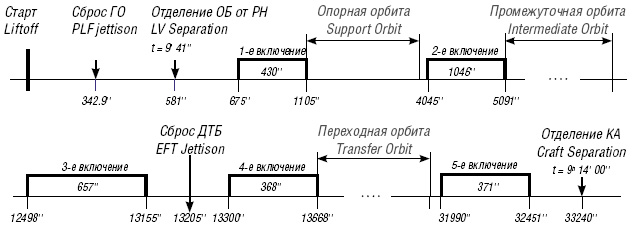
The first stage and the second stage separate 120 and 328 sec after liftoff, respectively.
Proton-M powered flight lasts 581 seconds. The AU powered flight begins at the moment of the third stage separation.
Proton-M Powered Flight Chart
Breeze-M Powered Flight
The upper stage follows a five-burn injection profile.
The first burn occurs 94 sec after the separation from the rocket, forming a support orbit.
The second burn transfers the ascent unit to an intermediate orbit. The third and fourth burns form a transfer orbit with an apogee close to that of the target orbit. The additional propellant unit is jettisoned during the gap between the third and the fourth burns. The target geotransfer orbit is formed by the fifth burn performed by in the transfer orbit apogee.
After the craft separation GTO parameters are measured, and the upper stage is withdrawn to drift in a safe mode (pressure in all the containers is dropped).
The Breeze-M powered flight lasts 33,240 seconds (9 hours 14 minutes).
Weather forecast for Baikonur, Kazakhstan on July 1, 2009

Hi: 31°
Lo: 19°
There is a 0% chance of precipitation. Partly cloudy. Warm. Temperature of 31°C. Winds NW 18km. Humidity will be 15% with a dewpoint of 1° and feels-like temperature of 29°C.
Watching the launch live
ILS broadcasts will begin approximately 20 minutes before liftoff
at 2:45 PM EDT June 30 / 6:45 PM GMT June 30
- ILS Launch Services, HQ: http://www.ccistream.com/ils063009/300kwm.html
- ILS Launch Services, HQ: http://www.ccistream.com/ils063009/56kwm.html
- Khrunichev COOPI (requires free of charge registration): http://coopi.khrunichev.ru/eng/real_pusk.htm
- Space Center Website Video: mms://www.space-center.ru/video


 There are some prospects that the Kazakhs will establish a real tourist business in Baikonur in about 3 years - so you may begin saving money for that.


 . According to legends Mercedes Benz did so with their Silberpfeile


