Space Shuttle Ultra 1.25 Revision B development

I just checked in project/solution files for Visual Studio 2010. AFAIK everyone else is using Visual Studio 2008, so I'll take care of keeping the VS2010 files updated.

---------- Post added at 11:43 PM ---------- Previous post was at 11:41 PM ----------

I was bored and started converting the flight checklist to html.

Here is the launch checklist for you to look at and comment on.

http://dl.dropbox.com/u/3550991/SSU Launch Checklist.html

Basic legend for Event Type:
S - Switch
O - Observation
SE - Scenario Enables
K - Key Pad
A - Autopilot
Looks pretty good to me. One thing you might want to do is make the values in the settings column a bit more explicit (i. e. for the +X translation, have 11 seconds instead of 0:11).
 
How much of the aerodynamics code remains to be implemented? I noticed that the elevon code has been checked in. Also had an idea of how we could simulate the entry plasma. We could use a zero-thrust thruster and get the particle stream that way as Orbiter isn't rendeing the plasma entry stream when it should. Also found a nice photo of the orbiter underbody during entry taken by the HyTherm aircraft which we could use.
 
Last edited:
How much of the aerodynamics code remains to be implemented? I noticed that the elevon code has been checked in. Also had an idea of how we could simulate the entry plasma. We could use a zero-thrust thruster and get the particle stream that way as Orbiter isn't rendeing the plasma entry stream when it should. Also found a nice photo of the orbiter underbody during entry taken by the HyTherm aircraft which we could use.

No thruster needed. Orbiter permits particle streams without a thruster connected to it. For example the vapor of the MLP is implemented as such, there are no thrusters on it AFAIR.
 
No thruster needed. Orbiter permits particle streams without a thruster connected to it. For example the vapor of the MLP is implemented as such, there are no thrusters on it AFAIR.
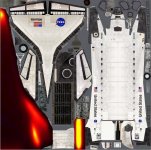
Even better then! So other than the thruster bit, is it a viable approach until the code in the core gets revised? Attached a screenshot of the entry texture.
 

Attachments

  • New_entry_texture.jpg
    New_entry_texture.jpg
    386 KB · Views: 498
Last edited:
How much of the aerodynamics code remains to be implemented? I noticed that the elevon code has been checked in.

I'm finishing basic pitch moment scale at the moment. So today I'll should attach completed SSU_Aero.
 
I'm finishing basic pitch moment scale at the moment. So today I'll should attach completed SSU_Aero.
Most excellent! Can't wait to try out an complete entry!
 
Would it be possible to simulate wing vortices?
 
How about if you were able to make the thruster emitting the particles to spin ?
 
How about if you were able to make the thruster emitting the particles to spin ?

That is why I mean - even if you spin it, the behavior of the particles would still be poor. also you can't really tell that the Vortices are spinning as observer, it would still be just a expanding plasma cloud there.
 
I'm having some problems with a STS-107 de-orbit burn scenario. The problem is that the orbiter hits EI 3 minutes and 16 seconds early. It's not just the time that's off but the EI position as well. I have used accurate orbital elements along with published de-orbit burn data.

What could be the reason for missing the historical EI point so badly?
 
What could be the reason for missing the historical EI point so badly?

well, one theory I could offer: orbiter uses a different exosphere state as it was in 2003. But since we hit EI early, and 2003 was close to solar maximum, we would have needed to be 3 minutes later now.

Next possibility could be the de-orbit burn was too strong compared to the original.
 
There seems to be a CTD upon jettison of the ET after launch. Both Poscik and I have experienced it so it seems to be real.
 
Checked in Poscik's aero file. I'll take a look at the CTD. Note that the Elevon aero file is missing some values (between Mach 4.0 and Mach 0.8), so you might have problems near the end of entry.

---------- Post added at 07:00 PM ---------- Previous post was at 06:45 PM ----------

I'm having some problems with a STS-107 de-orbit burn scenario. The problem is that the orbiter hits EI 3 minutes and 16 seconds early. It's not just the time that's off but the EI position as well. I have used accurate orbital elements along with published de-orbit burn data.

What could be the reason for missing the historical EI point so badly?
How accurate are the elements? I don't think non-spherical gravity effects are taken into account when elements are propagated to the current MJD, so this might cause an issue.

---------- Post added at 07:24 PM ---------- Previous post was at 07:00 PM ----------

There seems to be a CTD upon jettison of the ET after launch. Both Poscik and I have experienced it so it seems to be real.
I haven't been able to reproduce this. There were a few errors in the aero file (commas instead of periods), which might have caused problems trying to calculate aero data. I've checked in a corrected version; let me know if it still CTDs.
 
I haven't been able to reproduce this. There were a few errors in the aero file (commas instead of periods), which might have caused problems trying to calculate aero data. I've checked in a corrected version; let me know if it still CTDs.
Still CTDs.

---------- Post added at 01:54 PM ---------- Previous post was at 07:37 AM ----------

After doing a clean and rebuild of the Atlantis and ET projects, the CTD is now gone. I guess that some old stuff must have interfered and created the CTD. I guess the only thing left for the aerodynamics implementation is the final values for the elevons and making the AoA AP being able to hold the AoA using the RCS as well as the aerosurfaces.
 
Last edited:
Rebuild fixed CTD. Sorry for mistakes in SSU_Aero file. I also can say, that backflip after ET separation disappeared. Now everything works excellent.
 
Still having problems with the AOA AP. It just can't maintain the AOA. Have to use GlideslopeMFD for that. As soon as GlideslopeMFD is deactivated, the AOA slips quickly and the vehicle is lost.
 
The AOA AP should work now (it does on my computer). The earlier version was using the old Orbiter aerosurface definitions instead of the new code.
 
Back
Top