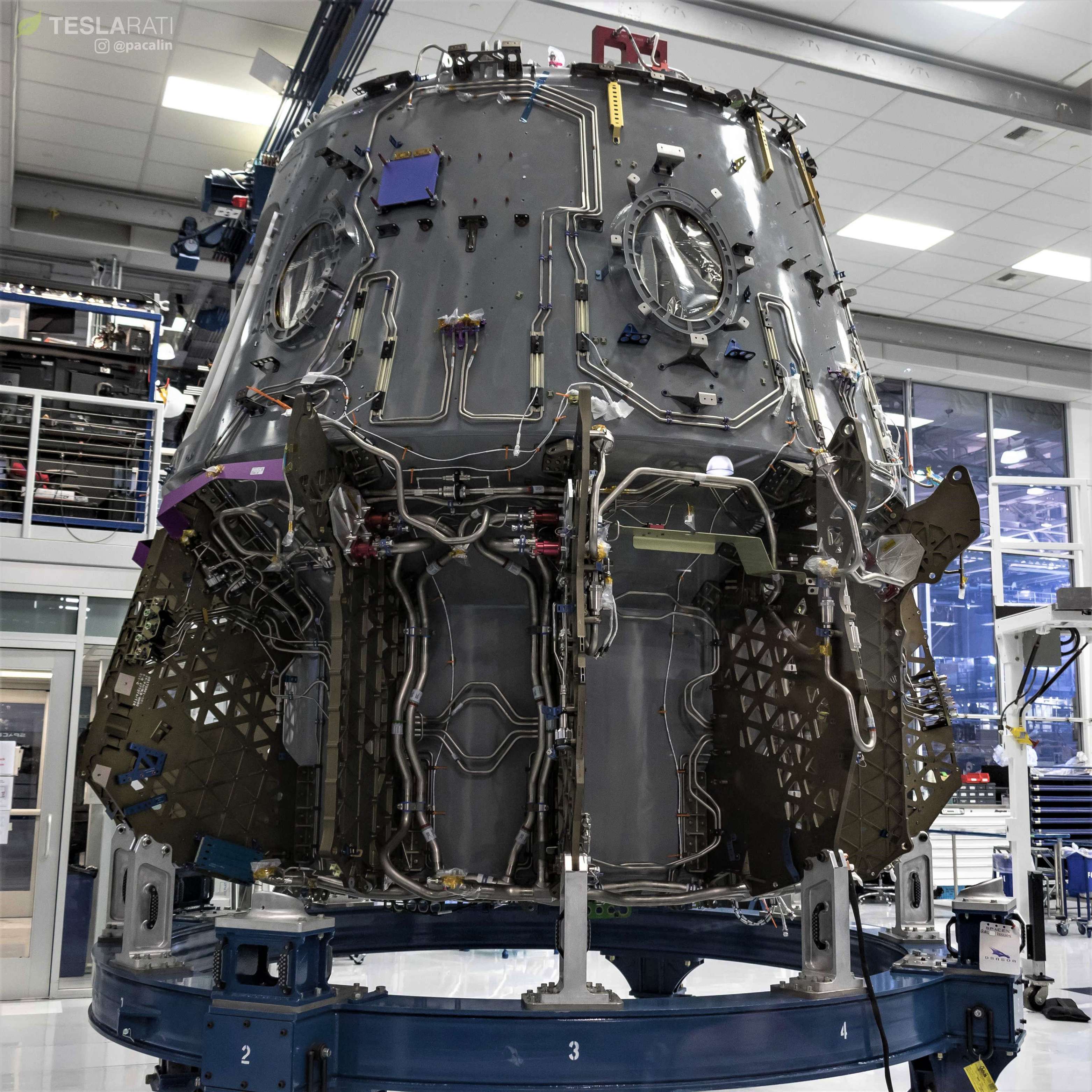
Updates SpaceX DM-1 capsule lost during static fire test

LES thrusters, really, probably shouldn't be very innovative. The rest of the spacecraft, sure, but for launch escape you want reliability and safety, not cutting edge. It's a seatbelt, not an engine, so to speak.

Of course, SpaceX was trying to do propulsive landing, but that had already been abandoned.

Hypergolic propellants are a bomb if the tanks are ever breached, whereas a solid propellant will have its maximum burn rate in an intact chamber and will sputter out if the chamber develops spontaneous unplanned nozzles of significant size.

Hypergols are fine on lower stages, unmanned spacecraft, or in applications like RCS thrusters where the required quantities are small and less damaging if they do cook off, but I guarantee you that after this, no space agency will accept liquid fuel, integrated LES motors on a manned spacecraft.

They're not a bomb. Fire hazard? Yes. Explosion hazard? No. It's only an explosion hazard when in gaseous form in a confined space, such as a Titan II silo... :shifty:

Tbh, looks to me like the valve/regulator that controls propellant tank pressure failed to the full-open position and blew the tanks apart during the pressurization sequence. Could be completely unrelated to the prior flight.
 
"After the failure of Apollo 1, I can guarantee you that no country will fly to the Moon!"

But then technical changes were made...

I am stating the nature of technical changes that will almost certainly be made. The US will almost certainly have a man-rated capsule flying within the next few years, but now any capsule that NASA actually accepts for manned flight will almost certainly have a more conservative LES. There is now a significant possibility that Dragon will not be that capsule, if SpaceX can't adapt their design ahead of the competing options. It's not necessarily the most likely possibility, but it's a significantly greater possibility than it was last week.

The Apollo-era corollary to the statements I made is not "After the failure of Apollo 1, I can guarantee you that no country will fly to the Moon!", but rather, "After the failure of Apollo 1, no nation will ever again fly a capsule with a 16 PSI pure oxygen atmosphere", or "After the failure of Apollo 1, the US may not reach the moon by the end of the decade, or at all, and there's a possibility that the Russians will get there first."

The first of those statements proved true, has remained true to this day, and will almost certainly remain true in the future. The second proved false, but was a very real possibility at the time, even if not the most likely one, and was significantly more likely the day after the fire than the day before.
 
This might actually be good for SpaceX in the long run. Imagine if this happened with a crew on board. I do think Elon is pushing too hard to get the crew dragon flying.

I've heard that the Apollo-1 fire most likely saved the whole Moon landing project. If they didn't re-design the capsule, NASA would probably have lost at least one crew during a mission.

An unmanned RUD is probably the best way to make SpaceX take a step back and "check the math" one more time.
 
They're not a bomb. Fire hazard? Yes. Explosion hazard? No. It's only an explosion hazard when in gaseous form in a confined space


Like in the pressure chamber of the thruster? It hasn't been ruled out that didn't fail during firing.

---------- Post added at 06:09 PM ---------- Previous post was at 05:47 PM ----------

I see nothing regarding the capsule having been destroyed, merely that there was an anomaly. Care to provide proof to back up the claim?


[ame="https://www.youtube.com/watch?v=h3Xs_6-MbwE"]SpaceX Crew Dragon C201 static fire explosion (anomaly) prior to in-flight abort test - YouTube[/ame]
 
No, count was at, what, T-8 when the RUD happened? They hadn't fired the engines yet.
I am highly suspicious that it's pressurization of the propellant tanks gone wrong.
 
No, count was at, what, T-8 when the RUD happened? They hadn't fired the engines yet.
I am highly suspicious that it's pressurization of the propellant tanks gone wrong.


Agreed. My first post was before seeing the video. The thrusters weren't firing and not much else could cause it to go kablooey like that.
 
Just got to work from the big Easter party at the ranch and heard about the mishap.
Dr Von Braun said that he looked at things like this as successes during the Apollo program and said " We had over 2700 successes before Apollo 4 flew because we learned what not to do."
The Draco guys are locked away down the hall trying to figure out what went wrong and the Dragon 2 managers are looking at options for the inflight abort test.
I know we were all excited about the July flight and that won't happen but the Dragon will fly again and when it does it will be a safer vehicle as was Apollo
 
Yes, the best solution is to test again!

I don't think anyone did testing on a flown capsule with propulsion systems before (perhaps Gemini B).
Reusability is important, but if that was the problem (reentry stresses, sea water, ...), perhaps tests can resume with a fresh capsule ?
 
Even a "soft" water landing has an astounding amount of stress. The pressure vessel should be able to take quite a beating, but valves, switches, and plumbing is a different matter entirely.
 
Last edited:
But still - if you remember how "slow" this fuel combination burns, just a leak at a line or valve would cause a major fire, but no such sudden surprising explosion.

That looks more like a single COPV failed catastrophically.
 
I dunno. Given the apparent timeframe for the failure of T-8 seconds, I'm fairly convinced that it was when they pressurized the propellant tanks that the failure occurred.
 
That looks more like a single COPV failed catastrophically.


If one fails, the rest likely follow in rapid succession. Their are 4 pairs of COPV tanks around the base of the capsule separated by structural framework, but the tanks are not physically isolated:


Crew-Dragon-DM-2-capsule-081318-Pauline-Acalin-1c.jpg
 
If one fails, the rest likely follow in rapid succession. Their are 4 pairs of COPV tanks around the base of the capsule separated by structural framework, but the tanks are not physically isolated:


Must not be the case, if the structural framework is covered with ballistic textile at least. The tanks are pressurized, so a overpressure event from outside would not be dramatic. Any shrapnel coming through would be terrible though.


Thats actually one important safety criteria, to make sure that both propulsion systems are not automatically destroyed by a tank failure.
 
I'm purely speculating here, and I might not have any idea what I'm talking about , but...is there any possibility that leaks might have caused an explosive mix to accumulate inside the capsule? as in, in the habitat itself?
 
I'm purely speculating here, and I might not have any idea what I'm talking about , but...is there any possibility that leaks might have caused an explosive mix to accumulate inside the capsule? as in, in the habitat itself?


Both propellants ignite on contact. On early soyuz spacecraft, some small leakage through pressurization check valves between the KTDU-35 propellant tanks was common and resulted in minor overheating and loss of usable propellant, AFAIR. They finally fixed it with the T version and the KTDU-80.

(A similar failure mode also existed on the Space Shuttle, if you did nearly everything wrong you can to force the N2O4 into the MMH tank of the aft pod OMS.)
 
Last edited:
Must not be the case, if the structural framework is covered with ballistic textile at least. The tanks are pressurized, so a overpressure event from outside would not be dramatic. Any shrapnel coming through would be terrible though.


If one tank is enough to cause LOV, I'm pretty sure isolating the tank from the other tanks really is not helpful.


Urwumpe said:
(A similar failure mode also existed on the Space Shuttle, if you did nearly everything wrong you can to force the N2O4 into the MMH tank of the aft pod OMS.)


I wonder if this is a possibility. If either the N2O4 or MMH system pressurized before the other and a check valve failed, that would be bad.
 
Last edited:
I wonder if this is a possibility. If either the N2O4 or MMH system pressurized before the other and a check valve failed, that would be bad.


Well, if I remember correctly, the problem required some careful preparation to work - you needed to heat the N2O4 past the boiling point (21.1°C at sea level pressure, slightly higher if pressurized) for example, so you had gaseous N2O4 in the ullage volume mixed with Helium. And then it required some mishandling of the RCS valves, but I can't look into the documents on my external HDD right now (I am in Hamburg right now, working at the customers site)
 
Last edited:
Not sure how thoroughly they checked the capsule. This being pretty much a first for the Dragon capsule, at least a partial disassembly would have been required (of the non-explodey type :p ). Not trying to compare with the old days of the Shuttle, but there's thermal and mechanical stress, not to mention seawater. A lot of stuff could get damaged.

Edit: would a pressurization test using an inert gas be possible using the current capsule design?
 
Edit: would a pressurization test using an inert gas be possible using the current capsule design?


Sure, but that would only catch flaws due to overpressurization. If there was something to do with an inadvertant fuel/oxidizer reaction, this would miss that scenario.


Test what you fly; fly what you test. Accept no substitutes.
 
Back
Top