Updates SpaceX Falcon 9 F5 CRS SpX-2 through CRS SpX-12 Updates

On the transferral of the external payloads brought along by the Dragon to the external platforms on the ISS:

 
If you want a looonngggg background movie playing in the background that would not interfere with your studying/work, try this: :hmm:


Dragon unberthing and landing in 5 days time (after another spacecraft leaves the ISS and lands - report coming soon :cool:)...
 
Today Dragon is heading for home! Unberthing of the Dragon from Node 2 is coming up shortly, and releasing of the Dragon from the SSRMS is planned at 13:26 UTC (will be on NASA TV). Afterwards the spacecraft will make its de-orbit burn at 18:09 UTC for a planned splash-down time of 19:02 UTC off the Californian coast. :tiphat:
 
Dragon is at release point.
index.php
 
SpaceX ‏@SpaceX 17s
Dragon's drogue parachutes have deployed.

---------- Post added at 07:03 PM ---------- Previous post was at 06:59 PM ----------

SpaceX @SpaceX · 26s
Recovery boats report three main parachutes have deployed!

---------- Post added at 07:07 PM ---------- Previous post was at 07:03 PM ----------

SpaceX @SpaceX · 34s
Splashdown is confirmed!! Welcome home, Dragon!
 
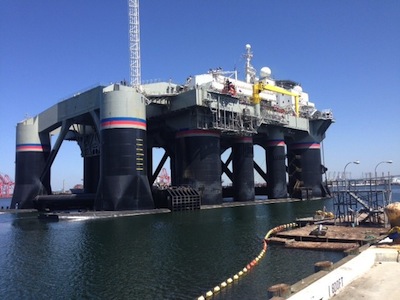
For stable landing platform for ocean landings perhaps SpaceX could rent Sea Launch's Odyssey platform:

Rocket-carrying Odyssey platform sailing to launch site
BY STEPHEN CLARK
SPACEFLIGHT NOW
Posted: May 12, 2014
depart_400300.jpg

http://spaceflightnow.com/sealaunch/eutelsat3b/140512departure/#.U3n-l_ldXbg

It is based in California for sea launch from the Pacific so it would be quite a steam to bring it to Florida. Still, considering Sea Launch's current shaky financial status they would welcome some more cash from the rental.

Another possibility would be to rent one of the huge container ships for the purpose. These are typically over 100 feet wide and 1,000 feet long.

container-ship-1-courtesy-of-shipsofthemersey-me-uk.jpg


A question is how accurate are the landing zones for the F9 first stage.


Bob Clark
 
A question is how accurate are the landing zones for the F9 first stage.

That's less a problem than the fact, that such landing pads will move in the wave and will thus also list and tilt. Its even more difficult landing on a large ship (with only small slow motion by waves), than on a tiny slope on land. A mountain runway, with serious slope, is still easier to land on with an aircraft, than on an aircraft carrier, that tilts only half the angle slowly.

The landing accuracy of a powered landing should be around 50 meters, if you use only GPS, 10 meters with WAAS. If you also have a local microwave landing aid or a working LAAS system, you could get this down to about 2.5 to 5 meters with a suitable guidance system.

Much harder is telling how much accuracy you can really afford. If you want to land on a ship, it makes no sense to put the ship into the centre of the landing ellipse. Should the re-ignition of the engines fail or the guidance go wrong, there is a high chance that the rocket would crash into the ship and a few tons of metal at 600 km/h can easily sink even an armoured ship. It makes more sense to aim the re-entry to a place next to the ship and have the ship at the edge of the landing ellipse, so that it can only land on the ship, when all guidance systems work properly - and the rocket crashes into the ocean, should it fail.

The further the ship is away, the more fuel you need to invest for flying to it during powered flight.

(And like the blast shields for aircraft carriers, used for deflecting the exhaust of the afterburner during catapult start, the landing pad of the ship would need to be water-cooled)
 
Last edited:
Should the re-ignition of the engines fail or the guidance go wrong, there is a high chance that the rocket would crash into the ship and a few tons of metal at 600 km/h can easily sink even an armoured ship.

Or in other words...
Z78.jpg

(though it didn't sink)
 
The shipping companies make a lot of money moving containers, probably wouldn't be interested.

A company looking to dispose of an old bulk freighter might be happy to take a few million USD to watch a rocket stage come crash into their artificial reef, erm I mean ship.

As Urwumpe said, landing on a pitching and rolling ship would not likely be successful. Not much point. Even if a stage can soft land in shallow water near shore, that would be an incremental success.
 
As Urwumpe said, landing on a pitching and rolling ship would not likely be successful. Not much point. Even if a stage can soft land in shallow water near shore, that would be an incremental success.

Not for reuse - saltwater is highly corrosive, it makes reusing the stage much harder and means that more parts have to be replaced. Especially the expensive engines, which will age much faster if you put hot engines into saltwater.

It was no big deal for the Shuttle SRBs, because they are just big stainless steel tubes, and the little bit of corrosion that you can't avoid was still easily fixed. Much worse had been the damages because of the water impact, which limited their reuse.
 
Reasons why we don't send people to the ISS with a Dragon, even if we don't like the Russians, volume 7.
 
They'll fix it. At least it wasn't a Liberty Bell 7.

Yes. And one day it will be ready for it. But not anytime soon. And sure not without SpaceX paying some big R&D bills until that moment.

But such problems show what forces have shaped NASA into its current form. Not alone politics, but also experience.

One day, SpaceX will also lose a crew - regardless how perfect SpaceX might become until that day. What follows then will show the true character.
 
Of course. Riding a barely controlled bomb and subsequently slamming into the atmosphere at 8 Km s^-1 is never going to be an entirely risk-free proposition.

Or in relation: Travelling by aircraft is the most secure way to travel in all statistics. Still you can die. Just like you can also die in your own bed. :lol:

Its just a matter of the handling of the situation.
 
For stable landing platform for ocean landings perhaps SpaceX could rent Sea Launch's Odyssey platform:

Rocket-carrying Odyssey platform sailing to launch site
BY STEPHEN CLARK
SPACEFLIGHT NOW
Posted: May 12, 2014
depart_400300.jpg

http://spaceflightnow.com/sealaunch/eutelsat3b/140512departure/#.U3n-l_ldXbg

It is based in California for sea launch from the Pacific so it would be quite a steam to bring it to Florida. Still, considering Sea Launch's current shaky financial status they would welcome some more cash from the rental...
The problem of crash landing would be a serious one when returning to the actual launch pad obviously. It would be better to test several times at a sea based platform before testing at the launch pad.

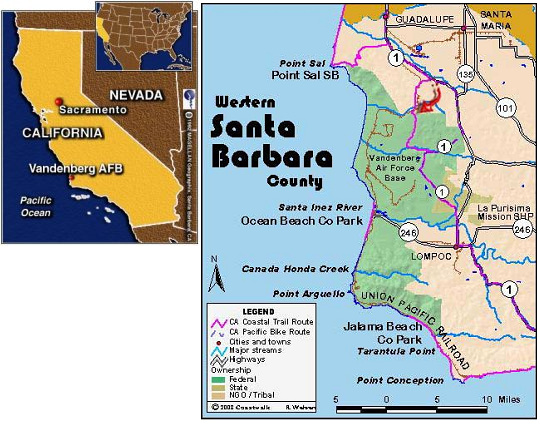
The previous landing test to this one took place in the Pacific since it launched from Vandenberg. Then you could leave the Odyssey platform off the coast of California.

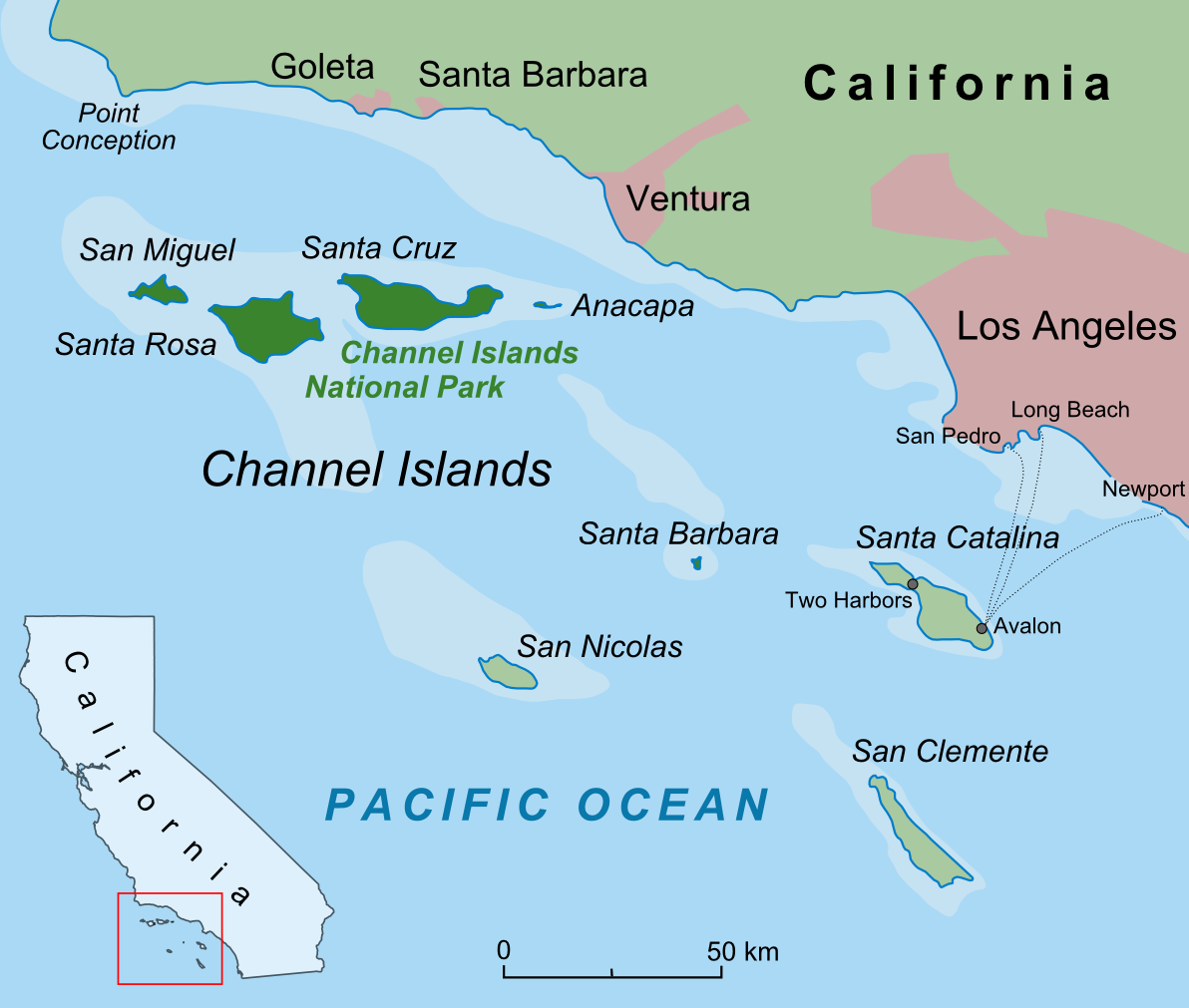
For launching from Vanderberg, another option might be landing at one of the numerous [ame="http://en.wikipedia.org/wiki/Channel_Islands_of_California"]small islands off the coast of southern CA[/ame]. Compare this image of Vandenberg:

01-karte-Vandenberg-air-force-base.jpg


with this image of small islands off the southern CA coast:

Californian_Channel_Islands_map_en.png


Some are sparsely populated. At least one is owned by the U.S. military.

The location of Point Conception in both images allows you to estimate the path the F9 first stage would have to take to reach one of these islands. From Vandenberg AFB though it would have to fly partially over populated civilian areas which could be a problem.

Bob Clark
 
Last edited:
Crash landing is not a huge concern; the booster will be almost out of fuel and heading for a large, treeless, unoccupied sandbar on a coastal flat. And they can always blow it up over water if it starts to stray from the desired flight path. Using a floating platform is taking a hard problem and making it a lot harder, and a lot more expensive, for no good reason.
 
Back
Top