News Speed of light broken?

They are speaking of this on the news, insisting on the fact measurements have been checked and rechecked. They also say that the reaction of the scientific community is to ask to re-make the experience, on a different place, with a different team. Seems right to me.

Anyway, scientific theories are made to be proven incomplete. It's how research goes on.
 
What about Tachyons? Eisteins theory never rulled out particles traveling faster than the speed of light, just anthing subluminal can't travel faster and anything superluminal can't travel slower, so the speed of light was more like a barrier than an upper limit.

The Neutrinos could have been traveling faster than light
 
That the measurements do show a slightly higher speed does not mean that the neutrinos were in fact traveling at a slightly higher speed. The measurements have to be confirmed by independent teams. For now it is just another report of allegedly breaking the speed of light.
 
What about Tachyons? Eisteins theory never rulled out particles traveling faster than the speed of light, just anthing subluminal can't travel faster and anything superluminal can't travel slower, so the speed of light was more like a barrier than an upper limit.

The Neutrinos could have been traveling faster than light

Indeed, Einstein theory is safe as long as we don't have proof that those neutrinos were accelerated to bigger then light speeds. Superluminical particles, while they are extremely interesting, don't contradict relativity theory. Acceleration to c and beyond will break the theory, but we are nto there. Yet.
 
Just heard this on the news. Einstein must be turning in his grave hearing this.

He was cremated. And now, to get something bigger than a particle doing it....... (Guys, its a joke, ok? :lol:)
 
Last edited:
Tachyons have negative mass, and do not fit at all in modern theroies of quantum gravity.

As far as information goes, I do not believe a partical can move and not convay information. Information itself must be conserved and a partical moving and not have that information is sort of the same issue that concerns black holes. The classical sense being matter falling into it and not being able to be reitrieved and thus lossed information. That in itself violates the laws of physics. The idea of Hawking radiation and the evaporation of blackholes and the idea that as the event horizon recedes it will expose the once thought to be lost matter to the universe once again shows that information is never truly lost, even in the most extreme cases.

The idea of speed of light being inviolate is that in reality, all matter runs at the speed of light when the objects velocities is observed on all dimensions, including time. If something is moving at C in the spacial dimensions, then there is no movement in time. If there is no movement in space, then there is velocity at C in time.

So to say something can travel through spacetime faster than C pretty much throws Relativity, and actually throws Quantum Mechanics as well, out the window. It will also throw a wrench into the theories of quantum gravity as well as they just show a universe that still plays by the same rules as Relativity.

So if this turns out to be true, then physicists have some serious work to do.

I myself often roll my eyes whenever I see a report of someone claiming to break C or discover time travel, or have violated the Uncertainty Principle. When it comes to the Uncertainty Principle it is often because it seems the team claiming the feat has no clue what the principle is even about and are claiming a victory that is clearly in bounds and allowed under our understanding of it. But this case seems different. My initial reaction is that this is clearly an error, since having C as a set speed limit makes to much sense in our understanding of the universe, but if it is not, and C can indeed be broken, interesting times indeed await us.
 
Last edited:
Tachyons have negative mass, and do not fit at all in modern theroies of quantum gravity.

Wrong. Tachyons are supposed to have an imaginary mass.

[ame="http://en.wikipedia.org/wiki/Negative_mass"]Negative mass[/ame] is something else (albeit the pixiedust required to create traversable wormholes, which fit into the "FTL zoo" elsewhere).
 
I wonder if we would be able to notice if the speed of light would change?
Many things are bound into it, so it's likely that all the process would alter respectively.
Is it an independent constant or a complex relation in the structure of underlying laws?
Can physical constants actually be tweaked, like the proponents of the a-little-off-and-we-would-not-be-there arguments like so much?

We look at this new experiment through prior knowledge and fiction, what if it's something else entirely, besides an error?
 
if they measured the distance correctly, there wont be any error. in "the trade" (construction) we use instruments that are accurate to 1mm over a kilometre. im sure atomic scientists will be able to measure the distance accurately enough
 
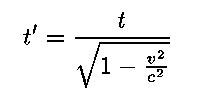
Hey, but to get speed of light we need infinite energy:blink: I'm suspicious how does they get it. So, breaking sol(speed of light) must affect time dilation:
050318mathew_time_dilation.gif
.
So, it means those neutrins finish they way before they start :hmm: Because we can't reverse the time(yet).

I think it would really help in space travel, because it will be faster than blink of an eye.:lol:

:hailprobe:
 
Wrong. Tachyons are supposed to have an imaginary mass


Well, it is imaginary because of the negative square root that occurs when velocity exceeds the speed of light, but in a practical construct when Energy must be a real number, like when it appeared in Bosonic String, the mass is negative, and made the whole system unstable and unreliable.

Essentially the rule is, and especially so in QM, if a tachyon shows up, you are doing it wrong.
 
Discovery News: Naughty 'Faster Than Light' Neutrinos a Reality?:
{...}

So why aren't they enthusiastically claiming discovery from the highest mountaintop? They recognize that, as the saying goes, extraordinary results demand extraordinary evidence. "Whenever you touch something so fundamental, you have to be much more prudent," Ereditato told The Guardian. "A result is never a discovery until other people confirm it." That's why the team spent six months double, triple, and quadruple checking their analysis. "If there is a problem, it must be a tough, nasty effect, because trivial things we are clever enough to rule out."

Don't Believe the Hype (Yet)

I'm sorry to report that, for all the hoopla, the general consensus that has emerged over the last couple of days is that (a) it's a really interesting, potentially exciting result, but (b) it probably won't hold up over time. Even the OPERA team isn't entirely convinced they're right; they're putting their work out there and basically asking their colleagues to poke holes in it and find anything they've missed. These are world-class physicists, mind you, but nobody is perfect, particularly when it comes to such tricky measurements.

{...}


Discover Magazine: Faster-Than-Light Neutrinos?:
{...}

The things you need to know about this result are:
  • It’s enormously interesting if it’s right.
  • It’s probably not right.
By the latter point I don’t mean to impugn the abilities or honesty of the experimenters, who are by all accounts top-notch people trying to do something very difficult. It’s just a very difficult experiment, and given that the result is so completely contrary to our expectations, it’s much easier at this point to believe there is a hidden glitch than to take it at face value. All that would instantly change, of course, if it were independently verified by another experiment; at that point the gleeful jumping up and down will justifiably commence.

This isn’t one of those annoying “three-sigma” results that sits at the tantalizing boundary of statistical significance. The OPERA folks are claiming a six-sigma deviation from the speed of light. But that doesn’t mean it’s overwhelmingly likely that the result is real; it just means it’s overwhelmingly unlikely that the result is simply a statistical fluctuation. There is another looming source of possible error: a “systematic effect,” i.e. some unknown miscalibration somewhere in the experiment or analysis pipeline. (If you are measuring something incorrectly, it doesn’t matter that you measure it very carefully.) In particular, the mismatch between the expected and observed timing amounts to tens of nanoseconds; but any individual “event” takes the form of a pulse that is spread out over thousands of nanoseconds. Extracting the signal is a matter of using statistics over many such events — a tricky business.

{...}
 
Hey, but to get speed of light we need infinite energy:blink: I'm suspicious how does they get it.

That's exactly the point. If those neutrinos indeed breached the speed of light, it means that the Lorentz equation isn't as universally aplicable as we thought it is.

As I see it, these guys handle the affair very much by the book: making a discovery, trying to rule out everything that might have gone wrong, and putting the thing out there for others to check and reproduce the experiment. I can't see much sensationalism involved on the side of the scientists. They're probably being torn apart between hoping to be proven wrong and go on with buisness as planed, and hoping to be proven right and win a nobel-price...

Currently, there's not much to speculate. These are some interesting results, based on solid work and experimentation, and I would expect it to take quite a while to do the neccessary work to either confirm or disprove it with further scrutiny and experimentation. Not much for us to do in the meantime other that to wait and drink tea.
 
A question: Is there anti-doping controls carried out on the course ?

:stirpot:
 
I wonder if we would be able to notice if the speed of light would change?
Many things are bound into it, so it's likely that all the process would alter respectively.
Is it an independent constant or a complex relation in the structure of underlying laws?
Can physical constants actually be tweaked, like the proponents of the a-little-off-and-we-would-not-be-there arguments like so much?

We look at this new experiment through prior knowledge and fiction, what if it's something else entirely, besides an error?

my gps woudn't work
 
alternatley, what if neutrinos are ghosts of particles from another dimension, one where the speed of light is either redundant or much higher? now all we need to do is work out how to get from our slow dimension to their fast one...

we can dream right? have a little faith!
 
Back
Top