
SRBs offset Center of Thrust from center of gravity?

BruceJohnJennerLawso

Dread Lord of the Idiots
Addon Developer
Joined
Apr 14, 2012
Messages
2,585
Reaction score
0
Points
36
Hello everyone,

Doing some thinking lately. I would like to try building a space-plane launch stack using only solid boosters. Naturally this would have to be somewhat asymmetrical, due to the demands of properly placing a spaceplanes CG onto the stack.

My original idea was somewhat like this:

munuy3y.jpg


But as you can see, the centers of thrust and mass are misaligned, perhaps heavily.

So the obvious solution is...

th2eRG3.jpg


But does that really work? Offset propellant tanks & engines are fairly trivial with liquid fuels, since all you really need is some pipes. With an SRB though, would it be possible to constrain the exhaust exit from the larger diameter of the propellant casing, or would this shape be prone to rupturing on the side opposite the exhaust exit?
 
But does that really work?

Not like the way, that you describe it.


With an SRB though, would it be possible to constrain the exhaust exit from the larger diameter of the propellant casing, or would this shape be prone to rupturing on the side opposite the exhaust exit?

You always have a constriction in a rocket engine nozzle - the throat.

But why such a strange construction as you paint it?

All you need is to make the nozzle point in the desired direction. This can be achieved either by rotating the whole SRM or by simply rotating the nozzle part of the SRM.

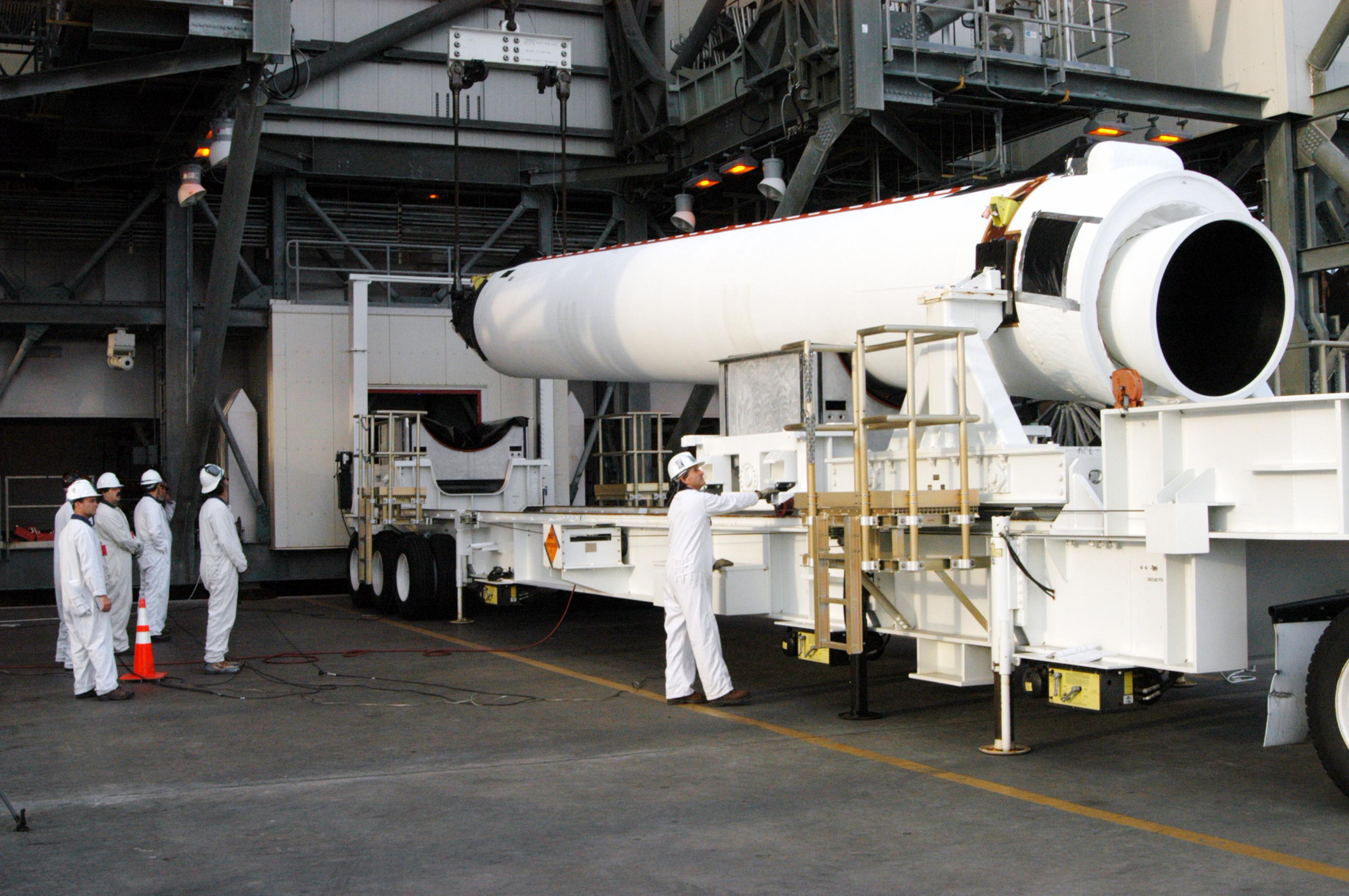
GEM-60_solid_booster_of_Delta_IV_rocket.jpg
 
Most existing SRB's have some form of trust vectoring, so it is feasible. But offsetting the exhaust with in an solid rocket is harder to do, and heavier than doing it with liquids. On a large scale at least.

With a Solid the combustion chamber is essentially the entire length of the propellant so to offset the exhaust (and trust) requires all the components to handle the chamber pressure and High temperatures of the exhaust gases and other bits (the shuttle SRB's spat out golf ball sized clumps of unburnt fuel). Which adds dry mass and complexity that is essentially not needed, and could probably be done overall cheaper with liquid engines.

:edit:
:ninja:
Urwumpe beat me to it and gave a better solution.
 
Last edited:
All you need is to make the nozzle point in the desired direction. This can be achieved either by rotating the whole SRM or by simply rotating the nozzle part of the SRM.

I considered rotating the booster, but that seems bad because it would angle the space-planes longitudinal (front-back) axis with relation to the direction of the thrust. That would mean presenting a larger frontal cross-section, not good for drag.

But, if exhaust nozzles can be vectored, does the same problem apply? The side of the nozzle "throat" opposite the direction it is pointing towards will have higher pressure than on the opposite side of the throat, no?
 
But, if exhaust nozzles can be vectored, does the same problem apply? The side of the nozzle "throat" opposite the direction it is pointing towards will have higher pressure than on the opposite side of the throat, no?

No, not that much. There is a small pressure difference in the aft end of the chamber, because the exhaust can flow better into the throat from somewhere approximately centerlined with it, but not at the throat. You thus need some space between the throat and the fuel, but that applies to all SRMs with thrust vectoring. The Shuttle SRBs also use thrust vectoring.

Another technology is injecting a liquid into the exhaust after the throat to create a pressure difference - this really creates a strong pressure difference in the nozzle. But nothing that can't be handled.
 
No, not that much. There is a small pressure difference in the aft end of the chamber, because the exhaust can flow better into the throat from somewhere approximately centerlined with it, but not at the throat. You thus need some space between the throat and the fuel, but that applies to all SRMs with thrust vectoring. The Shuttle SRBs also use thrust vectoring.

How far could I vector thrust from center in that case?

Another technology is injecting a liquid into the exhaust after the throat to create a pressure difference - this really creates a strong pressure difference in the nozzle. But nothing that can't be handled.

Interesting. What sort of liquid do they use, an alcohol for quick evaporation? What do they use the liquid method for, more vectoring capability?

Are there any good links on SRMs you could reccomend?
 
How far could I vector thrust from center in that case?

As far as you need... I know some SRMs that have 90° angled nozzles, the Russian launch abort system has even the nozzles on top of the SRM pointing downward and outward.

Interesting. What sort of liquid do they use, an alcohol for quick evaporation? What do they use the liquid method for, more vectoring capability?

Nitrogentetroxide is pretty popular, since it combusts unburned solid fuel and produces more thrust.

Are there any good links on SRMs you could reccomend?

Theory:

http://www.braeunig.us/space/propuls.htm#solid

Actual SRMs:

http://www.atk.com/wp-content/uploads/2013/02/ATK-Motor-Catalog-2012.pdf
 
As far as you need... I know some SRMs that have 90° angled nozzles, the Russian launch abort system has even the nozzles on top of the SRM pointing downward and outward.
90 degree angled nozzles? what exactly is the point of that, doesn't it seem like overkill a bit?
 
347231main_jsc2009e119848_665.jpg


Orion's LAS is an example of grater deflection

as for the the other bit.

 
Back
Top