

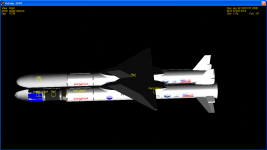
Welcome to the Deep Space Test Range. St. Kwan's Home for the Terminally ADD has established this site for the purpose of testing addons in their native environment. Real rocket companies have to build elaborate test stands and test ranges, and when they are done, they still don't know that their stage will work, since it was not tested in its native environment, either Space or the upper atmosphere.
The DSTR solves this problem for those of us building virtual rockets. Since we can create instances of our rockets anywhere, we can create them already in space, unlike our poor brethren who must build their rockets in factories.
The DSTR is not a facility as is commonly thought, as it doesn't have any hardware, station, or spacecraft associated with it, although I may build such someday. What it is, is an idea. Place your spacecraft at <1e12,0,0> relative to the Sun with the scenario editor or by editing a scenario file in your favorite text editor. Give it a speed of <0,0,100> and an orientation of <0,0,0>. Then any conventional spacecraft with its nose pointed at the Z-axis will be pointed downrange. We give it a nonzero initial speed so that prograde is well defined and so that the range instrumentation works properly
DSTR is a great place to test launch vehicles. You turn off all autopilots, which would be terribly confused by being in deep space, then just light the stages in turn in their normal sequence. No worries about crashing, as the range is about 5-10 AUs from the nearest solid object. The new Orbit HUD with its OS indicator makes a great addition to the test range. When a launch vehicle burns out, its current speed is shown in the HUD. It's initial speed is 100m/s, so its Delta-V is just the final speed minus 100m/s. The DSTR is far enough away from the Sun and any planets that gravity over the course of the few minutes it takes to test a vehicle is minimal.
I bring all this up because the above picture is from the DSTR. This time I wasn't testing the engines, but the staging system. We see here two identical Pegasus XL rockets. The top one is whole, while the bottom one has separated all its stages at zero velocity. You can see by the markers that all the stages are present and separate vehicles, and you can see by lining up with the top rocket that all the stages are in their correct position. I deleted the left fairing after it separated in order to reveal the third stage and payload inside.
This new feature of VesselMass is rather complicated, but all the complication is hidden. The interface is simple:
Code:
stage1->Detach("Stage1",_V(0,0,0),_V(0,0,0));The name is the suffix for giving an Orbiter name to the new vessel, the first vector is the relative velocity of the stage in the body frame, and the second vector is the relative angular velocity. So if you wanted to forcibly eject the first stage, and you got a small tip off velocity, you could say
Code:
stage1->Detach("Stage1",_V(0,0,-10),_V(0.1,0.1,0.1));which would eject the stage at 10m/s backwards and spin it by 0.1rad/s around each axis.


