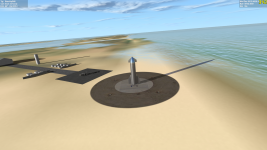
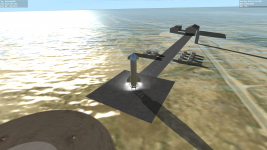
New Release Starship SN8

You could..
Also without EarthHi_10_07 installed, the problem persists. I've tried the LZ1 from the starship_sn8_201125 version, the one you posted above and I tried the scn editor to find a better spot myself, but the result is the same, it tips over.

This is a landing on a spot I tried with the scn editor. I think it should have worked:

POS -97.1507310 25.9932760
HEADING 178.84
ALT 0.416
AROT -115.948 1.975 -173.572
 
Last edited:
I just tried the latest version (201211) on a clean Orbiter2016 install (no hi-res tiles) and both "skydive" test scenarios work OK for me (with or without wind effect). Also tried after installing the hi-res tiles in EarthHi_10_07.zip, and also works OK. I don't know what else to try - sorry!
 
Flattening the area solves the problem for me, including visual glitches.

1607957310706.png

» Make sure you have the latest graphic client.
» If needed, create a folder named "flat" inside Textures\Earth .
» Inside \Textures\Earth\flat\ create a text file named spacex.flt
» spacex.flt contents
Code:
;;bocachica
Ellipse 7 -97.1512010 25.9944460 1000 1000 0 20

That's it, the area will be flat for about 1km around the pad (you can adjust the parameters for better realism)

:)
 
Flattening the area solves the problem for me, including visual glitches.

» Make sure you have the latest graphic client.
» If needed, create a folder named "flat" inside Textures\Earth .
» Inside \Textures\Earth\flat\ create a text file named spacex.flt
» spacex.flt contents
Code:
;;bocachica
Ellipse 7 -97.1512010 25.9944460 1000 1000 0 20

That's it, the area will be flat for about 1km around the pad (you can adjust the parameters for better realism)

:)
Ah! That's very cool :) Thanks. Would be even better if the default Orbiter2016 elevation was as easy to fix!
 
Well... all it takes is that small file with one line ;)
You can add as many flatten files as you like, so addon's won't collide with one another.
Give it a try and feel free to add it to the release...
 
Well... all it takes is that small file with one line ;)
Thanks for that.

But I am not seeing any differences (with the 411 client). It the filename 'spacex.flt' and the extention .txt or is the filename 'spacex' and the extention .flt? I tried both. And also naming the foldername 'flat' with and without a capital. But the sand is still there.

Do I need something else to make the flattening work?
 
Filename is "spacex.flt" (extension is .flt)

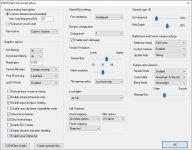
Have you enabled it on the client?
1607975098908.png

On Visual Effects I also have set "surface elevation: linear interpolation" since it gives more consistent results.
 
Also without EarthHi_10_07 installed, the problem persists. I've tried the LZ1 from the starship_sn8_201125 version, the one you posted above and I tried the scn editor to find a better spot myself, but the result is the same, it tips over.

This is a landing on a spot I tried with the scn editor. I think it should have worked:

POS -97.1507310 25.9932760
HEADING 178.84
ALT 0.416
AROT -115.948 1.975 -173.572
That will be SN9. It likes to lean.
 
That will be SN9. It likes to lean.
Wasn't it the bc_pad which did gave way?

Then it probably won't on the Moon :) :

I captured this video to ask about HoverMFD and whether it should work. I noticed the error did dissapear once TailSit mode is activated. But I wan't succesful at lifting off. The RCS control seems to work..
 
But I wan't succesful at lifting off.
Starship is attached to the launch pad until enough thrust is applied to lift off in Earth gravity.
HoverMFD might not be applying enough thrust in Moon gravity!
You may want to just forget about the BC-Pad for Moon launches ;-)
 
Any plans to update this with the masses outlined in the above video as well as the pre-planned engine shut downs during the ascent? You also might want to add the additional LOX vents from the actual Raptor engines.

 
This was my first reentry from LEO with the SN8 which didn't end in outright disaster. I find it exceptionally hard to fly home.

The hardest part is plunging out of the atmosphere at the right point. I can't find a good way yet to get close enough to the base. Overshooting is deadly as you have to turn the velocity vector around which is hardly possible. This time I undershot and close enough to the base so that with some extra unwanted burning, I was able to close in enough and let the autopilot take over. But is was a bit late and it didn't land on the pad.

Some questions:
Any idea what de-orbit parameters for Starship are going to be? I think I came in way too shallow and it has to be done much steeper, perhaps with a (2nd) retrograde reentry burn at 40km or so while already close to the base?
What attitude, speed, height, distance to base should I aim for so the autopilot has the easiest time to take over for a succesdful landing on the pad?
 
The hardest part is plunging out of the atmosphere at the right point. I can't find a good way yet to get close enough to the base. Overshooting is deadly as you have to turn the velocity vector around which is hardly possible.

This is pretty much experimental stuff in real life ; they are still far from a full flight with de-orbit and landing. It obviously requires extreme precision (not something that can be done by an human, only by a computer) ; and in Orbiter you don't have to worry too much about unpredictable stuff like wind.

So you need some kind of autopilot or MFD that computes the de-orbit burn to a precision of a fraction of a second, because in orbit each second you travel 7km+, and the landing pad you are targeting is only a dozen of meters large.

If you're not familiar with coding you could have a try at LUA scripting ; Orbiter supports that and you can write real autopilots with it. Even if you don't know the math you can experiment in a "trial and error" fashion, and record the results of your experiments.
 
I find it exceptionally hard to fly home.

Some questions:
Any idea what de-orbit parameters for Starship are going to be? I think I came in way too shallow and it has to be done much steeper, perhaps with a (2nd) retrograde reentry burn at 40km or so while already close to the base?
What attitude, speed, height, distance to base should I aim for so the autopilot has the easiest time to take over for a succesdful landing on the pad?
You are doing better than me! I think if you can be sub-sonic at 20km alt. within 8km range of base, the autopilot might be able to take over. But how to get to that condition.....I don't know yet. The only re-entry autopilot I ever made (for Cargo Dragon) uses some orbital mechanics math to make the retrograde burn to target the entry interface condition(alt/range to base/flight path angle), then it uses a look-up table of "total vessel energy at (x)range to base" that I recorded during a nominal reentry, and simple logic of "if vessel has too much energy, go lower to lose more energy" (or higher to lose less energy, etc.). Well, that is the general idea, anyway :) Maybe I can do something similar.

I have started an "orbital" version of Starship, but progress is very....very...slow.

@BrianJ have you considered sending your autopilot to Elon. I think he needs it, lol.
I think he would rather have 100% reliable engines ;-)

Cheers,
Brian
 
Is anyone getting the ocean texture on land with boca chica surface tiles? this has occurred with most if not all of the surface tiles I have put into orbiter.unknown.png
 
Back
Top