

Messierhunter
New member
- Joined
- Apr 30, 2008
- Messages
- 488
- Reaction score
- 2
- Points
- 0
This has to do with the 'gravity turn' portion of rocket launch. You're making a big assumption here that how an Orbiter add-on rocket behaves is close to how a real-world rocket behaves. Fred18 would be the best expert here IMHO and I recommend that you talk to him as well regarding your goals. (Perhaps BrianJ as well.) It would actually be cool to know how well the real-world 'gravity turn' compares to what is being done in the various Orbiter add-ons.
Edit: :ninja: by fred18. :lol:
Well, I should clarify that I'm not looking for absolute accuracy here; my program will still rely on video based guidance as the primary control input. The actual position and apparent motion of the rocket will dictate the tracking as it currently does in the program as long as the rocket is visible in the camera.
The orbiter-based prediction file will provide backup information in the event that the rocket passes through a cloud and tracking is temporarily lost. Exact accuracy will not be possible for most daylight launches anyway; the telescope will be only roughly aligned since a simple sync to Venus, the moon, or the sun will be the only alignment possible. The finder camera has a field of view of about 5 degrees so as long as the prediction gets the telescope within 2.5 degrees of the true location it will put it back in the finder camera. I may even be able to use the last-known vector to "nudge" the predicted track to fit that vector and improve accuracy. Once it re-appears in the finder camera I just need to click on it for it to resume video-based tracking.
---------- Post added at 02:07 PM ---------- Previous post was at 02:05 PM ----------
Please check the Ms2015 Camera module: it follows rockets during ascent pretty much as you are willing to do.
http://www.orbithangar.com/searchid.php?ID=7010
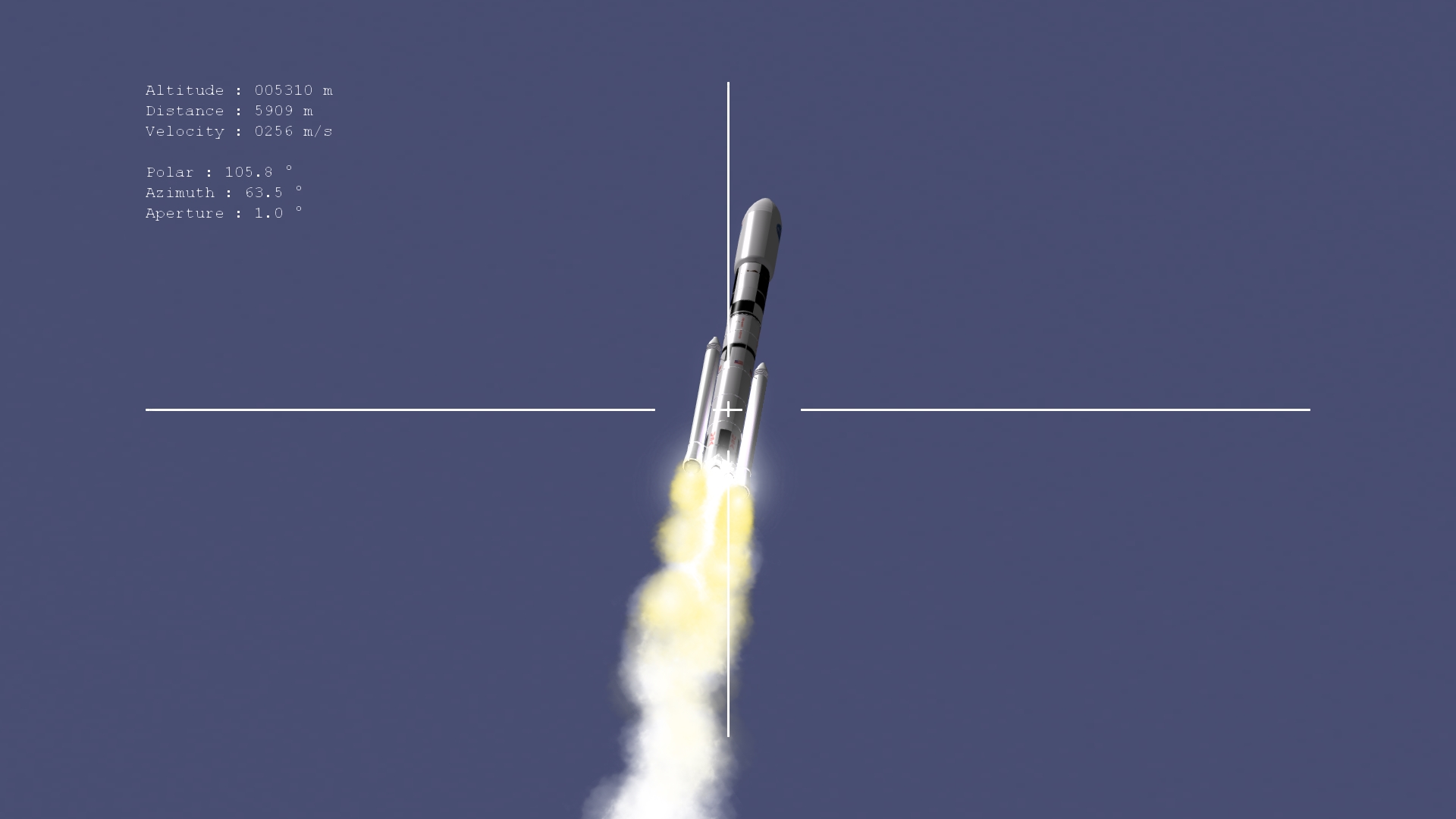
That looks excellent, thanks, I'll look into that.


