

- Joined
- Feb 13, 2008
- Messages
- 5,398
- Reaction score
- 8
- Points
- 0
- Location
- Khimki
- Website
- tigerofsiberia.livejournal.com


Launch site: Baikonur
Launch date: April 3, 2009
The launch time is:
22:24:00 Baikonur 03.04.2009
20:24:00 MDT 03.04.2009
16:24:00 UTC Apr 3, 2009
12:24:00 p.m. EDT Apr 3, 2009
Payload: W2A communication satellite.
Spacecraft: W2A
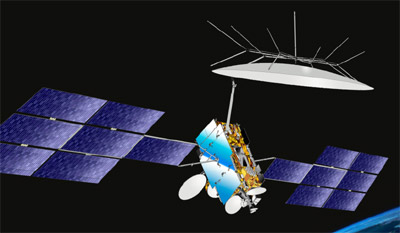
Manufacturer: Alcatel Alenia

Eutelsat’s new W2A satellite will be launched to 10 degrees East at the beginning of April 2009, where it will replace the W1 satellite. 10 degrees East is one of Eutelsat’s long-standing orbital locations and a key position for data and professional video networks. Services have been continuously provided at this location since 1987.
The W2A satellite, built by Thales Alenia Space, is a Spacebus 4000C4 model, similar to the Ciel II satellite just launched.
Designed with a lifetime of more than 15 years, W2A has a maximum launch mass of 5.9 tons and will deliver 11 kW of payload power.
The launch of W2A will more than double the amount of Ku-band capacity available at 10 degrees East, while also boosting C-band capacity available through Eutelsat’s fleet for services across Africa.
The W2A satellite will also feature a major innovation by carrying an S-band payload enabling delivery, for the first time, of mobile multimedia broadcast services directly onto user mobile terminals and vehicles in Europe. The S-band payload will be commercialized by Solaris Mobile, a venture jointly owned by Eutelsat and SES Astra.
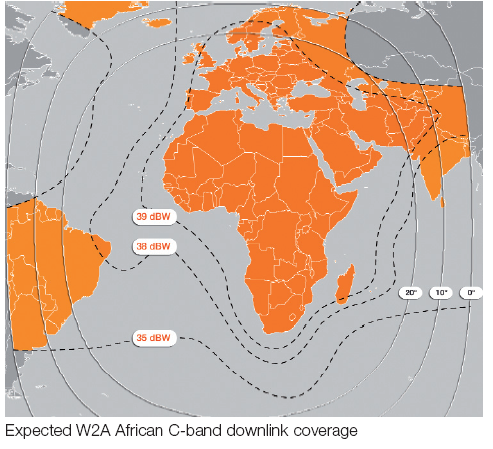
The Ku-band payload on W2A will provide up to 34 transponders connected to an enhanced Widebeam footprint serving Europe, North Africa and the Middle East. A second Ku-band beam will serve Southern Africa and Indian Ocean islands, and enable connectivity between Africa and Europe. The C-band payload of 10 transponders will provide pan-African coverage, extending to India and parts of Asia as well as Latin America, for broadband and telecommunications services.
The state-of-the-art S-band payload at 2.2 GHz will be targeted at European countries and will initiate the building of a hybrid infrastructure combining satellite and terrestrial networks. This infrastructure will provide both universal coverage and indoor penetration for mobile TV services. The S-band payload will also enable other communications applications such as security communications or crisis management.
W2A Major Characteristics
Code:
Application      Сommunications
Orbit            GEO
Orbit Position   10 deg. East
Operator         Eutelsat
Coverage         Europe, Middle East, Africa, Indian Ocean
Prime Contractor Thales Alenia Space
Platform         Spacebus 4000C4
Propulsion       S400, 4 SPT-100 plasma thrusters
Design Lifetime  15 years
Launch Mass      5,915 kg
Dry Mass         2,828 kg
W2A Payload Characteristics
Code:
Payload Power               11 kW
Bands                       Ku, C, S
Transponder Capacity        Ku-band    up to 46
                            C-band     10
                            S-band     ?
Transponder Bandwidth, MHz  Ku-band    72 and 36
                            C-band     72
                            S-band     5 per channel
Downlink Frequencies, GHz   Ku-band    10,70 -11,70; 12,50 -12,75
                            C-band     3,625 - 4,200
                            S-band     2,17 - 2,20
W2A footprints


Launcher: Proton-M with Briz-M upper stage

Code:
Rocket Family   Proton
Designation     8K82M
Class           Heavy
Type            Expendable
Designer        Salut Design Bureau
Manufacturer    Khrunichev State Research and Production Space Center
Stages          4
Height, mm      42340
Diameter, mm    7400
Launch Mass, kg 700000
W2A Ascent Profile
W2A will be delivered to orbit using the 48° support orbit injection profile. Two earlier commercial missions carrying heavy communications satellites – DirecTV 10 in July 2007 and Inmarsat-4 F3 in August 2008 – flew the same flight path.
Proton-M Powered Flight
The Proton-M first three stages place the ascent unit (AU), which consists of a Breeze- M upper stage, adapter system and W2A, into 48° inclination suborbital trajectory.
Six RD-276 engines ignite at approximately T–1.75 seconds and are commanded to 107 % of nominal thrust, which is increased to 112 % six seconds into flight. Liftoff confirmation is signaled at T + 0.5 sec. The staged ignition sequence verifies whether all engines are functioning nominally before being committed to launch.
The launch vehicle ascends vertically for about 10 sec. Pitch control, engine ignition and cut-off times, payload fairing jettison times and attitude control are calculated in such a way that Proton-M worked-out stages fall onto nominal drop zones.
The first stage and the second stage separate 120 and 326 sec after liftoff, respectively.
349 seconds after liftoff the payload fairing is dropped on to the second stage booster drop zone. During jettison longitudinal and cross joint clamps unlock, fairing halves are unfolded by means of pushers, following which the halves are broken off. Once in the nominal orbit, the launch vehicle control system shuts down the steering engines, breaks mechanical links between the third and upper stages and ignites solid retro motors in order to withdraw the third stage jettisonable booster.
Proton-M powered flight lasts 575 seconds. The AU powered flight begins at the moment of the third stage separation.

Breeze-M Powered Flight
Immediately after the separation of the third stage booster, the Breeze-M stability engines start, damping the angular velocities of the third stage separation and then providing ascent unit orientation and stability during coast flight along a suborbital trajectory to await the first burn.
The upper stage follows a five-burn injection profile.
The first burn occurs 124 sec after the separation from the rocket, forming a support orbit.
The second burn transfers the ascent unit to an intermediate orbit. The third and fourth burns form a transfer orbit with an apogee close to that of the target orbit. The additional propellant unit is jettisoned during the gap between the third and the fourth burns. The target geotransfer orbit is formed by the fifth burn performed by in the transfer orbit apogee.
Once in the target orbit, the ascent unit is stabilized for W2A separation, following which the satellite is released.
After the craft separation GTO parameters are measured, and the upper stage is withdrawn to drift in a safe mode (pressure in all the containers is dropped).
The Breeze-M powered flight lasts 33,000 seconds (9 hrs 10 min).


Weather forecast for Baikonur, Kazakhstan on Apr 4, 2009

There is a 0% chance of precipitation. Partly cloudy. Mild. Temperature of 16°C. Winds WSW 18km. Humidity will be 49% with a dewpoint of 5° and feels-like temperature of 16°C.
Watching the launch live
ILS broadcasts start at 12 p.m. EDT (4 p.m. GMT) April 3rd
- ILS Launch Services, HQ: http://www.ktprod.com/ils040309/300.asx
- ILS Launch Services, HQ: http://www.ktprod.com/ils040309/34.asx
- Khrunichev COOPI (requires free of charge registration): http://coopi.khrunichev.ru/eng/real_pusk.htm


